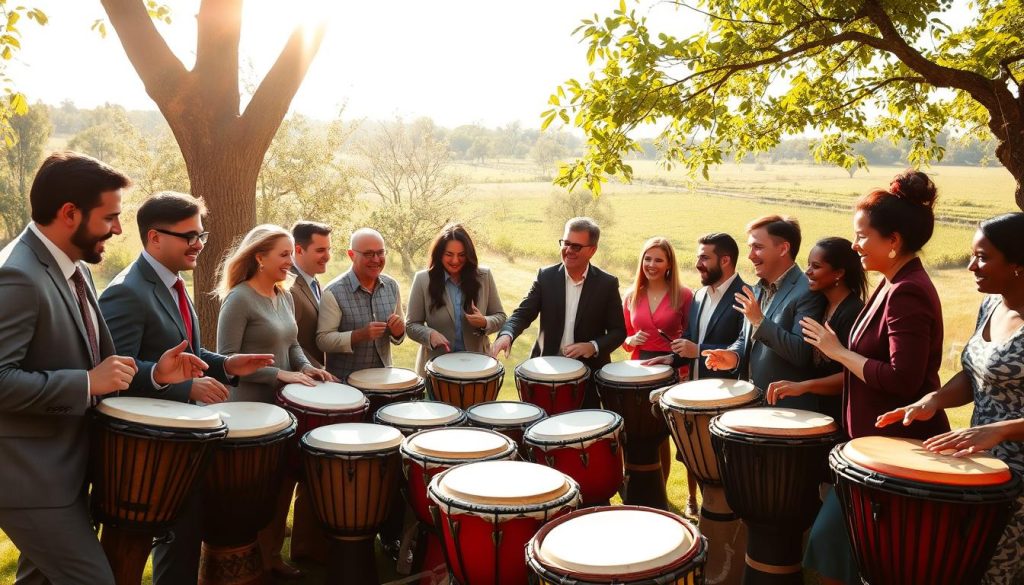
You are an HR manager, office manager, or team manager, and you are looking for a simple activity to set up for your internal events? This guide offers a clear path for organizing a percussion activity that is accessible to everyone.
The workshop generally lasts 30 to 90 minutes and can take place indoors or outdoors. The instruments are provided by the supplier; the company needs to provide chairs and a suitable venue.
The promise: quickly turn participants into a real orchestra through rhythm, listening, and progressive teaching. Musician coaches guide the group toward a unifying finale.
Concrete benefits: stronger cohesion, better communication, engagement, and a shared memory beyond a standard event.
For a quote or more information, discover our dedicated offer on the Djembe Orchestra module.
Why choose djembe team building to strengthen team cohesion
Rhythm acts as a shared language: it brings people together, creates order, and reveals listening within a group.
Create communication in unison through rhythm and active listening
The simple framework (tempo, signals, collective response) requires people to listen before acting. Nonverbal communication — eye contact, the coach’s gestures, starting cues — becomes a practical tool for improving clarity and timing at work.
Unite employees and develop a sense of belonging
Every person has a useful rhythmic role. The group only “sounds” right when everyone aligns, which strengthens the sense of belonging and team identity.
Motivation, letting go, and collective energy in service of performance
The rise in intensity and the unifying finale create a real boost of enthusiasm. This positive momentum carries over into motivation and collective performance.
Highlight leadership and synergy outside usual hierarchical structures
The workshop encourages initiative, orchestral direction, and informal recognition of the group’s driving forces. It is a playful and memorable way to break the ice during a seminar.
For a detailed proposal, discover our percussion workshop.
How to organize a corporate djembe team building event
Defining clear objectives makes preparation easier and guides the choice of format. Think cohesion, onboarding new employees, merging teams, or encouraging cross-functional work.
Choosing the format: choose unison djembe if you want a simple, immediate activity. Choose an orchestra format for guided builds and breaks. A polyrhythmic format divides percussion by sections to work on listening between teams.
Then frame the expected experience: cultural introduction, musical challenge, or creation of a unifying finale. This framing will determine the energy level and the degree of challenge.
Recommended duration: 30–45 minutes for an icebreaker, 60–90 minutes for a complete experience, half a day for an in-depth musical challenge.
Anticipate the venue, noise, setup time, and the real window between two key moments in the event.
- Check that the supplier provides musician coaches, an instrument stock, and options (balafon, dum-dum).
- Make sure the activity can be adapted and connected to the company’s day-to-day reality.
For a practical proposal, consult the icebreaker percussion workshop.
How a successful corporate djembe activity unfolds
The flow begins as soon as participants arrive: the room is ready, instruments are placed in front of each chair, and the coaches give simple posture and safety instructions.
First hands-on steps
The discovery of the sounds allows each participant to produce a clean sound quickly. The group works on grip and gestures for comfortable use of the instrument.
The three fundamental sounds
Tone, slap, and bass form the basic triad needed to create rich rhythms. The coaches demonstrate each sound, then ask the group to repeat it in call-and-response.
Learning through oral tradition
Learning happens through onomatopoeia, call-and-response, and imitation. This method speeds up memorization without music theory.
Construction and performance
The piece comes together gradually: setting the parts, managing the tempo, transition breaks, then building intensity through to the finale. The group plays all together and feels the unison.
The debrief anchors the learning: listening, cooperation, trust, and each person’s place within the group.
To extend the musical activity, consult our follow-up options.
Logistics and conditions for success on site or outdoors
Preparing the space and material conditions ensures a smooth experience that respects the venue. Allow around 1 m² per participant in a seated setup. Provide stable chairs and a flat floor for comfortable use of the instrument.
Space and layout
Arrange chairs in circles or semicircles to encourage listening. Leave aisles for the coaches to move around and for access by people with reduced mobility.
Managing sound volume
Choose an isolated venue or a suitable outdoor space to avoid disturbing the neighboring company. Anticipate simultaneous activity during other events in the building.
Equipment and supervision
The supplier provides the instruments, scenography, and musician coaches. Sound reinforcement is offered depending on group size.
“A well-prepared space makes the activity flow better and improves listening within the group.”
- Logistics checklist: surface area ≈ 1 m²/participant, chair layout, coach circulation.
- Client-side requirements: chairs, access, schedule, safety instructions, and comfortable clothing.
- Capacity: adjust the layout according to the room, auditorium, or courtyard.
| Element | Recommendation | Responsibility |
|---|---|---|
| Surface area | ≈ 1 m²/participant | Client |
| Chairs | Stable seats, without armrests | Client |
| Instruments | Djembes, percussion provided | Supplier |
| Sound system | Optional depending on capacity | Supplier |
| Supervision | Musician coaches to guide progression | Supplier |
For a turnkey solution for your next events, see our dedicated musical percussion workshops offer.
Participants, accessibility, and sizing the activity
The format is determined first by available capacity and instrument stock. Depending on the objective, you can choose an intimate format or a large rhythmic stage.
Group size and capacity
Small groups (8–20 people) encourage exchange and detailed work. For a standard format, aim for 20–150 people with djembes and dum-dum drums.
Large configurations are possible: up to 500 with alternatives such as boomwhackers, or even 1,200 if the supplier can mobilize an instrument network.
Access and required level
No musical experience is required. Progressive teaching emphasizes listening and synchronization rather than virtuosity.
Every person starts at the same level, which reinforces inclusion and the engagement of more reserved employees.
Languages and accessibility
Activities can be run in French, with options in English or Spanish and sometimes local vocabulary to enrich immersion.
Sound and vibration workshop: adapt the format for deaf or hard-of-hearing participants and provide hearing protection if needed.
Personalize the workshop for a memorable experience
Personalizing the session turns a simple activity into a powerful experience for participants.
Add melodic accompaniment
Including a balafon adds melodic color. The African xylophone structures the finale and increases the emotional impact.
Vary the instruments according to group size
For a solid base, combine djembe and dum-dum. For very large groups, favor lightweight alternatives such as boomwhackers.
Create a challenge between teams
Divide participants into sections and propose response sequences. This format sharpens listening and relational intelligence through coordination and timing.
Connect the experience to everyday work
Conclude with a simple action plan: three rituals to reuse at the office to improve nonverbal communication, stress management, and trust.
“Two or three clear rules and a shared signal are enough to extend musical learning into professional life.”
| Personalization | Objective | Example |
|---|---|---|
| Balafon | Enrich the performance | Melodic color in the finale |
| Djembe + dum-dum | Rhythmic stability | Foundation and accents |
| Boomwhackers | Suited to large groups | Controlled volume, lighter logistics |
| Team challenge | Strengthen relational intelligence | Sequences, responses, and debrief |
Conclusion
This proposal combines simplicity and impact: little preparation and fast results for cohesion. The percussion workshop works without prerequisites, generally lasts 30–90 minutes (or half a day depending on the format), and includes instruments and coaches.
The keys: define the objective, choose the right format (unison, orchestra, polyrhythm), adapt the duration, and check the logistics (space, volume, chairs). The unifying finale and debrief anchor the meaning and the sense of belonging.
Long-term impact: this activity creates shared reference points, listening reflexes, and concrete gains in team life. To frame group size, venue, date, and intention, and to request a quote, discover our solutions via our musical activities.