

Guide objective: to offer a clear method for learning to feel a pattern beyond a sequence of strokes. This text lays the groundwork for reading a motif, counting a cycle, and placing the accent.
What you will get: concrete reference points — starting tempos, simple notation systems (B/T/S/-), and self-assessment methods through recording.
We will explain the structure of cycles (4, 6, 8, 12 beats), the role of accents in creating groove, and why listening comes first in the oral transmission of this musical tradition.
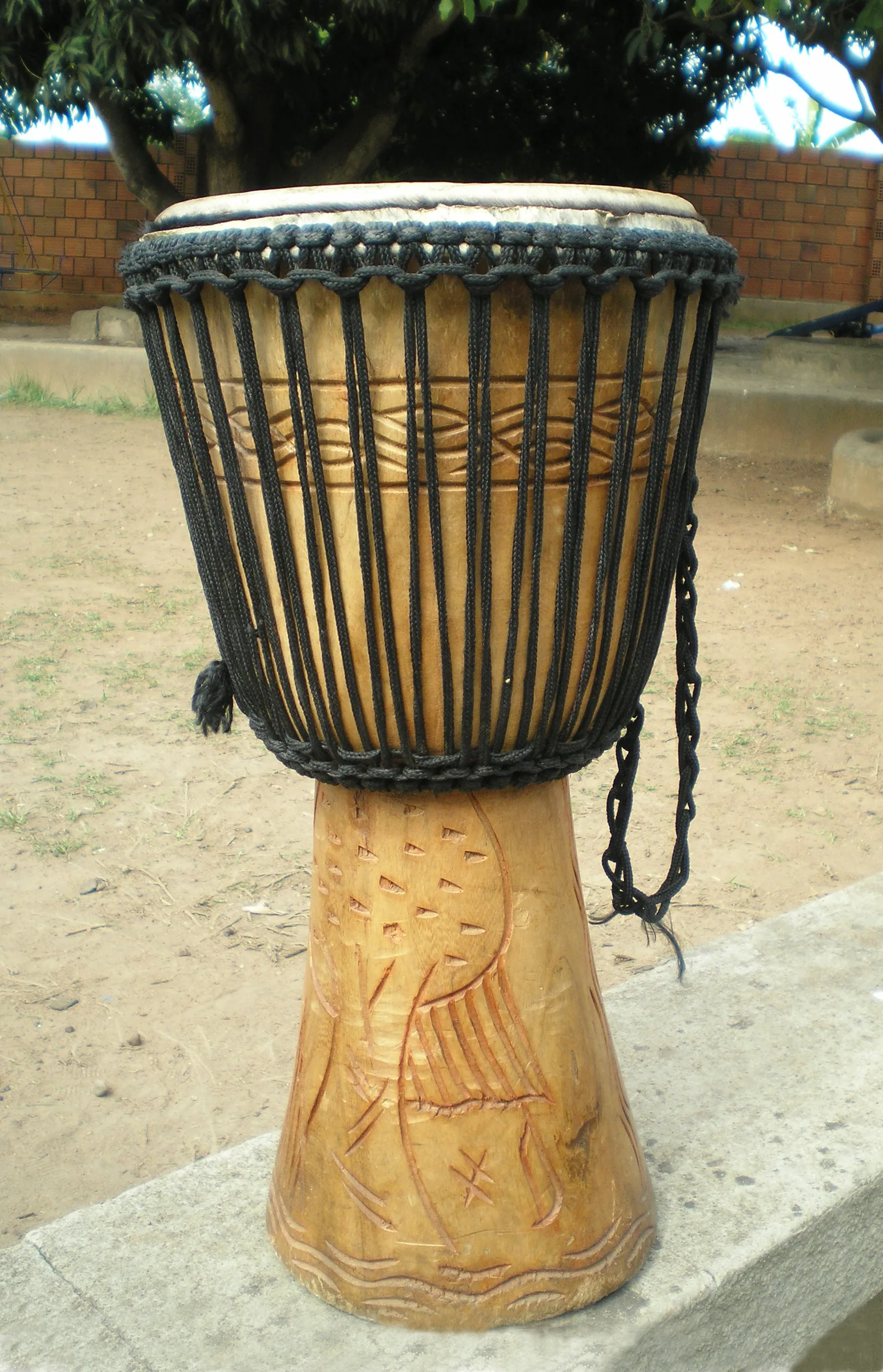
The guiding idea is simple: if you know where the 1 is, where the accent is, and where the cycle begins, you no longer get lost.
To go deeper into traditional patterns and guided exercises, see fundamental rhythms, then follow the progression technique → reading → tempo → repertoire.
Understanding the djembe in West African percussion
In a West African ensemble, the lead drum often plays the role of musical conversational partner.
The group role and the dialogue with the dunun
The djembe speaks above a rhythmic foundation laid down by the dunun (dununba, sangban, kenkeni). The dunun provide the pulse and density. The djembe can support, answer, or carry a rhythmic phrase.
Why oral tradition and listening shape the learning process
Learning happens through listening, observation, and repetition. Playing in a group forces you to lock in with the bass, respect the spaces, and hear the calls and responses of the other percussionists.
- Active listening routine: choose one version of a motif, identify where the “1” falls, then write down the accents.
- Mini exercise: tap the pulse on your thigh or drum for 1 minute, then add one stroke per cycle.
Beyond the gesture, this instrument serves a dance, a song, or a social situation. For a practical description of the instrument and how it is played, see what is a djembe.
Mastering the three basic strokes for a clean sound
Three simple gestures are enough to produce distinct sounds: bass, tone, and slap. Each one has a specific zone and attack. Work on them separately before combining them.

Bass, tone, and slap: essential gestures
Bass: strike the center with the palm for a full low sound. Listen to the resonance.
Tone: strike near the edge with your fingers together; look for a clear mid-range sound.
Slap: use slightly spread fingers near the edge; the sound should crack, not pinch.
Clarity, volume, and regularity
Contact points: a clear but relaxed motion, natural rebound, mobile wrists, and supple fingers. These techniques protect your hands and improve the projection of this instrument.
- “Clean sound” protocol: 8 slow basses → 8 tones → 8 slaps, aiming for consistency rather than force.
- Common mistakes: tone too close to the center, pinched slap, stiff hands, uneven volume between right and left hand.
- Quick fixes: move the tone closer to the edge, loosen the fingers for the slap, relax the wrists.
Regularity comes first: a clean sound at a slow tempo is better than fast, blurry playing. Check your posture (straight back, tilted djembe, relaxed shoulders) to avoid tension.
Progress marker: you can recognize your three sounds by ear on a recording, without looking at your hands. This simple test validates beginners’ progress.
Reading and memorizing a rhythm: B/T/S notation and rests
Clear notation turns a sequence of strokes into a motif that is easy to memorize.
The code: B = bass, T = tone, S = slap, “-” = rest. This grid lets you quickly see where the strokes fall and where to breathe.
To read a line, proceed as follows:
- Identify the length of the cycle (4, 6, 8, or 12 beats).
- Place the “1” and mark the possible accents.
- Read the sequence by following B/T/S/- to anticipate each attack.
Simple 3-step method: read → vocalize → play. First scan the grid, then say the syllables, and finally play without looking.
Vocalize to anchor the rhythm
Use helpful onomatopoeia: “Bam” for B, “Ta” for T, “Pa” for S. These syllables shorten the learning curve and make body memory easier.
“Recite the motif while walking, then play it blind: if the body follows, it is memorized.”
Then introduce subdivisions by counting “1-2-3-4” or “1-2-3 / 1-2-3,” depending on the feel of the tempo.
| Symbol | Syllable | Purpose |
|---|---|---|
| B | Bam | Mark the low sound, anchor the pulse |
| T | Ta | Define the mid-range, clarify the phrase |
| S | Pa | Accent, create the attack |
| – | (rest) | Respect the space, prepare the next stroke |
Mini test: recite the pattern out loud while walking. Then play it without looking. If the body follows, end the session.
This writing and vocalization system speeds up your djembe learning and prepares you to study Kuku, Djansa, and Soli.
Djembe rhythm: understanding cycles and accents
A rhythmic cycle is an audible loop where each instrument finds its place.
What is a rhythmic cycle?
It is a sequence of beats that returns again and again. Each phrase starts on the “1” and must loop cleanly.
Common cycles in West Africa
The usual formats are 4, 6, 8, and 12 beats. They support dance, group coordination, and song.
- 4 beats: clear and direct, easy for calls.
- 6 beats: intermediate, often used for local motifs.
- 8 beats: versatile for variations and songs.
- 12 beats: often ternary, felt as 4 groups of 3.

Accents: how they create groove
An accent is not always louder; it is a reference point. It guides the dance and sharpens group cohesion.
Simple method: tap the pulse, sing the motif, then mark only the important strokes.
“Ta-ki-ta” helps you feel the ternary pulse.
Feeling duple and triple time
Duple time divides into two and sounds “straight.” Triple time divides into three and brings swing.
- Walk on every beat.
- Clap on the accents.
- Move to the drum while maintaining the return to the “1”.
| Cycle (beats) | Feel | Use | Simple exercise |
|---|---|---|---|
| 4 | Straight, stable | Calls, fast dances | 4 slow basses → repeat |
| 6 | Intermediate | Local variations | Count 1–6 out loud |
| 8 | Open, flexible | Songs, transitions | Accent the 1 and the 5 |
| 12 | Ternary, swing | Group dances | Sing “ta-ki-ta” then play |
Setting the tempo: counting, listening, and playing with a metronome
Building a reliable pulse depends on a metronome and simple reference points. Always start low: 60–70 BPM is recommended. At this speed, you hear stroke clarity better and can correct your movement.
Step-by-step procedure: choose a low BPM, play for two minutes without mistakes, then increase by 5 BPM. Repeat in stages until you reach the target speed.
Work on subdivisions to stay stable. Count “1 and 2 and…” in duple time or sing ta‑ki‑ta in triple time. These internal cues keep you from speeding up without noticing.
Body cues: settle the breathing, keep a slight sway, and feel the cycle. Also listen to the bass, real or imagined, to stay anchored on the “1”.
Recording method: film or record 30 seconds per exercise, listen right away, then write down one single point to correct (tempo, accent, or sound quality).
Objective marker: you can hold eight cycles with the metronome without shifting the 1. Favor short but regular sessions, a few minutes a day, to anchor regularity.
To extend your practice, see guided pathways and useful resources on the mental rhythm box.
Learning accessible traditional rhythms and their cycles
Start with three simple traditional motifs to build your first repertoire. These patterns show how cycle length (4 / 12 / 8 beats) changes the feel and the musical phrase.
Kuku (Guinea): cycle 4
Basic pattern: B – – T S – T -. Identify the “1,” play the loop slowly, then introduce the variation B – T T S – T S without breaking the cycle.

Djansa (Guinea): 12-beat ternary cycle
Pattern: B – – T – – S – S B – -. Work in 4 x 3, sing ta-ki-ta to feel the swing and check accent placement.
Soli (Malinke): cycle 8
Pattern: B T S – T – S T. Focus on energy and accent control so you do not “rush.” Start very slowly.
Learning plan (for each motif): 1) separate hands, 2) slow loop, 3) add accents, 4) test a variation, 5) record and listen.
A class, in person or online, often helps validate ternary swing and precise stroke placement.
Exercises for accents, coordination, and endurance
Turning theory into reflexes requires progressive, targeted exercises.
Goal: convert pattern reading into automatic gestures to gain coordination and endurance.
“L’Echauffe” warm-up routine
Play the following sequence over two four-beat cycles: B B T T S S B T / T T S S B T S B.
Practice for 5–10 minutes, slowly, aiming for equal volume between strokes. This routine balances the three sounds and prepares the wrists and hands.
Moving accents and independence
Take a motif and accent the 1, then the 2, then the 3 in turn. Repeat each position for 8 cycles.
Then hand A keeps the pulse (bass/tone) while hand B adds light slaps. After ten cycles, reverse roles to stabilize coordination.
Transitions and error prevention
To move from one motif to another (for example Kuku → variation → return), keep the “1” as your anchor. If the cycle breaks, return to the metronome, slow down, and rebuild in 2-beat blocks.
Success criterion: link 16 cycles with clean accents and no wrist tension.
Building a regular practice habit that brings progress
The key to real improvement often lies in short but regular sessions. Aim for 10–15 minutes a day: it is more effective than rare, long sessions.
Session model (10–15 minutes)
- 1–2 min: warm up the wrists and fingers (rotations, opening/closing).
- 3 min: isolated sounds (bass, tone, slap), gently.
- 4–6 min: one motif in a loop at the target tempo.
- 2 min: targeted accent exercise.
- 1–2 min: mini recording for playback.
Why it works: regular practice builds muscle memory, stabilizes tempo, and reduces tension. Short sessions support consistency of movement.
Simple warm-up
Rotate your wrists, stretch your fingers, then play a few very light strokes. Gradually increase intensity. If you feel fatigue, slow down and correct posture instead of forcing.
Goals and practice journal
Set measurable goals: “clean Kuku at 80 BPM,” “8 cycles without losing the ternary feel,” “clean sounds at medium volume.” Keep a journal: date, BPM, exercise, difficulty, 1 improvement, 1 point to work on.
Weekly method: listen back to two recordings (start/end of the week) and note your progress. For in-person guidance, see percussion lessons in Nemours.
Speeding up learning with classes, online resources, and group playing
A good class gives you immediate feedback and concrete reference points for moving forward. Consider instruction when the sounds remain blurry, when you lose the cycle, or when you doubt your ternary placement.
Tutorials and guided pathways: how to choose reliable resources
Prioritize videos with clear audio, slow explanations, hand views, and an indicated tempo. Prefer a structured pathway to isolated clips.
Look for well-known platforms: YouTube for tutorials, Pratiquetv and Bala Land for complete pathways. For beginner traditional patterns, also see basic rhythms.
Group practice: listening, locking in, and understanding roles
In a group, learn to lock in with a reference point (often the bass). Understand the roles: support, calls, responses.
Simple exercise: one person holds the pulse, another plays the motif; then switch. Goal: do not speed up.
Record rehearsals (with consent) to analyze tempo, cohesion, and listening quality.
| Option | Advantage | Indication | Example |
|---|---|---|---|
| In-person class | Immediate feedback | Technical blockage, accent validation | Koradjembe workshop |
| Online pathway | Guided progression | When practicing alone | Pratiquetv, Bala Land |
| YouTube tutorials | Free access | Occasional supplement | Videos with slow breakdowns |
| Group playing | Cohesion and real reference points | Learning roles and dynamics | Local sessions with other percussionists |
Practicing the djembe without disturbing others: volume, timing, and alternatives
Practicing at home without disturbing others means thinking about volume, suitable times, and alternatives.
The problem: this instrument projects strongly. In an apartment, you need concrete solutions to keep practicing without creating conflict.
Muting techniques
Slide a cloth, towel, or small sponge into the shell to reduce resonance. Test several materials; thickness changes the color of the sound.
Technical tip: work on contact points at low volume. Focus on stroke precision rather than power.
Practical solutions and alternatives
- Choose acceptable time slots (late morning, early evening) and let neighbors know.
- Play outside when the weather allows, or book a rehearsal room.
- Consider an electronic model with headphones: it is better suited to silent practice and recordings.
| Problem | Solution | When it fits |
|---|---|---|
| Strong resonance | Cloth / sponge in the shell | Apartment, short session |
| Schedule constraints | Fixed time slots and communication | Sensitive neighbors |
| Need for total silence | Electronic djembe with headphones | Apartment building, night |
Relationship advice: a simple conversation with your neighbors makes regular practice easier. Saying when you rehearse reassures people and creates flexibility.
Conclusion
Keep these key steps in mind to turn listening into confident movement. Understanding this instrument, mastering the three strokes (bass/tone/slap), reading B/T/S/- notation, and placing accents creates a clear method.
Beginner action plan: 10–15 minutes a day for two weeks, metronome at 60–70 BPM, one simple rhythm (Kuku), one warm-up exercise, and one weekly recording to track progress.
Sound quality matters more than speed. Favor stroke clarity and tempo regularity over acceleration. Playing in a group speeds up learning and sharpens listening.
If you get stuck, take a class to correct technique early. Set a concrete goal (target BPM + number of error-free cycles) and progress without forcing your fingers or posture.