
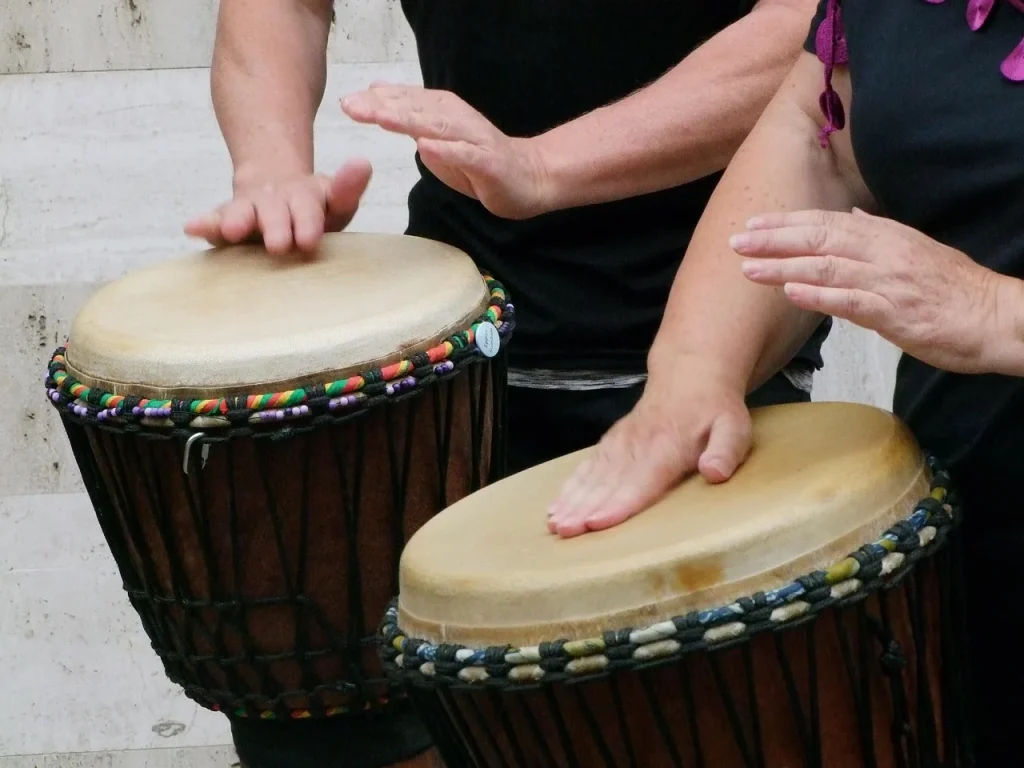
Promise: this guide shows how to hold an accompaniment foundation that “sounds right” in a group, without getting lost in individual performance. After ten years of teaching experience, I share a clear, progressive method.
By accompaniment, I mean a stable, repeatable pattern. It serves the soloist, the dance and the song. Its purpose is to create an ensemble logic in which every instrument finds its place.
What you will gain: secure posture, clean sounds, a sense of time and an understanding of roles (djembe, doundoun, bell). You will also learn your first polyrhythms and learning routines.
Audience: beginners, intermediate players and percussionists joining a group in France, for lessons, workshops or rehearsals. West African music is collective and cyclical; every line has a precise function.
Simple progression: first listen and understand, then work on basic technique, reading and counting, then locking in during rehearsal. Note the key tuning idea: the accompaniment stays lower, while the soloist plays with more tension.
Understanding the Spirit of Ensemble Playing in West African Percussion
Collective playing comes first: it is the shared pulse that supports the whole performance.
The priority is to keep the common rhythm before chasing speed or complexity. If the sense of time is stable, the soloist can breathe and the piece comes alive.
In a group, the functional hierarchy is clear: the leader offers calls and breaks, the accompaniments stabilize the framework, and the doundoun lays down the low foundation that guides everyone.
Playing too much creates density: the bell gets lost, the line becomes blurred and the musicians tire. Listen to the bell, identify the doundoun lows and place your accents against the sangban or the kenkeni.
- Practical rule: if you cannot sing the cycle, you cannot accompany it reliably.
- Collective responsibility: one drifting musician pulls the whole group with them.
In rehearsal, aim for cleanliness and regularity. Leave space for the soloist instead of filling everything. These cultural and instrumental reference points are detailed in the following sections, so you know exactly who does what.
Mande reference points and practical guidance complete this approach.
The Djembe and Doundoun in African Music: Useful Cultural Reference Points
Mande drums carry a social memory that goes back to the twelfth century. Born in the era of the Mali Empire, they traveled through Mali, Guinea and Côte d’Ivoire. Their history links rituals, communication and community cohesion.
Traditionally, these instruments are used during ceremonies: weddings, harvests, festivals and messages. Griots play a key role here: guardians of memory and transmitters of stories.
In France, several elements remain: clear cycles, distinct roles and the bell as the thread of the rhythm. Other aspects change: amplified stages, fusions with jazz and world music, as well as lesson/workshop formats, which sometimes simplify the form.
- Practical key: a rhythm tells a situation; keep the accompaniment readable.
- Listen to the place of the doundoun and the djembe’s response to grasp the meaning of the cycle.
| Aspect | Traditional | Modern/stage |
|---|---|---|
| Context | Ceremonies and communication | Concerts, studios, fusions |
| Social role | Griots, transmission | Teaching, leisure |
| Structure | Cycles and bell as thread | Adaptations, amplification |
“The drum speaks to the heart.”
Recognizing the Instruments and Their Functions in the Ensemble
Identifying each instrument helps you understand its precise role in the rhythmic texture.
Soloist vs. Accompaniment: Intentions and Placement
The soloist offers phrases, calls and breaks. They seek color, tension and projection.
The accompaniment stays focused on stability. It supports the foundation, responds when needed and modulates the dynamics.
Kenkeni, Sangban, Dunun(ba): Who Plays What
The three doundoun form a complementary line. The kenkeni provides drive and regularity.
The sangban carries linking tones and accents. The dununba provides low-end power and structure.
The Bell: Thread of the Rhythm
The bell serves as a cyclical reference point. Everyone must hear it, even when the playing becomes dense.
Always listen to the bell before adding variations.
Stacking Registers: Low, Mid, High
Lows: dununba and djembe basses. Mids: tones and responses. Highs: slaps and bell.
To avoid masking, distribute the accents. Do not let everyone play high or low at the same time.
- Listening protocol in rehearsal:
- Isolate the bell
- Add one doundoun
- Add the djembe accompaniment
- Bring in the soloist
- Arrangement: one layer per instrument, not everyone on the same accents.
| Role | Function | Register |
|---|---|---|
| Kenkeni | Drive, tempo | Mid |
| Sangban | Reference points, accents | Mid |
| Dununba | Foundation, power | Low |
| Bell | Cyclical thread | High |
If everyone plays high, the ensemble becomes aggressive. If everyone plays low, the cycle loses readability.
To go deeper into the theory of the line and its functions, see this educational work: reference points and analyses.
Posture and Placement: Holding the Djembe to Play for a Long Time, Together, Without Injury
The way you hold your instrument shapes the cleanliness of the rhythm and the health of your wrists. Before any technique, set yourself up stably so your strokes stay regular.
Sitting on a Chair: Stability and Precision
Sit on the edge of the chair, feet flat, knees apart. The edge of the head should sit at navel height for a natural rebound.
Tilt the shell slightly to free the hand and keep the back neutral. This position reduces fatigue and improves technique.
Sitting on the Floor: Mobility and Release
On the floor, you gain freedom of movement. Stay alert to lower-back alignment to avoid numbness and tension.
Plan regular breaks and vary your position to limit the risk of tendinitis.
Standing with a Strap: Stage and Rehearsal Constraints
Adjust the strap so the head sits at pelvis height. The instrument should remain stable without forcing the shoulder.
In concert, control the volume and watch the neck: long rehearsals require alternation and rest.
- Injury-prevention markers: warm up wrists and forearms, control volume, stop if sharp pain appears.
- Choice according to the context in France: lessons often on a chair, stage with strap, rehearsal = alternate.
Practical note: unstable posture produces uneven strokes and an accompaniment that drifts. Once the body is well placed, move on to the three essential sounds.
The Essential Basic Djembe Sounds for Accompaniment
Three essential timbres are enough to build a clean and reliable foundation.
Bass: Anchoring Time
Goal: set the time and the pulse. The palm strikes the center; the hand rebounds to keep the same resonance.
Do not force it: an overplayed bass chokes the cycle. Work with a metronome at 60 BPM.
Tone: Drawing the Line
The tone is produced at the edge with the phalanges. It creates the midrange color that answers the low foundation.
Maintain a consistent timbre: same attack, same volume. This is the key to collective learning.
Slap: Projection and Character
The slap requires a whipping motion, with fingers open and relaxed. It gives the accent without becoming aggressive.
Avoid tense fingers or striking too far from the edge, which creates dry sounds without resonance.
- Common mistakes: finger tension, hand stuck to the head, uncontrolled volume.
- Correction: relax the hand, listen to the resonance, practice slowly with a metronome.
Mini-exercise: 8 bars of bass → 8 of tone → 8 of slap. Then combine them in a simple pattern.
| Sound | Area | Function |
|---|---|---|
| Bass | Center | Anchor the 1, low pulse |
| Tone | Edge | Draw the line, response |
| Slap | Corner/edge | Accents, projection |
In a group, a slap that is too strong crushes the bell, while a weak bass makes the time disappear. The next section shows how the low foundation lets the djembe breathe.
The Doundoun: Laying Down the Rhythmic Foundation (and Letting the Djembe Breathe)
The doundoun provides the sonic backbone: it traces the low line and the base on which the whole group relies. Its presence creates clear reference points and constant propulsion.
Stick/Head Stroke and Resonance Control
The stroke should aim for a full, controlled sound. Touch the head with a clean angle to prevent the resonance from “smearing” across the cycle.
Placing Accents: Stability, Not Rigidity
Identifiable accents, regular volume and clean repetition allow the group to “see” the rhythm. But stability does not mean mechanical playing.
Micro-dynamics keep the pattern alive: vary the intensity slightly without moving the time. If the foundation stays solid, the djembe can play lighter and more musically.
- Rehearsal method: isolate doundoun + bell.
- Add one accompaniment only, then the rest of the group.
- Frequent mistake: overplaying accents and speeding up in loud passages.
| Role | Action | Effect |
|---|---|---|
| Low foundation | Regular stroke | Reference points, propulsion |
| Accents | Mark 1 or 3 | Cycle readability |
| Resonance | Control the duration | Clear the sonic space |
A solid doundoun lets the other percussionists breathe and embellish the pattern.
Transition: for this foundation to hold, everyone must find the time and lock the cycle — the subject of the next section.
Finding the Time: Counting, Feeling and Locking the Cycle
Locking the cycle starts with distinguishing the pulse from the points of support. You need to name the pulse, the strong beats and the subdivisions so you do not get lost.
Difference Between Pulse, Strong Beats and Subdivision
Pulse = the regular beat the whole group feels.
Strong beats = marked points of support, often 1 and 3 or only 1 depending on the pattern.
Subdivisions = smaller divisions that fill the bar and give color.
| Element | Function | Application |
|---|---|---|
| Pulse | Frame | Listen to the bell or the low bass drum |
| Strong beats | Reference points | Mark clear accents |
| Subdivision | Ornament | Words, slaps, small notes |
Metronome Work: From Slow to Fast Without Losing Cleanliness
Start at 60 BPM. Speak or sing the subdivision, then play while keeping the voice. Remove the voice when the feel holds.
- 60 BPM — 2 minutes without mistakes.
- +5 BPM — repeat; if cleanliness drops, return to the previous level.
- Progression in short cycles: increase, then stabilize.
This protocol supports rehearsal and progressive learning.
Entrances and Cycle Endings: Avoiding “Falling Between Two Beats”
Find the bell, breathe and place the first stroke “inside” the cycle. To finish, memorize the final reference point and stop on a strong beat.
Common mistake: speeding up on every slap. Example: getting carried away by the accent. Solution: listen to the low foundation and return to the pulse.
Progression by Level
Beginner: work on the pulse. Intermediate: add subdivisions. Advanced: feel several layers simultaneously.
Once the time is locked, reading signatures and polyrhythm becomes possible — the subject of the next section.
Reading a Simple West African Structure: 4/4, 12/8 and Polyrhythm
Identifying the bell and the accents reveals the form of a pattern in West Africa. This reference helps the group feel where the supports land and stay united.
12/8: Swing and Points of Support
12/8 creates a rocking feel. The dununba places the lows on the heavy beats. The bell “draws” the cycle by landing on regular subdivisions.
4/4: An Effective Entry Point
4/4 is simple to count. The kenkeni often serves as the engine. It is a good format for starting a mixed group and stabilizing the time.
The 3 Against 2 Polyrhythm: Progressive Coordination
3 against 2 juxtaposes two phrases that share the same rhythm. The sangban is often linked to this logic.
Method: tap 2 with the foot, say 3 out loud, then add the hands. If the bell remains clear, the polyrhythm becomes readable.
“The accompanist does not try to prove their calculation; they make the cycle obvious.”
| Structure | Typical instrument | Use |
|---|---|---|
| 12/8 | Dununba | Swing, low supports |
| 4/4 | Kenkeni | Starting point, collective learning |
| 3:2 | Sangban | Polyrhythm, texture |
Mini-sequence: 4/4 → 12/8 → 3:2, with a metronome and recording yourself. This strengthens technique and collective learning.
Djembe and Doundoun Accompaniment: Basics for Playing in an Ensemble
Set up a short, stable pattern: choose a simple rhythmic phrase. Play it cleanly without varying it for 3 to 5 minutes. This creates a solid, audible base for the whole group.
Distribute the layers clearly. Doundoun and bell form the low reference. The accompaniment djembe supports the pulse. The soloist begins their narration when the line is locked.
Control density: count the number of strokes per bar. Reducing notes immediately gives the group more groove.
Work on dynamics: play lighter to leave space for the soloist. This avoids fatigue and masking of the low or high registers.
Safe Micro-Variations
- Move an accent without touching the time.
- Replace a slap with a tone to reduce aggressiveness.
- Add a discreet ghost note to bring the head to life.
Rehearsal rule: only one musician proposes a variation. If the test works in rehearsal, integrate it; otherwise return to the base.
Always validate changes against the bell and the low foundation.
Transition: now use traditional rhythms (Dununba, Sangban, Kenkeni) as structured training grounds.
Setting Up Traditional Rhythms as Training Grounds
Traditional rhythms are excellent training grounds. They strengthen listening, cycle stability and group coordination.
Dununba: Energy, Power and a 12/8 Cycle
Dununba (Guinea) teaches controlled power. Work on 12/8 without speeding up: bell + doundoun first, then add the accompaniment, then the soloist.
Sangban: 3:2 Logic and Collective Placement
The sangban is a school of placement. The 3:2 polyrhythm forces listening and accent precision.
Method: isolate one hand, repeat, switch hands, then combine. Add the group tempo when coordination is stable.
Kenkeni: Fast Engine and Regularity
The kenkeni holds the 4/4: regularity, endurance, cleanliness of fast strokes. Work in short series with a metronome to keep things clean without tension.
- Why these rhythms are useful: even in contemporary music, they build stability, layered arrangement and mutual listening.
- Practical instruction: “rotate the roles”: everyone holds the foundation, the accompaniment and then the soloist role in turn.
Keep the bell and the foundation as reference points: that is where the importance of traditional work lies.
Communication in Rehearsal: Signals, Active Listening and Synchronization
Simple visual signals regulate starts, breaks and tempo changes. The “glance” is a brief gesture: eye contact and a head tilt, or a discreet hand movement. This signal avoids multiple starts and hesitation.
Group rules: one person gives the signal (often the leader), everyone follows. If the signal is not clear, stay on the framework and ask again. This keeps the group united and avoids tempo conflicts.
Call & Response: A Simple Method for Bonding a Group
The leader plays a short phrase, the group answers. This teaches breaks and makes learning breaks easier.
Concrete practice: 4 bars of base → 1 bar of call → 1 bar of response → return to the base. Repeat in a loop until fluid.
Managing Sonic Space
If everyone increases volume, the bell disappears and the music falls apart. Use a simple “mix”: stable doundoun, accompaniments one notch below the soloist, bell audible above.
Correction in rehearsal: stop, isolate the problem part, work slowly, validate, then raise the tempo again. Once synchronization is achieved, you can enrich the accompaniment without complicating it.
Techniques for Enriching the Accompaniment Without Complicating It
A few subtle touches are enough to animate the head without saturating the framework. The idea is to add life, not noise. Keep the bell as a reference point and let the foundation breathe.
Ghost Notes and Nuance: Bringing the Head to Life Without Saturating the Rhythm
Ghost notes = very light strokes that keep the pulse alive without stealing the soloist’s space.
Play them discreetly between the beats and reserve accents for the structural points of the cycle. Nuances are developed through touch: smaller, rounder, less attack.
Muting and Drier Sounds: When to Use Them
Muting is obtained by pressing the head with the hand to produce a dry, short sound. It is used for contrast and articulation.
Use cases: end of a phrase, brief response to a call or clarification of an accent without increasing the general volume.
Rolls and Rolled Figures: Punctuate, Do Not Fill
Rolls or rolled figures are useful for marking a transition or break. They must stay short.
- Simple rule: if the roll hides the bell, it is too long or too loud.
- Safe use: a short roll before a restart or to announce an ending.
Practical exercise, progressive level: stable base 8 bars → add 1 ghost note in bar 8 → on the restart, place 1 mute on the strong beat. Repeat until stable.
Observation: listen to the strokes of masters such as Harouna Dembele to grasp the placement of nuances. These tools then feed improvisation and musical soloing without breaking the collective rhythm.
Improvisation and Solos: Staying Musical Above a Collective Base
Improvising while respecting the cycle turns a solo into a musical conversation.
Solos “in phrases” means short ideas, clear breaths, then a return to the pattern. Answer the low reference points and keep the form audible.
Solos “in Phrases”: Breaths and Responses
Build two-bar phrases. Play, breathe, listen to the foundation, then conclude. A readable solo always shows where you are in the rhythm.
Hand Independence: Initial Exercises
Beginner exercise: left hand = regular bass; right hand = 2-bar series (tone/slap). Reverse after stabilizing.
Example inspired by Babara Bangoura (Sewa Kan/Mamady Keïta): two heads with different tensions create the illusion of two players through hand independence.
In the modern world, this approach adapts to jazz or rock if the collective base remains solid. Useful limit: if the group gets lost, simplify and return to the starting pattern.
Transition: the next section offers concrete exercises for progressing quickly, alone or in a group.
Practical Exercises for Progressing Quickly in a Group (and Alone Between Two Lessons)
Brief, frequent exercises transform learning. They strengthen placement, clean sounds and listening to the time.
Weekly Routine
Goal: keep a regular thread despite a busy schedule.
- 10–15 min: sounds (bass/tone/slap).
- 10 min: cycle + bell with a metronome.
- 10 min: endurance (short fast series).
- 5 min: active listening (short recording).
Ensemble Exercise: Role Rotation
Rotate places: leader, accompaniment, low part. Each musician holds one role for 4 minutes.
This gives concrete experience of the constraints and the level required.
Recording Yourself and Self-Correcting
A smartphone is enough. Listen for whether the bell remains audible and whether the accents land in the same place.
- Stable tempo
- Clear sounds
- Consistent accents
- Balanced volume
Protocol for Speeding Up Without Tensing Up
Comfort tempo → +5 BPM → validate 2 minutes. If quality drops, return to the previous level and release tension.
| Block | Duration | Goal |
|---|---|---|
| Sounds | 10–15 min | Cleanliness and timbre |
| Cycle | 10 min | Placement against the bell |
| Endurance | 10 min | Regularity under fatigue |
| Listening | 5 min | Self-correction through recording |
Speed comes from control: prioritize cleanliness first, then acceleration.
In rehearsal, listen more than you impose. This balance makes practice genuinely useful between two lessons.
Choosing, Tuning and Maintaining Your Instrument to Sound Better in an Ensemble
The choice of shell and head largely defines an instrument’s color and projection. A dense wood such as lenké offers strong projection. A goatskin head gives clarity; hare skin will be thinner and drier.
Wood, Head and Impact on Timbre
The material influences the sounds: a solid shell reinforces the lows. A thick head favors the “bass,” while a thin head favors the highs.
Tuning: Different Tensions According to the Role
In practice, tune the accompaniment a little lower to leave room for the more tightly tuned soloist. Two djembes that are too high step on each other; vary the tension to keep the base readable.
Maintenance and Practical Details
Check the head regularly and avoid excessive humidity. Raise the tension progressively, not all at once. Store excess rope by wrapping it neatly at the base so it does not interfere with the hand.
| Element | Sonic effect | Maintenance |
|---|---|---|
| Shell (lenké) | Projection, clear lows | Oil occasionally, protect from knocks |
| Head (goat) | Midrange clarity | Avoid humidity, tighten progressively |
| Head (hare) | Brighter highs | Monitor fragility, avoid overtensioning |
| Rope | Maintains tension | Wrap excess, check knots |
Comfort and longevity: choose an instrument that responds easily with little effort. In rehearsal or lessons, this reduces fatigue and makes technique easier. With proper setup, the next section gives tips for practicing in an apartment without disturbing others.
Practicing in France Without Disturbing Others: Realistic Apartment Solutions
Goal: keep time quality, clean sounds and coordination without forcing volume on the neighbors.
Silent Pads, Rugs, DIY Box: Lowering Volume Without Losing Feel
Place a silent pad on the head and add a thick rug under the instrument. These solutions reduce transmission through the floor while preserving rebound.
- Thin pad on the head to soften the attack.
- Rug or dense foam under the shell to limit lows traveling through floors.
- DIY box: a closed support that absorbs resonance without distorting the touch.
Alternatives: Modules, Headphones, Rehearsal Rooms
Work on regularity near the edge, favor nuance rather than power. Use a metronome and headphone playbacks to hear the bell and the lows.
For group playing, consider renting a room, joining a group class or using a community studio. These slots allow collective learning without sound constraints.
Rehearsal hygiene: short and frequent sessions, reasonable hours and communication with neighbors. Even alone, train yourself to “hear” the bell and hold the base as if you were in a group.
Priority: time, role, sound and listening — then the next action: test one low-volume session this week.
Conclusion
In summary, effective accompaniment depends on clear roles, clean sounds and constant listening.
A stable pattern = locked time + clean sounds + respect for the bell and the low foundation. Follow the progression: posture, three timbres, cycle and structures (4/4, 12/8, 3:2), rehearsal setup, then enrichments.
In a group, favor a simple, musical pattern rather than a flood of strokes. Stack one line per instrument, leave space for the soloist and work on dynamics.
Recommended routine: short metronome sessions, recordings and role rotation. Choose Kenkeni or Dununba, work on the base + bell for two weeks, then test it with a lesson or a group.
With these foundations, accompaniment becomes a true musical language in service of the music and the ensemble.