
Discover a simple guide to getting started with the djembe. This article offers a progressive selection for beginners and intermediate players. You will find traditional rhythms, a warm-up, and clear technical goals.
The djembe is an accessible West African instrument. It can be played seated or standing. The three main sounds — bass, tone, and slap — are enough to form most patterns.
You will find simple exercises for counting cycles and stabilizing the tempo. Each rhythm targets hand coordination, accents, and swing. With a few minutes a day, you will produce driving music.
To go further, see a practical resource on primary education that mentions the djembe: routine and instruments for primary school.
Why play the djembe to explore rhythms and African music
This instrument makes traditional rhythms easier to access and quickly reveals the cycle logic specific to West Africa. Very few prerequisites are needed: you quickly get motivating sounds that encourage practice.
An accessible instrument that develops coordination, precision, and tempo
Regular practice strengthens coordination and hand independence. You gain precision by playing slowly with a metronome.
A rich musical experience between solo practice, group playing, and expression
Solo playing cleans up your strokes and builds automatic habits. In a group, listening and synchronization create a living groove.
“The djembe is a tool for nonverbal communication: it lets you improvise and express a rhythmic story.”
To deepen this approach and find teaching methods, see a practical resource for playing the djembe.
Preparing well before working on djembe pieces
Before playing a piece, prepare your instrument and your space to get clean sounds.
Choose a suitable instrument and useful accessories
To start, aim for a diameter of 30-35 cm. Solid wood models give a warmer sound. Synthetic versions are lighter and easier to carry.
- Indicative budget: 150-300 euros.
- Accessories: anti-humidity bag, adjustable strap, metronome.
Set up the instrument and prepare your hands
Set yourself up on a stable floor and make sure the base does not block projection. Let the shell “breathe” for a pure tone.
Do a short wrist and finger warm-up. Drink water, take care of your hands, and take short breaks to avoid tension.
Adjust the tilt, the hand-to-skin distance, and your placement before every session. A good setup reduces fatigue and makes practice more effective.
For practical tips on care and tuning, see a useful resource: setup and maintenance.
Djembe posture and hold for playing longer without fatigue
A suitable position reduces fatigue and improves playing precision. Here, we detail how to set yourself up to protect your body and stabilize the rhythm.
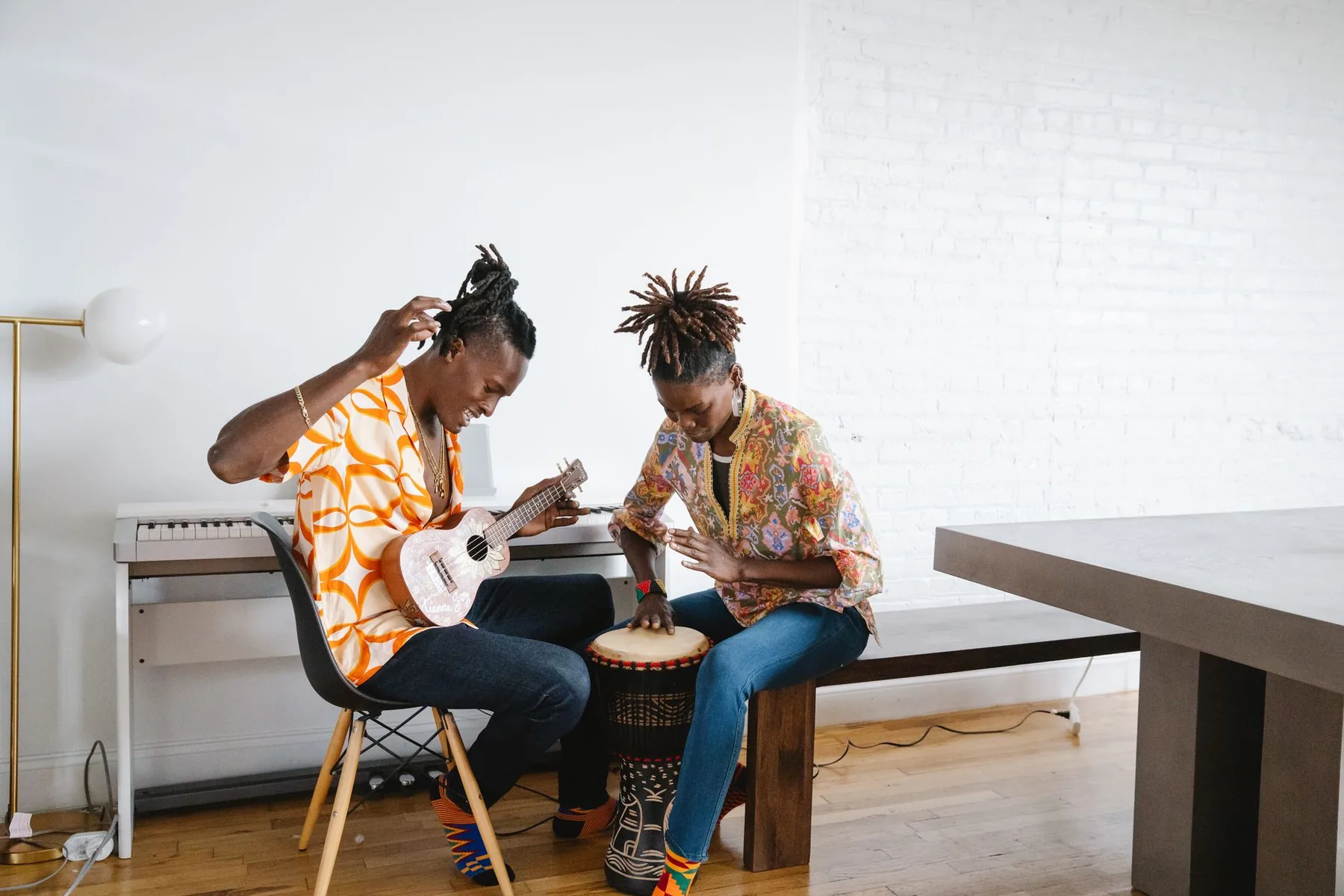
Seated position: chair or floor
On a chair, sit on the edge, without armrests. Place the instrument between your legs, slightly tilted. Keep your feet flat and your back straight.
Hold it lightly with your knees to stabilize the instrument. This frees the hands and protects endurance. An engaged back should remain natural, without tension.
Sitting on the floor
Cross-legged or on your knees, adjust the tilt so the air can flow out freely. Play with your arms and shoulders rather than your wrists.
Avoid “breaking” the wrists: keep them flexible for better rebound and cleaner sounds.
Standing play for rehearsals and performances
For rehearsals or performances, wear a strap or harness. Adjust the height so the head of the instrument reaches around the pelvis or upper stomach.
Keep your shoulders relaxed and favor arm movement. The shared goal is rhythmic stability, freedom of movement, and consistency over long sessions.
- Mini-checklist: if you feel pain, review the height, tilt, forearm tension, and range of motion rather than hitting harder.
Essential striking techniques for sounding right on every rhythm
Sound quality matters more than speed: start by clarifying each type of stroke so the rhythm stays readable and musical.
Low stroke (bass)
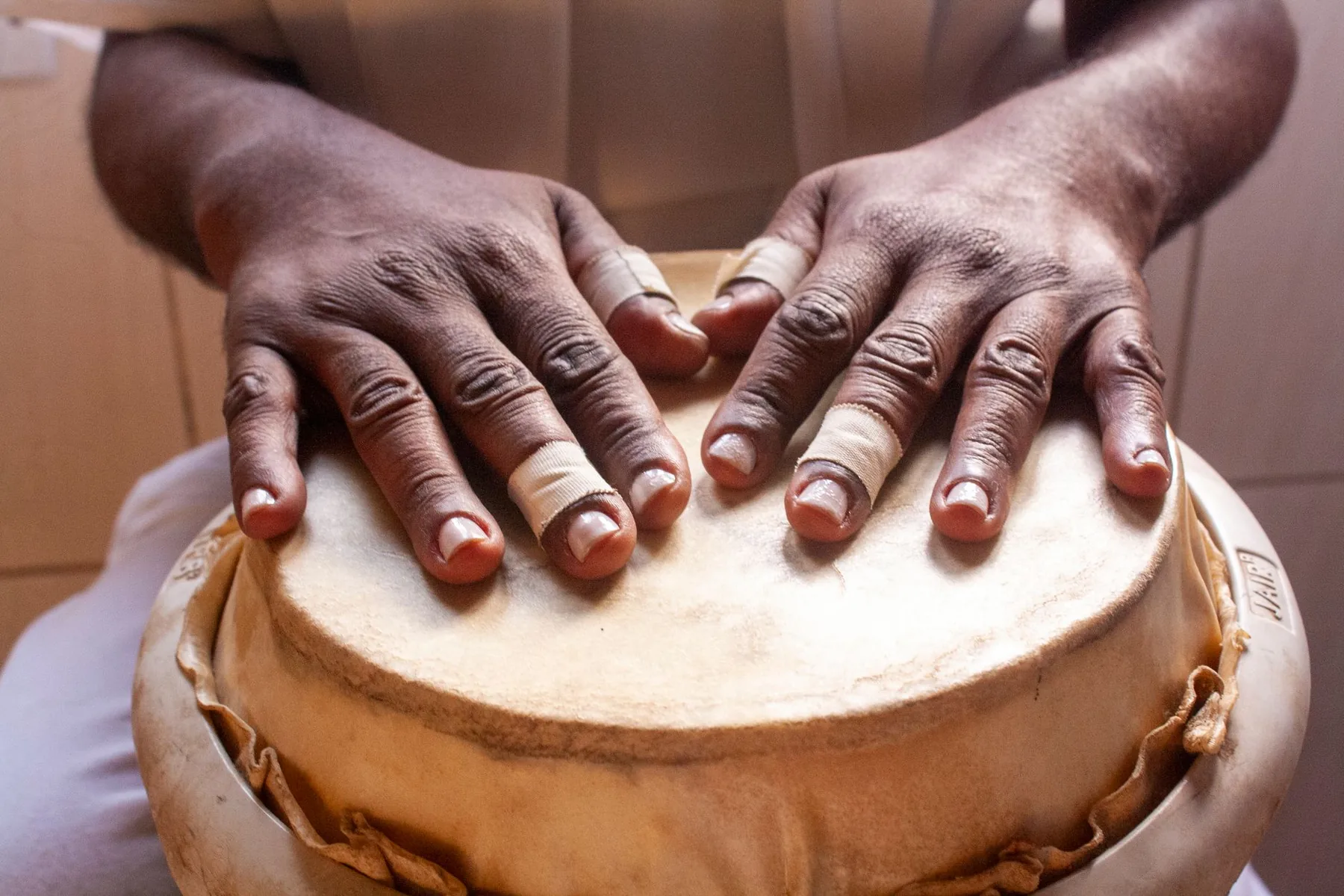
The bass targets the center of the skin. Touch with the whole palm, using the weight of the arm, then let the hand rebound. You can mute the sound by resting the hand to cut the resonance.
Tone
Strike near the edge with four fingers together. The palm should not stick. The gesture should be short and precise to get a clear midrange rather than a flat sound.
Slap
For the high sound, spread the fingers slightly and round the hand. The attack is very brief at the edge: look for a sharp sound without tension.
Practical tips: work slowly with a metronome, prioritize relaxed fingers and rebound. Limit unnecessary movements to gain precision.
Control protocol: alternate 8 bass / 8 tone / 8 slap, record yourself, and correct the timbre before increasing the tempo. Clean technique makes rhythms such as Kuku or Djansa more musical.
To deepen the basics and find additional resources, see this instrument reference.
Music with djembe: easy piece ideas to practice
Each proposed piece is practiced as a cycle, with a precise technical goal. The aim is endurance, coordination, swing, and clean sounds.
Kuku — simple Guinean fishing rhythm
Context: rhythm linked to fishing activities and ceremonies. Basic pattern (4 beats): B – – T S – T –.
Tip: keep the bass in the center and the slaps clean at the edge. Variation: B – T T S – T S to add movement.
Djole — circle energy
A collective rhythm, ideal for group playing. Stay on a stable base and answer with short phrases.
Work on the clarity of the S before increasing speed.
Djansa — ternary feel
12-beat cycle (4×3). Count “ta-ki-ta” in four groups to feel the swing.
Bring out the accent without pushing the tempo.
Soli — fast challenge
8-beat cycle. Target: lock in accents and transition precision.
Progress from a slow metronome (60-70 BPM) toward higher speeds.
Warm-up — technical pattern
A short loop balancing B/T/S. Play for 5-10 minutes to prepare the hands and endurance.
Reading and counting cycles
Notation: B = bass, T = tone, S = slap, – = silence. Common cycles: 4, 8, 12 beats.
Quick method for each piece:
- Isolate each sound cleanly.
- Play the complete cycle slowly.
- Hold it for 3 minutes without errors.
- Increase the tempo slightly.
- Record yourself and correct.
“Start slowly, stay clean, then let the gesture follow.”
| Rhythm | Cycle | Goal | Example pattern |
|---|---|---|---|
| Kuku | 4 beats | Steady groove, coordination | B – – T S – T – |
| Djole | 4/8 beats | Circle energy, responses | Simple base + response phrases |
| Djansa | 12 beats | Ternary swing | 4x(ta-ki-ta) |
| Soli | 8 beats | Speed & accents | Tight accents on 1 and 5 |
| Warm-up | 4 beats | B/T/S technique | B T S T (loop) |
Practical exercises to progress quickly on these djembe rhythms
A short, precise routine speeds progress on common patterns. Here is a simple method for structuring your sessions and improving precision.
30-minute routine and metronome
Adaptable 30-minute routine: 5 min warm-up (Warm-up), 10 min isolated technique (B/T/S), 10 min work on one rhythm, 5 min cool-down.
Start at 60-70 BPM. Increase the tempo only if the cycle is clean.
Sequences and coordination
Work on simple permutations: R/L alternating, then B-T-S. Aim for equal hands and rebound.
For complex rhythms, break down the cycle: 2 beats, then 4, then 8 or 12. Mark the beat with your foot.
Accents, dynamics, and cleanliness
Accent a bass or a tone to add musicality. Vary volumes rather than hitting everything hard.
Control contact points (center for bass, edge for tone/slap) and keep the hands relaxed.
Record yourself and measure progress
Simple protocol: smartphone at 1 m, 1 minute of looping. Listen for clarity and regularity.
- Note the starting BPM.
- Note the duration without errors.
- Assess perceived quality: round bass, clear tone, crisp slap.
| Goal | Duration | Indicator |
|---|---|---|
| Warm-up | 5 min | Flexible wrists, 3 cycles without tension |
| Isolated technique | 10 min | 3×10 clean B/T/S repetitions |
| Target rhythm | 10 min | Cycle at constant tempo, then +5 BPM if clean |
Playing in a group and learning rhythmic communication
Collective playing first requires active listening and shared rhythmic stability. This listening turns every stroke into a useful signal for the other percussionists.
Listening, each percussionist’s role, and building a collective groove
Solo / group difference: playing alone serves technique; playing in a group serves the shared tempo. Holding the rhythm should be a service to the group.
- Base role: repetitive and stable loop.
- Support voices: they fill the space without covering everything.
- Variation voices: they offer short phrases to animate the music.
Variations, breaks, and responses to make a piece come alive
Signal a change with an accent or a slight rise in volume. Come back together on the “1” to keep cohesion.
- Base alone for 2 minutes.
- Add a simple variation.
- Introduce a short break, then come back together.
- Rotate roles so every percussionist learns every part.
“The feeling of a shared groove speeds up learning and strengthens the experience.”
| Role | Function | Short exercise |
|---|---|---|
| Base | Rhythmic stability | 2 min looped |
| Support | Fill without overloading | 2 min, moderate volume |
| Variation | Interest and dynamics | 1 min of short phrases |
| Break | Transition and response | Announced 4-8 beats |
Improvisation and creativity on djembe from a basic rhythm
Improvisation is always built on a solid foundation: keep the pulse and vary around it so creativity stays clear. The goal is to express an intention without losing the beat.
Build a vocabulary of short phrases
Create 5 to 10 short motifs (2 or 4 beats) by combining bass, tone, and slap. Repeat them until they become automatic.
- Repetition: play each phrase 8 times in a loop.
- Reuse: insert these motifs into different rhythms to enrich learning.
Leave space and use silence
Silence is a musical decision. A rest creates tension and leaves room for others. Mark returns to the “1” so expression remains readable.
Improvising as a duo or ensemble
Simple exercise: one player holds the base for two cycles, the other answers with a variation over one cycle. Switch roles.
“Vary without breaking the pulse, then return cleanly to the base.”
Listen to the masters (Mamady Keita, Famoudou Konaté) to nourish your ear and anchor this practice in the tradition of African music.
Conclusion
Real progress comes from short, regular, targeted practice. Master the three sounds (bass, tone, slap), and take care with posture and warm-up. Work slowly with a metronome to clarify every stroke.
Choose 10-15 minutes a day rather than a sporadic session. Record your cycles, listen, and correct one point at a time. This method makes technique more durable and prevents injuries.
Choose one rhythm this week (Kuku, Djole, or Djansa), hold a clean cycle, then add a variation and a short break once it is stable. Move quickly into group playing: collective listening speeds learning and makes performances more alive.