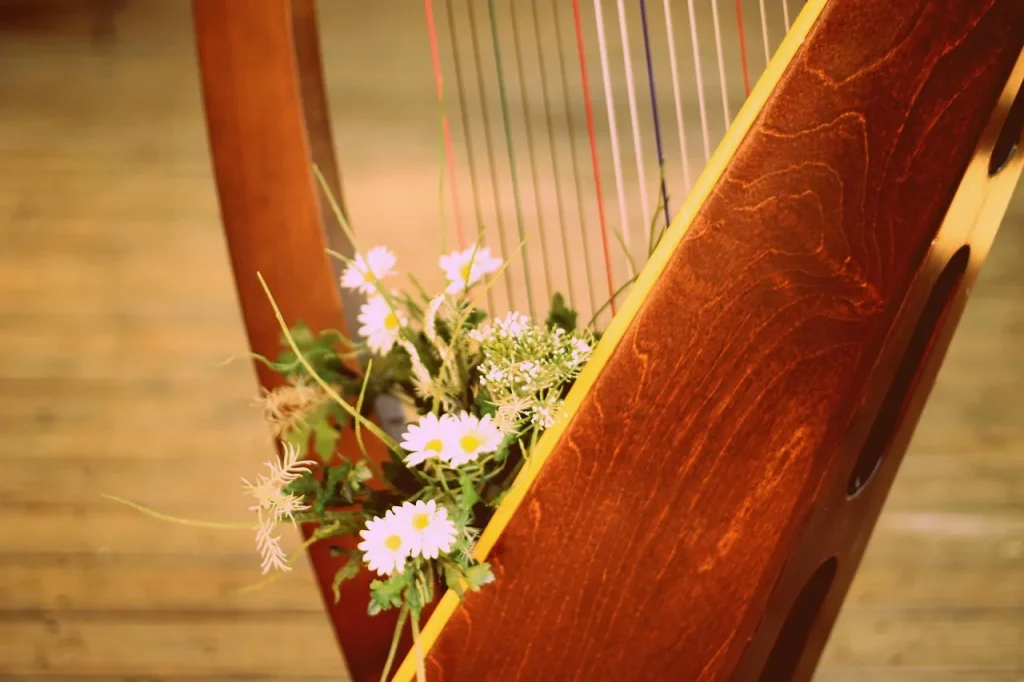
The Celtic harp is an iconic instrument in Irish and Breton traditions. Its spellbinding melodies evoke mystical landscapes and ancient legends. Compact and lightweight, it appeals to beginners and experienced musicians alike.
Its moderate weight, between 5 and 12 kg, makes it accessible to children from age 7. Its soothing tones offer a unique musical experience, ideal for relaxation. In addition, its reduced size, from 1.30 m to 1.50 m, makes it easier to transport.
This guide will help you navigate the available models. We will cover recognized brands, suitable budgets and playing levels. Whether you are passionate about traditional music or simply curious, you will find useful reference points here.
The Celtic harp: an instrument steeped in history
Discover the deep roots of an iconic musical object. Associated with Irish and Breton cultures, this Celtic harp embodies traditions thousands of years old. Its elegant curves and spellbinding tones make it far more than a simple instrument.
An Irish cultural symbol
It appears on Ireland’s coins and national flag. This symbol represents the people’s identity and resistance. In the sixteenth century, Henry VIII even adopted it as a royal emblem.
Medieval minstrels used it to recount epics. Its curved pillar, typical since the Middle Ages, sets it apart from other models. Today, UNESCO recognizes it as intangible heritage.
Evolution through the centuries
First seen among the Celts of Ireland and Scotland, it has undergone major transformations. In the twentieth century, the addition of levers revolutionized its manufacture. These mechanisms make it possible to change notes quickly.
| Feature | Celtic harp | Pedal harp |
|---|---|---|
| Weight | 5-12 kg | 20-40 kg |
| Mechanism | Levers | Pedals |
| Use | Traditional | Classical |
Unlike the pedal harp, it remains light and portable. Its streamlined design appeals to lovers of acoustic music. A rich history that continues to inspire modern musicians.
Composition and technical characteristics
Dive into the fascinating anatomy of this ancestral instrument. Its design combines aesthetics with acoustic performance. Each element, from the frame to the strings, plays a key role in its sound.

Basic structure and mechanism
The triangular frame has between 22 and 38 strings. The soundbox, often made of cherry or walnut, amplifies the vibrations. The neck and pillar provide stability and balance.
Modern models sometimes include Camac levers. This system makes it possible to adjust semitones quickly. An innovation that makes playing easier without weighing down the instrument.
Types of strings and their particular qualities
The choice of strings directly influences the tone:
- Nylon: ideal for beginners, flexible and affordable
- Gut: warm sound, reserved for professionals
- Fluorocarbon: increased durability and precision
“String tension varies depending on the material. Careful adjustment preserves intonation.”
Levers vs models without mechanisms
| Feature | With levers | Without levers |
|---|---|---|
| Versatility | ✔️ Note modulation | ❌ Fixed key |
| Weight | + 1-2 kg | Ultralight |
| Maintenance | Regular adjustments | Simplified maintenance |
Purists often prefer the authenticity of models without levers. Natural resonance is preserved, offering a more organic sound.
Essential criteria for choosing your Celtic harp
Finding the perfect instrument requires a careful analysis of several factors. Your level, available space and materials influence your choice. Here are the key points to consider.
Playing level: beginner vs experienced
Beginner models prioritize lightness and simplicity. Rental, such as Camac study harps at €70 per month, is a sensible option. Professionals will prefer precise mechanisms and noble materials.
Size and footprint
Size affects comfort and portability. The Aziliz, at 11 kg, suits travel, unlike the Mélusine, at 15 kg. Measure your storage space before buying.
Materials: wood vs synthetic
Wood offers warm resonance, ideal for concerts. Padauk, exotic and durable, is prized by experts. Synthetic composites withstand climate variations better.
“An adjustable riser, as on the Aziliz, optimizes ergonomics for long sessions.”
Optimal number of strings
A number of strings suited to your body type is crucial. For adults, at least 34 strings allow an extended range. Compare the options:
| Model | Strings | Use |
|---|---|---|
| Study | 27 | Beginners |
| Intermediate | 34 | Regular practice |
| Concert | 38 | Professionals |
In short, assess your needs before deciding. Trying an instrument in a shop remains the best way to validate your choice.
Budget and price range
Investing in a harp requires a clear understanding of the financial options available. Prices vary considerably depending on manufacturing level and materials used. A methodical approach helps avoid unpleasant surprises.
Differences between study and professional models
Beginner instruments prioritize robustness and accessibility. Reputable brands such as Camac offer specific ranges for learning.
| Criterion | Study model | Professional model |
|---|---|---|
| Average price | €1,200 – €3,000 | €5,000 – €15,000 |
| Materials | Standard solid wood | Rare woods |
| Warranty | 2 years | 5 years minimum |
Camac’s Odyssée represents an excellent compromise between quality and price. Its moderate cost, around €2,500, suits music schools.
Economic calculation: renting versus buying
The rental formula appeals to undecided players, with monthly payments starting at €70. Over 5 years, the analysis reveals significant differences:
- Rental: €4,200 with no purchase option
- New purchase: €2,500 with maintenance included
- Verified second-hand: €1,800 on average
“Independent luthiers such as Delorme often accept interest-free installment payments.”
Guide to the main manufacturers
Three reputable brands dominate the French market:
- Camac: leader with the Excalibur, a high-end model at €12,000
- Salvi: a reference for intermediate models, from €4,000 to €8,000
- Lyon & Healy: artisanal excellence, starting at €10,000
The second-hand market requires particular vigilance. Choose specialized platforms over private classified ads. Authentication by serial number is recommended.
Do not forget the additional costs: transport cover, from €150 to €300, electronic tuner, around €80, and annual string replacement, around €100. These elements influence the overall budget.
Our selection of Celtic harps
Browse our carefully selected traditional instruments. We have retained the models most appreciated by musicians, classified by level and budget.
Entry-level models
The Camac Mélusine dominated 2023 sales with its excellent value for money. At €1,850, it offers 34 strings and fine resonance.
Other economical options:
- Aoyama: compact design for small spaces
- Troubadour: ideal for the first years of learning
Intermediate instruments
The Dusty Strings Crescendo impresses with its exceptional tone. Its precise mechanism suits regular musicians.
| Feature | Camac Aziliz | Dusty Strings Crescendo |
|---|---|---|
| Weight | 8.5 kg | 10.2 kg |
| Strings | 34 nylon | 36 fluorocarbon |
| Price | €3,200 | €3,800 |
High-end harps
Concert models use noble woods such as maple or rosewood. Their artisanal manufacture justifies prices between €5,000 and €15,000.
Electroacoustic options are available for stage performances. Some luthiers also offer left-handed versions.
Essential accessories
The TKL case, at €189, protects the instrument during air travel. Complete your setup with:
- Flight cases: maximum protection
- Hercules music stands: optimal stability
- Electronic tuners: cent-level precision
“A good case protects the instrument from thermal and humidity shocks.”
Tips for getting started with the Celtic harp
Mastering this ancestral instrument requires solid foundations and a methodical approach. Here are the essential tips for making quick progress while preserving your equipment.
Posture and basic technique
Adopting correct posture prevents muscle pain. Sit up straight, feet flat, with the instrument tilted at 45°.
The Suzuki method recommends 15 minutes a day to acquire reflexes. Start with simple scales before tackling traditional melodies.
Learning with a teacher vs self-teaching
Statistics show that 85% of self-taught learners give up within a year. A weekly lesson corrects bad habits.
Platforms compared:
- Harp Mastery: progressive teaching method
- Udemy: thematic modules
Care and maintenance
Monthly maintenance extends service life. Use beeswax to nourish the wood.
Simplified protocol:
- Check string tension
- Clean surfaces with a soft cloth
- Inspect the condition of the levers
“Workshops in Dinan and Lorient offer ideal immersive settings for perfecting your technique.”
Conclusion: finding the ideal Celtic harp
Choosing your instrument rests on a balance between sound quality and playing comfort. Beginners will favor lightweight models such as the Thomann Ashwood, while experienced players will opt for noble woods.
The in-shop experience remains essential. Try several instruments to compare their feel and resonance. Specialized distributors offer free trials.
To progress, explore dedicated forums or resources such as this complete comparison. Some musicians then move on to pedal harps.
The essential point? Select a model that enchants you from the first notes. Musical pleasure should guide your final choice.