The Middle Ages, a fascinating period rich in artistic discoveries, gave rise to a wide range of musical genres. This article explores the different types of music that existed in the medieval period and how they evolved over time.
Gregorian chant: an ancient legacy
From the beginning of the Middle Ages, Gregorian chant established itself as the dominant musical form in Christian liturgy. Inspired by ancient music and Jewish traditions, this monophonic music is characterized by its simple melody and sacred Latin texts. Gregorian chant underwent several changes over the centuries, especially with the appearance of musical notation and the creation of new forms of chant that enriched the repertoire.
Polyphony: a musical innovation
In the ninth century, polyphony marked a major break in the history of medieval music. This technique consists of layering several voices or melodic lines at the same time, creating a sense of harmony and sonic depth. The earliest forms of polyphony, such as organum and discantus, first appeared in the schools of Notre-Dame in Paris and then spread throughout Europe.
The role of music schools
In the twelfth century, polyphony developed further thanks to the work of music schools and master composers. Among the most famous were Pérotin the Great and Léonin, who helped expand polyphonic chant by inventing new compositional techniques. Music schools also encouraged the spread of musical knowledge through the copying and circulation of manuscripts.
Secular song: a popular form of expression
Alongside sacred chant and polyphony, secular music also held an important place in medieval culture. The troubadours and trouvères, poet-musicians from southern and northern France, actively contributed to this tradition by composing songs of courtly love and epic narratives. Their works were often performed at festivals, banquets, and tournaments, reflecting the diversity of social life in the Middle Ages.
Musical instruments
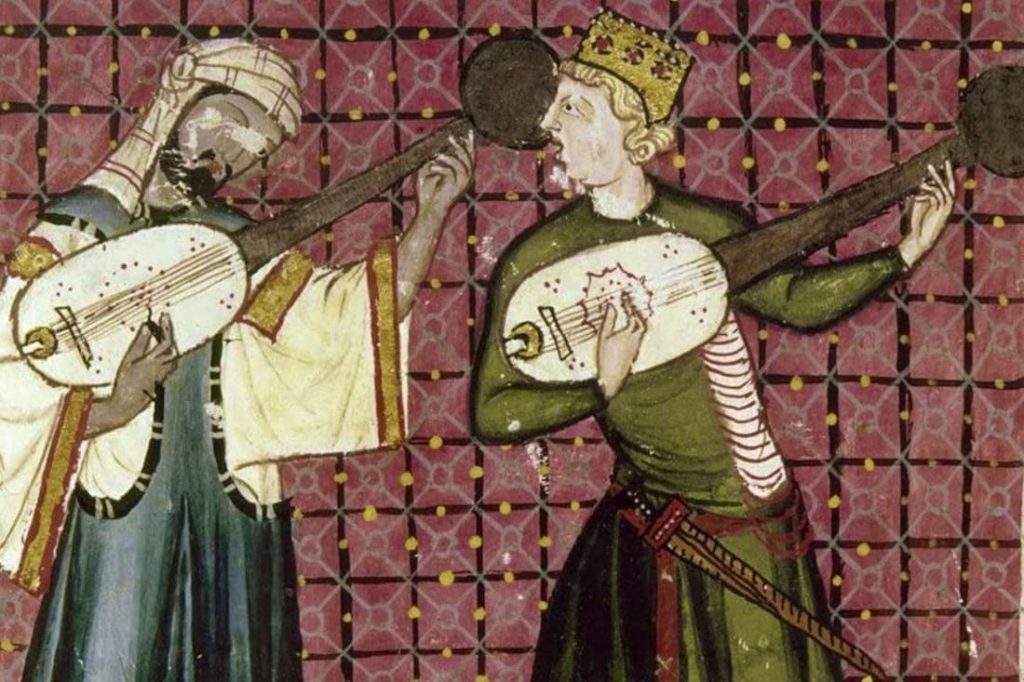
The medieval period was also marked by a great variety of musical instruments. Among the best known were the vielle, lute, harp, flute, tambourine, and bagpipes. These instruments were used to accompany singers during secular performances, but also in instrumental music in its own right, which grew considerably during the Middle Ages.
Religious music: between mysticism and emotion
Beyond Gregorian chant and polyphony, medieval music was also shaped by the emergence of specific religious genres. The laude, vernacular hymns dedicated to the Virgin Mary, became highly popular from the thirteenth century onward. Likewise, the mystery plays and Passion plays, theatrical forms combining text and music to recount episodes from the life of Christ, testify to the vitality of religious musical creation in the medieval period.
The role of confraternities
Confraternities, associations of laypeople devoted to a religious or charitable cause, played an important role in the development of religious music in the Middle Ages. By organizing processions, pilgrimages, and services, they helped bring sacred chants and new musical forms to a broad public. Some confraternities were also behind the creation of original musical pieces, further enriching the medieval repertoire.
In short, medieval music displays a great diversity of genres and styles, reflecting the cultural richness of this historical period. Between Gregorian chant, polyphony, secular music, and religious music, it is fascinating to see how these different musical forms evolved over time, bearing witness to the inventiveness and creativity of the artists of the age.