
This guide offers a clear, reassuring path for getting started. It is written for beginners who want simple, effective progress.

Goal: choose the right instrument, set up a stable posture, and master the basic strokes.
The logic is practical: choosing the instrument → setup → holding position → sounds → strokes → first rhythms → routine and resources.
Key tips: favor short, regular sessions, clean sounds, and a steady tempo before speed.
Avoid common mistakes such as tension or an instrument that does not fit you. Enjoyment and experience come quickly with measured practice.
To learn more about equipment and useful resources, follow this link to a dedicated guide: instrument and learning guide.
Understanding the djembe and what to expect when you start
Rooted in West African traditions, this instrument offers a rich sound palette. It speaks through dynamics: basses, tones, and slaps form a highly expressive rhythmic language.
At first, your hands will get tired and the sounds will often blend together. That is normal. Technique quickly makes all the difference: separating bass, tone, and slap clarifies the sound.
Posture, technique, and regularity
Posture stabilizes the instrument and improves resonance. A well-positioned djembe requires less effort and produces richer sounds.
- Favor relaxed movements and a steady tempo over speed.
- Ten clean minutes are better than one messy hour.
- Progress comes from separating the sounds and respecting the beat.
If you want to go deeper into equipment and practical advice, read this beginner’s guide. It prepares the ground well before choosing a suitable instrument.
Choosing the right djembe so you enjoy getting started
Your choice of instrument affects the sound, comfort, and your desire to come back and play. Before buying, try several models and listen to their resonance. Check how it sits between your legs and how stable the base feels.
Size and weight: matching the instrument to your body
A djembe that is too large quickly becomes tiring. A model that is too small limits deep bass.
If you move the instrument often, choose a lightweight djembe. Otherwise, solid wood offers a tonal warmth that is hard to match.
Materials and sound quality
Solid wood (teak, lenke, djalla) gives warm resonance and rounded bass. Synthetic or fiber models are sturdy and lighter, sometimes with a drier sound.
Tuning, skin, and response under the fingers
Look for three distinct sounds: bass in the center, clear tones at the edge, and crisp slaps. The skin should provide good rebound under the fingers so you can learn without forcing.
Appearance and purchase
An instrument you like increases the pleasure of practicing. If possible, buy from a specialist seller or ask for the tuning to be checked before purchase.
For size advice and detailed criteria, read this guide.
Setting up your practice space so you can progress without injury
A well-prepared space speeds up progress and limits the risk of injury. A quiet place helps you distinguish bass, tone, and slap, and lets you correct technique faster.
Choose a quiet place so you can hear better
Favor a room without noise so your sounds are clear. A stable floor, enough light, and proper ventilation are the minimal setup.
Use a chair without armrests for freedom of movement
Sit on the edge of a chair or stool without armrests to free your elbows. This position improves your range of motion and protects your shoulders.
The seat should be high enough for your knees to stabilize the djembe without rounding your back.
Before each practice session, warm up your wrists, forearms, and shoulders for 2 to 3 minutes. Practice in micro-sessions: a few minutes a day supports consistency and sound quality.
Safety checklist: the djembe must be stable, there should be no fragile objects nearby, and you should be able to move without hitting furniture. For guided lessons, see options for percussion classes.
Holding the instrument correctly according to your playing position
Holding your instrument well deeply changes sound quality and comfort. Here are simple, effective positions for practicing alone or in a group.

Sitting on a chair
Sit on the edge of a chair without armrests, feet flat and knees slightly open. Place the djembe between your legs, stable but not squeezed.
Your back should stay straight so you can breathe and play for longer. This position supports clean strokes and good endurance.
On the floor
Sit cross-legged, on your knees, or on a large djembe depending on your comfort. Each option changes the shell height and hand reach.
Choose the one that leaves the base free to resonate and keeps your back relaxed.
Standing
Use a properly adjusted strap or harness: the drumhead should reach your pelvis or stomach. The instrument should be accessible without raising your shoulders.
Ideal tilt and common mistake
Tilt the djembe forward at about 45° so air can escape through the base and the sound is not muffled.
“A base stuck to the floor or an instrument held too vertically chokes the sound and causes fatigue faster.”
- Tip: a stable hold makes listening and rhythmic consistency easier in a group.
- For advice on other percussion instruments, see this practical guide.
Hand basics: producing clean sounds on the skin
Getting clean sounds starts with a clear finger and wrist position.
Hand and finger position
Goal: make every stroke repeatable before speeding up.
Keep your wrists supple. The fingers should be neither tense nor completely loose.
Relaxation and rebound
Tension ruins rebound. Strike, then let the hand rise naturally to prepare the next stroke.
“A relaxed movement supports a clear sound and protects your joints.”
Striking area: center and edge
The center of the skin produces the bass. The edge gives the highs. Identify these areas and strike accurately.
| Area | Effect | Tip |
|---|---|---|
| Center | Deep bass | Open palm, clear impact |
| Edge | Clear high sound | Fingers close to the edge, short movement |
| Rebound | Clarity and speed | Let the hand rise after the stroke |
Short exercise: alternate center and edge at a slow tempo, then listen to the difference in tone color.
These basics prepare you to master the three fundamental strokes. To extend your learning, see the essential steps.
Mastering the three fundamental djembe strokes
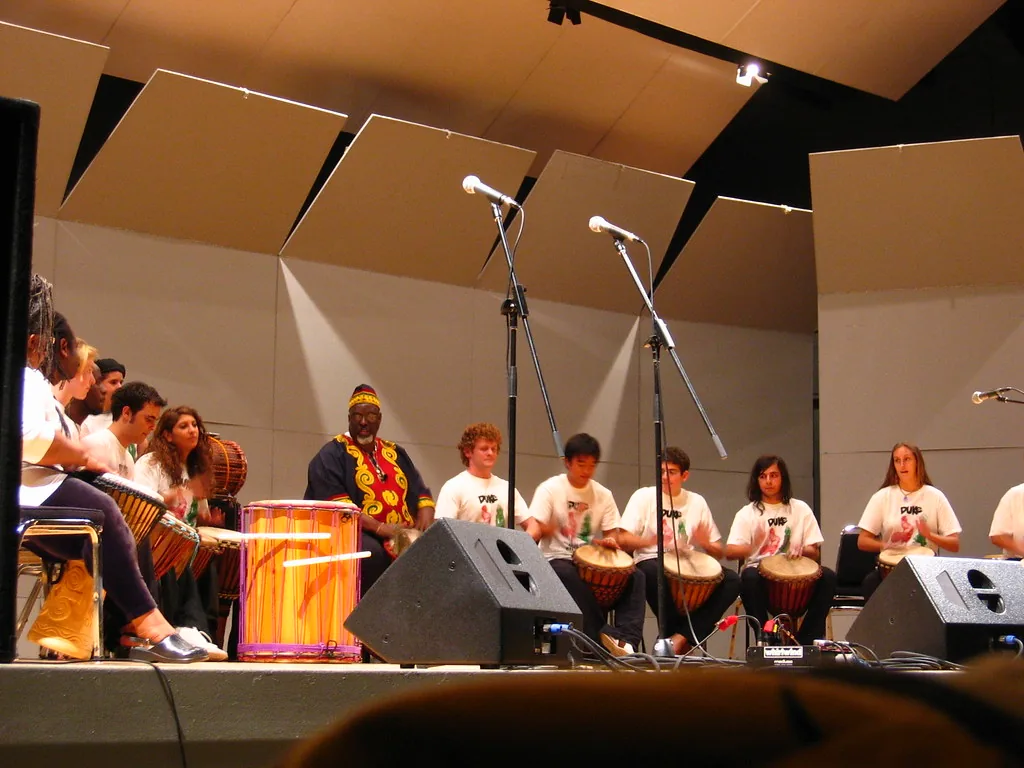
Knowing how to distinguish bass, tone, and slap makes your patterns immediately cleaner. These three strokes form the core of the rhythmic vocabulary and let you play simple rhythms from the first few weeks.
The bass
Aim for the center of the skin with the whole hand. Use the weight of your arm without stiffly “hitting.” The sound marker is a deep, round “boom.”
The tone
Strike near the edge with four fingers together. The palm must not touch the skin: contact should stay brief for a clear, clean sound.
The slap
Still near the edge, but with the fingers spread and the hand slightly rounded. The attack is quick so you get a dry high sound without pain.
Routine and common mistakes
Simple routine: 5 minutes of bass → 5 minutes of tone → 5 minutes of slap, then slow sequences to work on quality and technique.
- Tension → breathe, shake out your hands, slow down.
- Palm left on the skin → lift the hand quickly after impact.
- Muffled sounds → check the tilt and make sure the skin can resonate freely.
With these solid strokes, you can already build many rhythms. For detailed advice and extra exercises, follow this basic guide.
Learning to play the djembe: where to start as a beginner
Short looping patterns are the key to internalizing a good sense of rhythm.
Launchpad: choose a simple rhythm. Repeat it slowly, then stabilize it before speeding up.
Stabilize the tempo
Count quietly and mark the beat with your foot. This helps keep your strokes consistent.
With a metronome, start slowly and increase by only 2 to 4 BPM when the phrase is clean.
Partner work and vocabulary
A partner can keep time or play a simple line while you place your strokes.
Learn a few basic rhythms: dununba, sangban, kenkeni. What matters is regularity, not speed.
Mini session plan (15-20 minutes)
- Short warm-up.
- Work on the three strokes.
- One simple rhythm in a loop for 8 to 12 minutes.
- Cool down and listen.
“Think of the loop as a phrase: beginning, middle, end – not as a series of hits.”
Building a regular practice that fits into your daily life
A few minutes each day are enough to anchor good reflexes. Regular practice is better than one long sporadic session.
A few minutes a day
Simple framework: 5 to 15 minutes with a timer. This format avoids procrastination and protects against overwork.
Clear goals for each session
Vary your targets:
- Clean sounds – work on bass, tone, and slap.
- Tempo – play with a metronome.
- Transitions – move cleanly from one pattern to another.
- Endurance – play for 2 to 3 minutes without tension.
Record yourself to improve
A smartphone is enough. Listen to the quality of the sound, tempo control, and stroke regularity.
“Muscle memory is built in small doses.”
| Duration | Focus | Weekly frequency |
|---|---|---|
| 5-15 minutes | Technique / sounds | 4 days |
| 5-15 minutes | Rhythms | 2 days |
| 5-15 minutes | Free playing / expression | 1 day |
After each session, ask three simple questions: clear sound? steady tempo? tension? These tips make learning easier and improve your experience with the djembe.
Finding resources to learn faster and better
The right resource turns hours of trial and error into visible progress. Choosing suitable materials makes practice easier and preserves your enjoyment.
YouTube tutorials: watch and repeat
Favor videos that show the hands in close-up. Slow down playback and loop difficult sequences.
Tip: note the tempo and work in short segments.
Structured online course platforms
Sites such as Pratiquetv and Bala Land offer level-based learning paths. They guide your progress and help avoid technical jumps.
Books and notation to understand the line
A simple book helps you read patterns, identify accents, and memorize sequences. Check whether the notation uses “B/T/S” or syllables.
Choose one system and stick with it to clarify your learning.
Workshops, courses, and group practice
Workshops (Atelier Koradjembe) offer live corrections: posture, sound, placement. Courses provide immersion and exchanges with other percussionists.
In a group, you learn to listen, hold a role, and lock rhythms together.
“Favor a teacher who insists on clean sounds, relaxation, and tempo before performance.”
Conclusion
Conclusion: this short recap summarizes the useful path for starting the djembe well.
Choose a suitable instrument, set up a simple space, and take care with how you hold it. Work first on the hands and sounds, then on rhythms in short loops.
Priorities: clean sounds, steady tempo, and relaxation. These tips form the basis of lasting learning.
Favor regular practice: a few minutes each day are enough. Playing in a group speeds up experience, musicality, and motivation.
Concrete next step: choose one rhythm, play it with a metronome for 7 days, then add a transition. The djembe is an instrument that quickly becomes enjoyable to play and rewards effort with tangible progress.