

A rehearsal can tip over. During a tryout on Tiriba, Mélissa Lavergne stopped the session: the result had become cacophonous. That moment shows that a disconnected ensemble loses the clarity of its sound.
This guide has one simple goal: learning to listen better, respond in call-and-response, and maintain a steady pulse. You will leave with practical reference points — doum-doum, foot placement, and the first-beat marker — to restore cohesion.
Here, keeping tempo means collective stability, placement, and dynamics. We will follow a practical progression: understand the stakes, work on receiving what you hear, strengthen the foundation, then improvise without breaking the ensemble.
For detailed advice and exercises you can test at your next rehearsal, follow this link to a useful article: how to play well in a group.
Understanding collective djembe playing and its musical stakes
Understanding how an ensemble holds together musically is the first step toward avoiding cacophony. When each musician focuses only on their own part, the ear closes in. The result loses the identity of the rhythms and the beat.
Warning signs: gradual speeding up, rising volume, misaligned attacks, and patterns that no longer land together. These signs show that overall listening has weakened.
The learning model follows three phases: exposure (discovery), consolidation (stabilization), and integration (automation). The risk of disconnection is highest during exposure, when everything is new, and during integration, when effects or solos make the practice more complex.
Roles: the bass (doum-doum) forms the frame, the accompaniments create a bed, and the soloists carry the voice. Everyone remains responsible for cohesion; accompaniments = support for solos.
For additional ideas on learning and collective practice, read this useful article: why play.
| Phase | Goal | Risk |
|---|---|---|
| Exposure | Discovering patterns and time | Weak listening, rhythmic confusion |
| Consolidation | Stabilizing parts and balance | Drift if you do not listen to the bass |
| Integration | Automation and variations | Soloists taking up too much space |
Playing Djembe in a Group: Listening, Responding, and Keeping Tempo
An ensemble becomes stable when each musician controls their stroke while following a shared reference point.
Listening to yourself: stroke accuracy and phrasing
Check the quality of each stroke: a clear sound and a clean attack allow the rhythmic line to remain readable.
Respecting the phrasing means placing the stroke at the right moment. A hit that comes early or late blurs the rhythm.
Listening to others: stepping outside your individual bubble
Choose an external reference point (doum-doum, bass, or footstep) and reduce the attention you give to your hand.
A simple protocol: play 8 measures while following only the reference point, then bring your patterns back in. This opens the group ear.
Keeping a steady pulse and managing volume
Agreeing together on a fixed point (first beat, footstep) helps lock in the tempo. Count in 4/8/12 depending on the pattern.
When accompanying, aim for a sound that is present but reasonable. Playing too loudly causes fatigue, tension, and acceleration.
| Goal | Action | Result |
|---|---|---|
| Self-listening | Check your sound and placement | More precision |
| Opening the ear | Follow an external reference point | Better cohesion |
| Volume | Limit intensity | Endurance and stability |
To go deeper into techniques and advice or find listening ideas, read a listening resource.
Preparing your instrument and technique for a clean group rhythm
Preparing your instrument well immediately changes the clarity of an ensemble. Setup and technique influence the sharpness of every stroke.
Position and posture
Sitting on a chair: sit at the edge, without armrests, with the djembe tilted toward you so the head can vibrate. Keep your back straight and your breathing free.
On the floor: cross-legged or kneeling, keep the instrument stable between your legs. Control the height to avoid shoulder tension.
Standing: use a strap or harness adjusted to pelvis or stomach height. The instrument should stay fixed when you move.
The essential strokes
- Bass: full palm in the center for a resonant low sound.
- Tone: fingers together near the edge, palm raised for a clean sound.
- Slap: fingers spread, a short snap without forcing.
Zones, rolls, and drum rolls
Center = low, edge = high. Consistency in the striking zone improves precision.
Work on rolls and drum rolls slowly, then increase speed. Use them sparingly: if a roll hides the base line, simplify it or remove it.
For simple rhythms to practice after setting up, read patterns for beginners.
Locking in together on the rhythmic foundation: doum-doum, footsteps, and the first beat
To stay connected to the patterns over time, you first need to feel the foundation that carries the rhythm.
The doum-doum as the backbone
The basses provide immediate information about pulse and tempo. They serve as a sonic reference point: when they stay clear, everything else reconnects.
Instruction: the volume must be high enough for the base to be heard even while playing. If it is not, reduce the intensity.
Footsteps as a body metronome
Anchor one foot on each main beat. A regular step helps the collective ear avoid floating in time.
Synchronize steps among participants during practice to stabilize the tempo before adding variations.
Identifying the first beat
Find the structural accent of the pattern: the phrase that starts the cycle indicates the 1st beat.
Mini “I’m lost” protocol: I stop, I listen to the bass, I reset my steps, I find the 1 again, then I rejoin. This avoids adding more mistakes.
| Element | Action | Result |
|---|---|---|
| Doum-doum / bass | Maintain a clear sound | Stable tempo reference |
| Body step | Mark the 1st beat | Less drifting |
| First beat | Identify the cycle accent | Quick reconnection to the patterns |
A solid foundation then makes improvisation easier without breaking the pulse. This practice increases the group’s ability to converse cleanly.
Practicing call-and-response and improvisation without breaking tempo
Knowing when to speak and when to stay silent turns improvisation into collective music. Here, the goal is simple: preserve the base while letting the musicians’ creativity breathe.
Listen, respond, leave space: rules for rhythmic dialogue
Definition: a clear call followed by a readable response, then an immediate return to the base to maintain time.
Practical rules: wait for the end of the call, answer with the same length, leave space between two phrases, and avoid constantly overlapping.
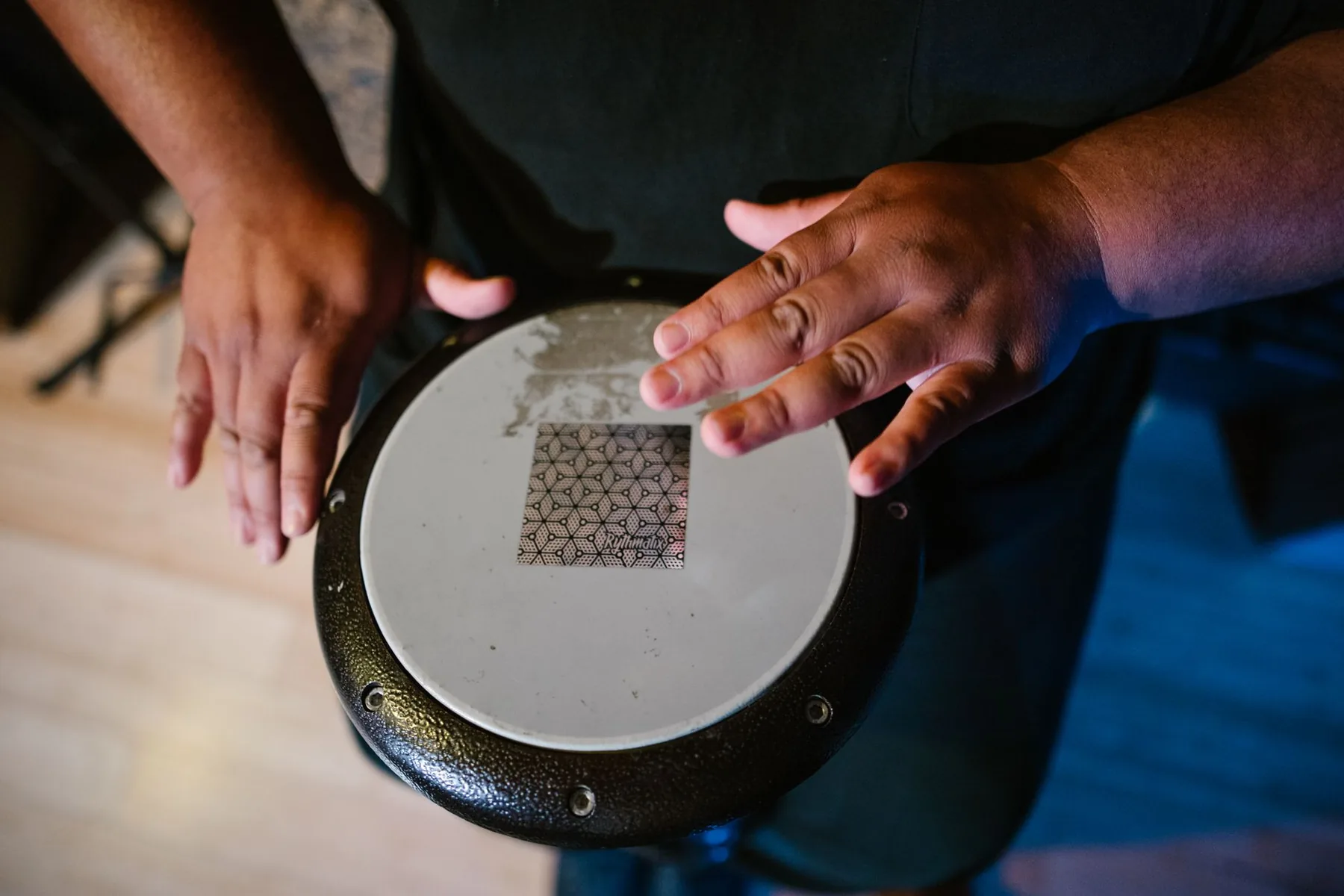
Improvising with intention: variations in service of the group
Vary a pattern without changing the pulse: play accents, shift the density slightly, but do not destabilize the rhythm.
A useful hierarchy: first time stability, then musicality (accents), and only then virtuosity. Limit each improvisation to 1 or 2 cycles, then return to the accompaniment.
Respecting the accompaniment function
Support before shining: accompaniments carry the dance and the structure. Do not fill the entire sound space.
A small shared ending signal (common accent) helps everyone reconnect quickly. To work on precision, follow hand techniques: tone sounds, bass, and adapt them to the style.
Practical exercises to improve synchronization and precision
A regular training plan turns precision into an automatic habit. Start with short sessions in a quiet place, recording yourself so you can adjust.
Working with a metronome
Start: choose a moderate tempo and play a simple pattern for 2 minutes without speeding up.
Then increase in steps (+5 bpm). Repeat 3 times. This exercise strengthens tempo stability and precision.
Hand coordination and independence
Place the foot on the steady pulse while the hands deliver the accompaniment.
Then reverse it: foot on the offbeat. This develops hand-foot independence and the ability to follow varied patterns.
Accents, ear, and looped repetition
Practice accenting certain attacks without changing tempo. Work a pattern until you reach “zero mistakes.”
Listen to a short pattern, reproduce it alone, then with others. One new thing per lesson: absorb it before adding a variation.
| Goal | Duration | Expected result |
|---|---|---|
| Metronome exercise | 2–4 min / step | Better tempo stability |
| Hand+foot coordination | 5–10 min | Greater hand independence |
| Accents and loop | 10–15 min | More precision and stronger patterns |
Managing energy, comfort, and posture to play longer in a group
Managing your energy and comfort changes how well an ensemble holds together over time. Adopting a simple strategy prevents fatigue and involuntary speeding up.
Finding your comfort zone
A clean, integrated part is better than an accompaniment that is too exposed. Choose simple patterns that support the bass line. This preserves cohesion and makes collective practice easier.
Staying upright and relaxed
Straight back, relaxed shoulders, short gestures: breathe deeply between phrases. Relaxation widens listening and reduces tension in the hands.

Balancing energy and endurance
Lower the volume slightly when the session gets longer. Favor regularity over power. Keep something in reserve for the important passages.
Spot acceleration: fatigue → tension → shorter strokes → rising tempo. When this happens, take a micro-pause at the next break to release the hands.
Self-assessment: if the sound loses quality, return to simple technique. To explore this practice advice further, read this article.
Conclusion
In summary, three simple skills are enough to stabilize a collective performance.
Listening to yourself and others, controlled rhythmic dialogue, and maintaining a shared pulse are the key takeaways. These points form the basis of clean, readable playing.
Keep three saving reference points: the bass (doum-doum), the footstep as a body metronome, and identifying the first beat. Progressive reset: stop, recenter yourself, then rejoin.
Work slowly, consolidate through regular exercises, then increase complexity. Clarify roles in rehearsal and record one session. Choose one weak point, then correct it over two weeks.
Goal: recover pleasant, lasting collective music, where every percussionist serves the ensemble.