Music has always held an important place in human history. In medieval society, it served many different functions, touching both religious and secular life. Let us examine what those functions were and how they appeared in different compositions, whether vocal or instrumental.
Music in the Religious Context
One of music’s main functions in the Middle Ages was to accompany religious ceremonies. Liturgical music, essentially vocal, highlighted sacred texts and helped the faithful understand their meaning more deeply. Several types of chant were used for this purpose:
- Plainchant, also called Gregorian chant, was monodic (a single melody) and syllabic (each syllable of the text corresponded to one note). It was intended to accompany Mass and the offices in churches and chapels.
- Tropes were melodic and textual additions to existing liturgical chants, enriching their meaning. They were generally composed for specific feasts in the Christian calendar.
- Sequences were also vocal compositions added to liturgical chants, but they had a more complex structure than tropes. They were sung during certain Masses and could include several sections.
Religious music also aimed to create a bond between the faithful and the divine by encouraging meditation and contemplation. Polyphonic chants, such as motets and organa, played an important role in this process, since they made it possible to layer several melodies and thereby express the complexity and richness of the Christian faith.
Secular Music and Its Various Functions
Music was not reserved for the religious sphere; it was also present in many aspects of everyday life for people in the Middle Ages. Among the main functions of secular music were:
Accompanying Ceremonies and Festivities
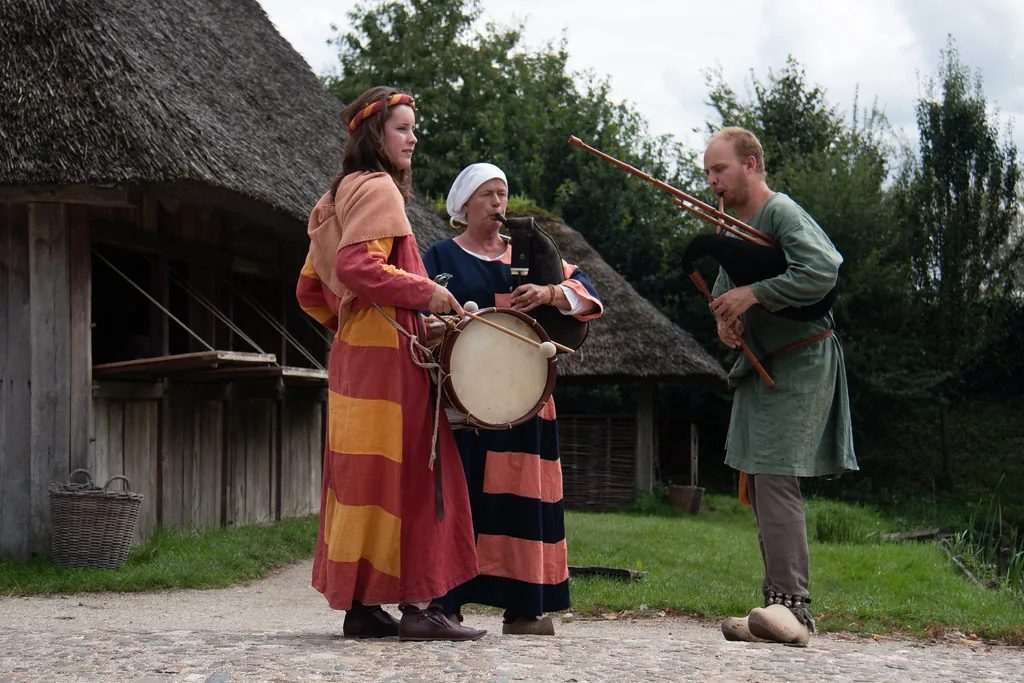
Whether at weddings, tournaments, or banquets, music was an essential element in creating a festive and entertaining atmosphere. Professional musicians, known as minstrels, were hired to enliven these events with stirring songs and dances. Dance, in particular, played a crucial role in medieval society, as it allowed different social classes to come together and share a convivial moment.
Passing Down Epic Tales and Legends
Troubadours and trouvères were poets and composers who told stories of courtly love, chivalry, and bravery through their songs. These verse narratives were often accompanied by music to make them easier to memorize and circulate. In this way, music also served as a vehicle for transmitting culture and history.
Expressing Feelings and Emotions
Secular music allowed individuals to express their emotions and personal feelings. Songs of courtly love, for example, portrayed romantic relationships between a knight and his lady while respecting certain social and literary codes. Music was then considered a noble art, capable of elevating human passions and touching listeners’ hearts.
The Diversity of Medieval Instruments
Although the voice held a predominant place in medieval music, instruments were by no means absent. Several categories of instruments can be distinguished:
- String instruments, such as the vielle, lute, or harp, were highly valued for their ability to produce gentle, melodious sounds.
- Wind instruments, such as the flute, shawm, or trumpet, added dynamism and brilliance to musical compositions.
- Percussion instruments, such as the drum, tambourine, or cymbals, brought rhythm and energy to dances and songs.
This wide variety of instruments made it possible to create rich and diverse sound combinations, testifying to the artistic abundance of the medieval period.
In short, music occupied a fundamental place in medieval society by fulfilling both religious and secular functions. It served the liturgy, entertainment, the transmission of knowledge, and personal expression. The many musical genres, both vocal and instrumental, reflect this cultural richness and offer a fascinating panorama of the sound world of the Middle Ages.
It turns out that musical notes had particular names in the Middle Ages. Learn more about this subject by reading our article.