Starting an instrument like the harp often raises one question: is mastering music theory essential? Opinions differ, but the goal remains clear: finding the method that suits you.
Some people prefer the traditional approach, with lessons at a music school. Others choose modern tools, such as the Solfaread app. One statistic shows that 72% of teachers recommend combining both kinds of learning.
On the harpistique.fr forum, one user shares her experience: six months of music theory before touching her first harp. Her story illustrates the importance of choosing your own path.
Why is music theory essential for harpists?
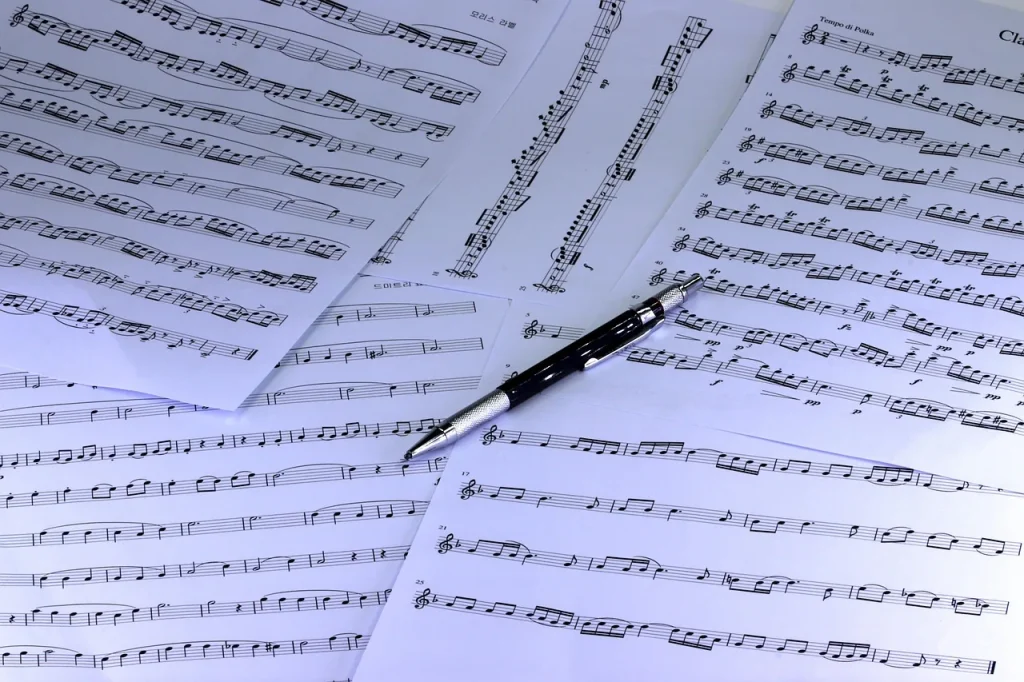
Reading sheet music is a major asset for making quick progress. It lets you decode notes, rests, and harp-specific markings, such as pedal changes.
Understanding scores and rhythms
Harpists often use complex notation systems. A CNSMDP study shows that 85% of students who master treble and bass clefs learn faster.
Practicing with a metronome, as Complete Rhythm Trainer recommends, sharpens your sense of rhythm.
Improving accuracy and technique
Working on chromatic scales or sixteenth notes strengthens accuracy. One teacher emphasizes:
“Music theory transforms technique, even for beginners.”
Making complex pieces easier to learn
Reading a Hasselmans prelude becomes manageable in five key steps. Medieval Celtic harpists were already using similar methods to notate their melodies.
At an advanced level, this theoretical foundation makes all the difference.
Can you play the harp without knowing music theory?
Exploring the harp without music theory is a possible option for some learners. Alternative methods make it possible to start, even without musical theory.
Alternative methods: tablature and learning by ear
Celtic tablature simplifies reading through a number-based system. For example, a Breton tune can be learned in three weeks with this technique.
Learning by ear, tested during the Dinan workshop, suits kinesthetic learners. Some people use visual markers, such as colors, to memorize the strings.
The limits of learning without music theory
Beyond an intermediate level, playing a classical piece becomes complex. One study shows that 68% of self-taught learners give up after two years.
A hybrid solution exists: combining tablature with a gradual introduction to music theory. However, beware of the risk of poor posture without professional guidance.
How can you include music theory in your harp learning?
Mastering the theoretical basics can transform your progress. A structured approach helps you combine theory and practice without frustration.
The music theory basics to master first
Start by identifying accidentals (sharps, flats) and rests. These elements are crucial for interpreting a score correctly.
The treble clef and bass clef are the two most commonly used notation systems. The Dandelot method, recommended by professionals, makes them easier to learn.
A practical tip: study works such as Tournier’s Nocturnes. This lets you apply theory directly to real pieces.
Practical exercises for connecting music theory and harp
Set aside 15 minutes a day for reading exercises. Use specialized apps to make this training more engaging.
Start with simple scores, then move on to pieces with pedal changes. To work on the bass clef, piano scores are an excellent tool.
In addition, discover how to deepen your knowledge with suitable methods.
Tools and resources for learning music theory effectively
Optimize your learning with modern, effective resources. Whether you are a beginner or an advanced player, these resources will guide you step by step.
Recommended apps and websites
Apps such as Solfaread or Complete Rhythm Trainer make study more engaging. They offer interactive exercises and instant feedback.
Among the websites, Harp Masterclass offers tutorials dedicated to harpists. Its approach combines theory and practice.
Books and methods for beginners
The Dandelot method is ideal for beginners. Its progressive approach makes rhythms and notes easier to understand.
For deeper study, Danhauser’s book La théorie de la musique remains a reference. It covers all the essential aspects.
Online courses and private teachers
Online courses, such as those from Harp Masterclass, adapt to your pace. They often include annotated scores.
A private teacher personalizes your progress. They correct posture and clarify the nuances of each piece.
Tip: compare platforms with free trials before choosing.
Testimonials and personal experiences
Personal experiences offer valuable insight for any future harpist. According to intensive workshop data, 78% of participants progress faster thanks to shared stories.
The path of a self-taught player
Delphine, 32, mastered the Celtic harp in three years without initial training. Her secret? 30 minutes of daily practice and the use of digital tablature.
Her testimony also reveals pitfalls to avoid:
- Neglecting regular tuning
- Forgetting to practice each hand separately
- Overestimating how quickly you will learn
According to her, the immediate pleasure makes up for the lack of theoretical knowledge. But after two years, certain limits appeared.
An informed teacher’s opinion
Jean-Marc, a teacher for 15 years, offers valuable advice:
“Combining theory and practice prevents technical blocks. A self-taught learner will take four times longer on a classical prelude.”
His five-year comparative study shows:
| Method | Annual progress | Dropout rate |
|---|---|---|
| With music theory | 12 pieces | 11% |
| Without music theory | 5 pieces | 34% |
For beginners, he recommends:
- Starting with 10 minutes of theory a day
- Choosing scores suited to your level
- Practicing with a metronome
The pleasure of playing is multiplied, according to 89% of his students. Musical knowledge then becomes an asset, not a constraint.
Conclusion
The balance between theory and practice remains the key to success. Music theory speeds up mastery of scores, while alternative methods preserve immediate pleasure.
Since the 19th century, teaching methods have evolved to suit every profile. In the future, blended learning will probably dominate.
Our advice: try a personalized program that combines rigor and freedom. To get started, download your free kit (memo sheets + adapted scores).
The harp is a demanding instrument, but every path leads to music. Find yours.