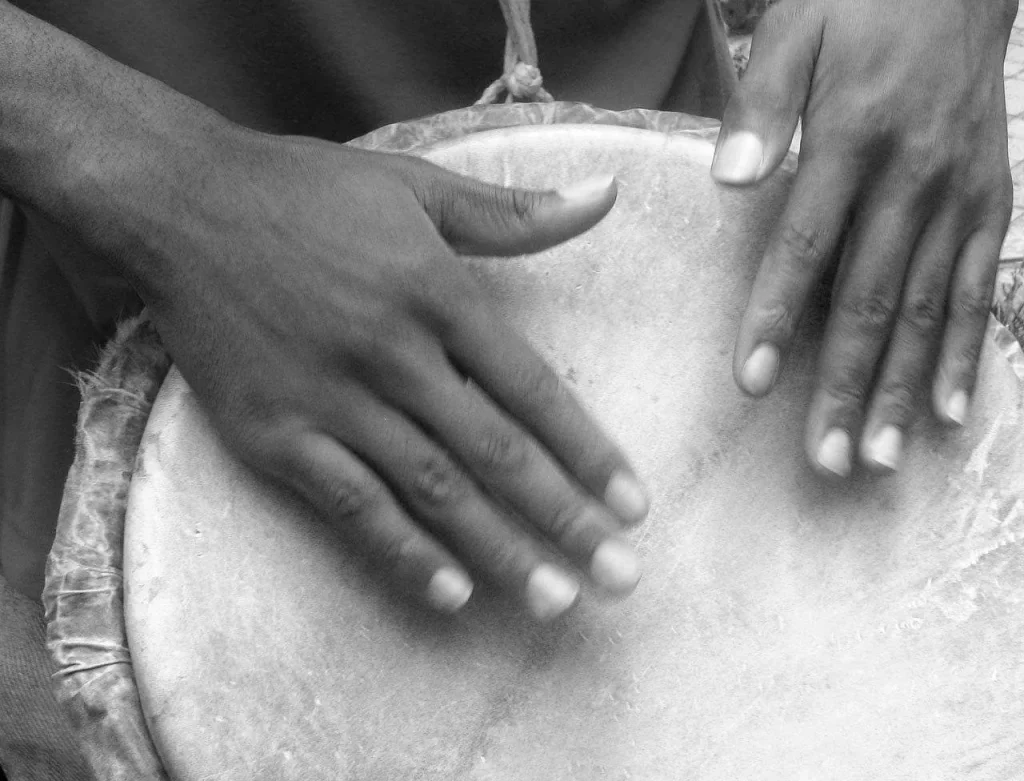
Djembe (EN): “A West African drum with a goblet shape, played with bare hands.” This definition immediately frames the topic and places the instrument within the percussion family.
When you play, English terms quickly appear in a rehearsal, workshop, technical rider, or video. The goal is clear: make these words immediately usable in real situations.
The rest takes the form of a glossary: short entries, French translations, and example sentences. You will find the instrument’s name, its classification (drum/percussion), rhythm vocabulary, rehearsal instructions, and studio and electronic-music terms.
International context: understanding these words makes it easier to communicate with a teacher, a sound engineer, or other musicians. By the end, you will be able to describe what you play, what you hear, and where you play (band, session, studio).
To go further, see a complete list of instruments and terms on justallmusic.
The Djembe in English: Useful Vocabulary for Musicians
Taking part in a session with musicians from all over the world means mastering a few key English words.
Djembe: Definition, Origin, and Translation
Djembe is generally translated as “West African drum.” It is a goblet-shaped drum, played with bare hands, originating in West Africa.
Drum vs. Percussion: Where the Instrument Fits
In English, drum refers to a specific drum, while drums can mean a drum kit. Percussion is the broader family: percussion / strings / woodwind / brass / keyboards / electronics — useful when introducing yourself in rehearsal.
Drum Circle, Ensemble, Band: Playing in a Group
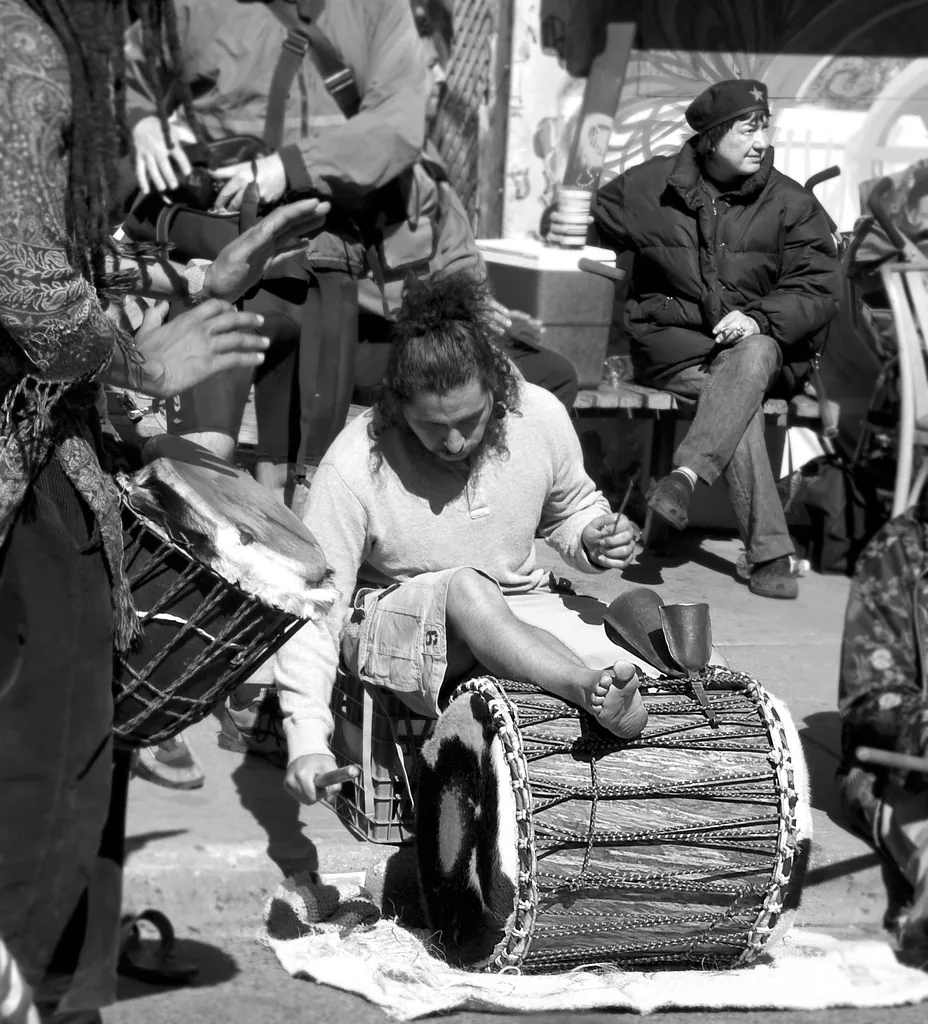
Actionable terms: drum circle (group workshop), ensemble (group formation), and band (stage group). Examples: “I play the djembe in a drum circle.” “We’re a percussion ensemble.” “Our band has drums, bass and djembe.”
| Term | Translation | Context |
|---|---|---|
| West African drum | Tambour ouest-africain | Instrument description |
| Drum / Drums | Tambour / Batterie | Rehearsal, stage |
| Percussion | Percussion (family) | Announcement, festival listing |
| Drum circle / Ensemble / Band | Cercle / Formation / Groupe | Workshop / concert / association |
Knowing these specific terms improves your understanding of announcements and makes international exchanges easier. For a more complete list, see the list of English music terms.
Djembe Playing Glossary: Actions, Techniques, and Rehearsal Instructions
In rehearsal, some English verbs become essential for describing musical action. Here is a practical mini-glossary designed for the stage, workshops, and the studio.
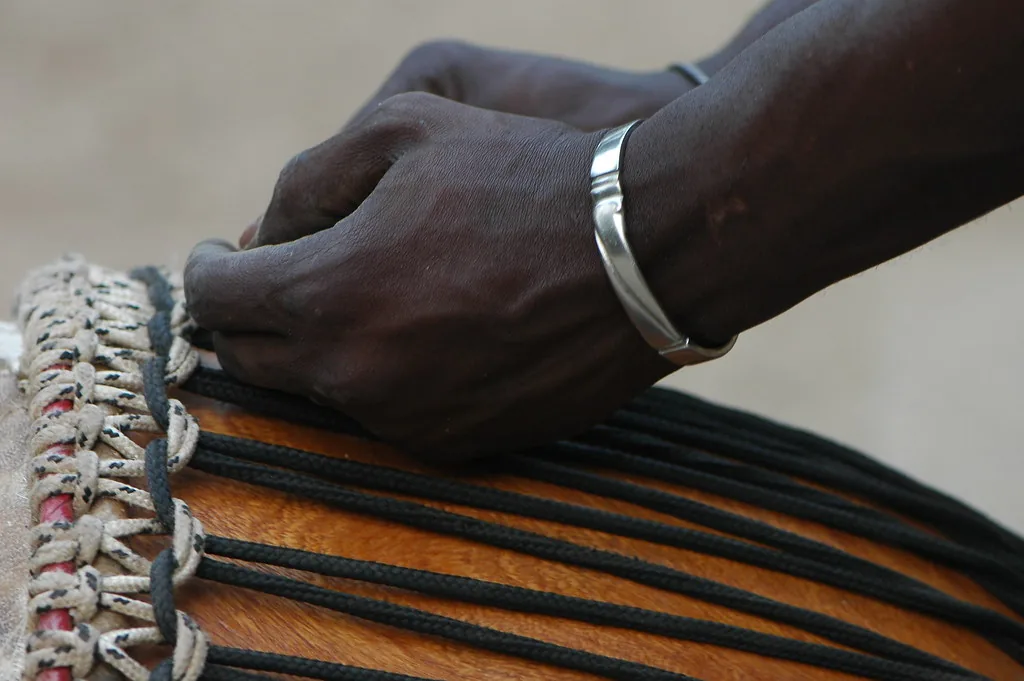
Essential Verbs
- to play — jouer
- to hit / to strike — frapper
- to clap — taper des mains
- to accent — accentuer
- to practice — s’exercer
- to rehearse — répéter (avec un groupe)
Improvisation and Live Playing
To improvise (improviser), to jam (faire une jam session), groove, and riff are often used in sessions. Example: “Let’s jam in E minor” — useful even if the instrument is not tonal in the strict sense.
“Practice slowly with a metronome.” — a typical workshop instruction.
| Term | Translation | Context |
|---|---|---|
| warm up | s’échauffer | before rehearsal: hands, wrists, steadiness |
| gig | concert (slang) | informal announcement, calendar |
| to perform / on stage | se produire / sur scène | stage brief, soundcheck |
Useful expressions: play it by ear (jouer à l’oreille) and, as a cultural nod, march to the beat of your own drum. Mastering this musical vocabulary strengthens your rehearsal skills and makes communication easier in the English-speaking music world. To explore stage practices further, see this guide to dance and urban scenes: stage guide.
Understanding Rhythm in English: Essential Basics for Percussionists
Words that describe rhythm serve as quick reference points in workshops and live settings.
Rhythm describes the organization of durations. Beat is the regular pulse. Tempo indicates speed, and meter describes structure (e.g. 4/4, 3/4).
Practical examples: “Keep the beat”, “The tempo is faster”, “This rhythm is in 4/4 meter”. These phrases are used with acoustic instruments as much as with electronic music.
Dynamics and Nuance
Dynamics covers fortissimo, crescendo, and decrescendo — Italian-derived terms widely used in classical music. On a hand-played instrument, producing softer or more powerful sounds changes the color of the groove.
Common Structures
Verse, chorus, bridge, solo, and duet help you follow an arrangement. Useful cues: “Go to the chorus” or “Take a solo”.
“Count one-two-three-four and enter on the beat.”
| Term | Meaning | Use in rehearsal |
|---|---|---|
| Rhythm / Beat | Organization / Pulse | Keep the beat, lock with snare |
| Tempo / Meter | Speed / Time signature | Set tempo, count 4/4 |
| Fortissimo / Crescendo | Very loud / Increase | Dynamic change, build |
| Verse / Chorus | Couplet / Refrain | Go to chorus, repeat verse |
Instruments to Know Around the Djembe
A good rehearsal exchange starts with clearly naming the instruments in the room. Here is a practical mini-glossary for holding a group conversation and reading a technical rider.
Commonly Mentioned Percussion
- snare drum = caisse claire
- bass drum = grosse caisse
- cymbal(s) = cymbales, conga, bongo drum, gong, maracas
Strings and Bowed Strings
guitar / acoustic guitar / electric guitar / bass guitar often structure the harmony around the rhythm.
violin, cello, double bass: the double bass is the largest and lowest-pitched bowed string instrument.
Woodwind, Brass, and Keyboards
Woodwind covers flute, clarinet, saxophone — the clarinet and saxophone use a single reed.
Brass: trumpet, trombone, (French) horn. Keys: piano, grand piano, and organ are often mentioned in the studio.
“On percussion: djembe and congas; on strings: bass guitar; on woodwind: clarinet; on brass: trumpet; on keys: piano.”
| Family | English | French |
|---|---|---|
| Percussion | snare, bass drum, conga, cymbal | caisse claire, grosse caisse, conga, cymbales |
| Strings | guitar, bass guitar, violin | guitare, basse, violon |
| Woodwind / Brass | clarinet, saxophone, trumpet | clarinette, saxophone, trompette |
| Keyboards | piano, grand piano, organ | piano, piano à queue, orgue |
In announcements, drums, guitar, bass, piano, trumpet often come up. For courses or workshops related to percussion and world rhythms, also see courses and workshops.
Electronic Music and Studio Work: The English Vocabulary That Goes with Percussion
In the studio or on a hybrid stage, production vocabulary quickly becomes central for a percussionist.
Synthesizer (synthétiseur), drum machine (boîte à rythmes), and sampler (échantillonneur) are key tools. For example, you can layer an electronic pattern over a djembe take to create a hybrid groove.
Recording and Producing
To record: capture a clean take with a well-placed microphone. To produce: organize the tracks and prepare the piece for mixing.
Audio Post-Production
To edit = cut and tighten a track. To mix = balance volumes and spaces. To master = finalize for release.
DJing and Live Electronics
Turntable, deck, and loop are often used in a set. A percussionist can play over a loop or trigger loops live.
In the professional world, distinguish the musician’s language (playing) from production language (record/mix/master). These words are often used in tutorials, plugin sheets, and studio discussions. Understanding both worlds helps you collaborate better with a sound engineer or DJ.
| Term | Translation | Use |
|---|---|---|
| synthesizer | synthétiseur | texture, pads, bass |
| drum machine | boîte à rythmes | pattern, electronic beat |
| sampler | échantillonneur | playing/triggering takes |
| microphone / to record | micro / enregistrer | take, placement, isolation |
| to mix / to master | mix / mastering | balance, release preparation |
Musical Genres and Use Contexts: Where the Djembe Can Fit
Knowing how to name musical styles helps you position your playing within a project.
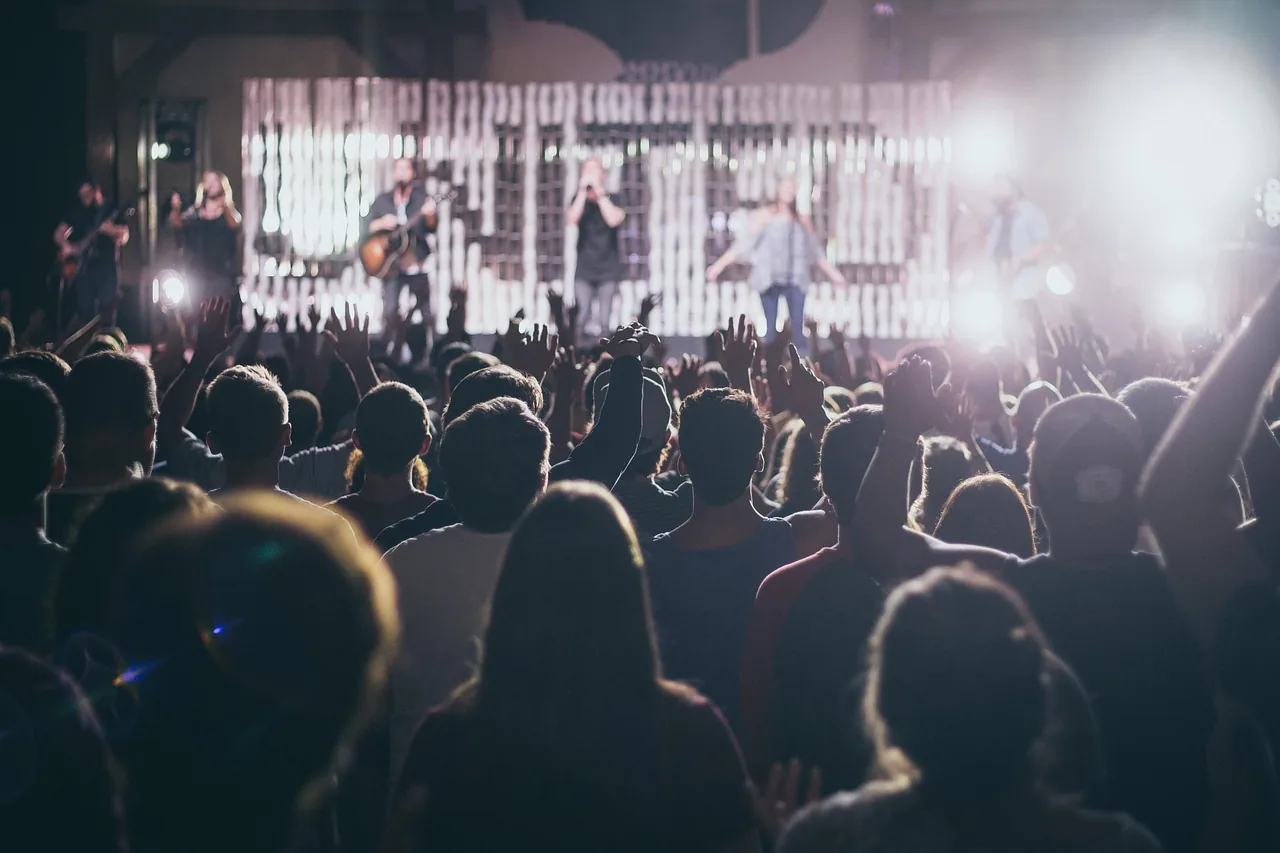
Here is a useful mini-repertoire for reading an announcement or describing a style. Style names are often transparent: rock, pop, reggae, funk, soul.
Essential Genres
classical, jazz, rock, pop, electronic — these styles call for different approaches.
In rock/pop, the contribution is textural: precise hits, accents. In jazz, color and dynamics matter. In electronic music, the playing can blend with loops or electronics. Even contemporary music sometimes incorporates acoustic percussion.
Hybrid and World Scenes
world, reggae, funk, soul offer spaces where groove and timbral identity are central.
“I play djembe in world and funk contexts.” — model sentence to post on a profile.
Casting vocabulary: project, set, repertoire, arrangement, line-up (guitar, bass, keys). These words help you understand an announcement such as “percussionist needed for world/reggae project”.
| Genre (EN) | Genre (FR) | Instrument role | Example announcement |
|---|---|---|---|
| Rock / Pop | Rock / Pop | Textures, accents | “Percussionist for pop set” |
| Jazz | Jazz | Colors, dynamics | “Percussionist for jazz quartet” |
| Electronic | Électronique | Hybrid with loops | “Live percussion with electronics” |
| World / Funk / Reggae | Musique du monde / Funk / Reggae | Groove, pulse | “Percussionist needed for world/reggae project” |
To explore other repertoires and historical instruments, see the instrument directory on early-instrument directory.
Conclusion
Mastering a few key words makes it easier to enter an international music project.
With this glossary, a percussionist can name their instrument, follow rehearsal instructions, talk about rhythm and intensity, and communicate on stage or in the studio.
Remember the logical thread: (1) instrument and family, (2) action verbs, (3) rhythm, (4) neighboring instruments, (5) electronic production, (6) genres and contexts. Learn by situation (rehearsal, session, concert, studio) to anchor the words quickly.
Practical mini-checklist: say “I’m a percussionist”, ask “Can you repeat that?”, adjust the tempo (“slower”/”faster”), and confirm a date (“We have a gig”).
This foundation helps with playing, music-related professions, and cultural communication alike.