Exploring the history of music helps us understand the roots of many musical styles and appreciate our present-day culture even more. Medieval music is a perfect example. In this article, we will explore the fascinating world of vocal, religious, and secular compositions from this historical period.
The Origins and Styles of Medieval Music
Medieval music covers a vast period from the 5th century to the end of the 15th century. This era saw the birth of several musical forms that greatly influenced the development of Western music. These forms include:
- Plainchant (also called Gregorian chant) : this was the earliest form of Christian religious music. This style of monodic singing consists of a single melodic line, without instrumental accompaniment.
- Polyphonic music : more elaborate than Gregorian chant, polyphony is characterized by the combination of several independent voices, creating complex harmonies.
- Secular music : in contrast to religious music, it deals with everyday and worldly subjects such as love, war, or nature. Troubadours and trouveres were the main representatives of this musical form.
Medieval Instruments and Performers
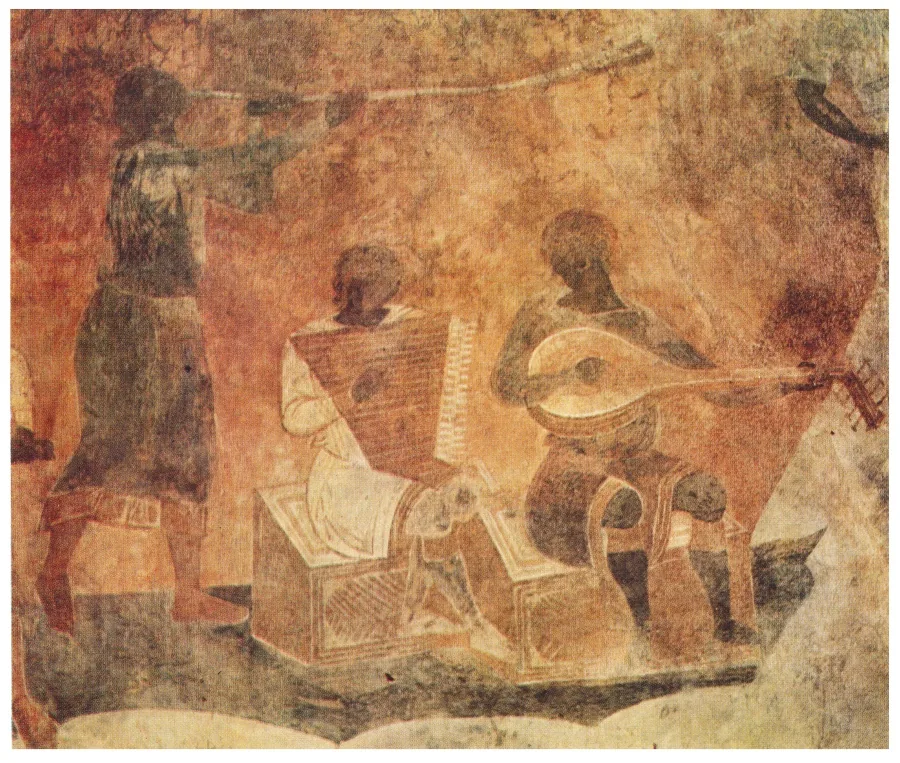
Although vocal music predominated in the medieval period, several instruments were also used to accompany songs or play instrumental pieces. Some of these instruments have disappeared today, while others are still in use. Here are a few examples:
- The vielle : an ancestor of the violin, this bowed string instrument was very popular in the Middle Ages. It existed in different sizes and shapes, making it possible to play a varied repertoire.
- The recorder : a wind instrument in the woodwind family, it was made from different materials such as wood, ivory, or bone. The recorder is still used today, especially in music education.
- The lute : a cousin of the guitar, this beautiful plucked-string instrument was especially prized by both professional and amateur musicians.
As for performers, they could be clerics, monks, minstrels, troubadours, or trouveres. The latter two groups were especially known for their role as poet-composer-performers and for their courtly love songs.
The Evolution of Musical Notation
Musical notation underwent major changes during the Middle Ages. Initially, melodies were passed down orally, and there was no universal notation system. However, from the 9th century onward, neumes (signs placed above syllables) began to be used to indicate the pitch and duration of notes.
The Development of Square Notation
After several centuries of evolution, neumatic notation gradually gave way to square notation, also called Gregorian notation. This system is characterized by the use of geometric shapes (squares, diamonds, hooks) to represent notes on a four-line staff. This type of notation greatly facilitated the reading and learning of liturgical chants.
The Invention of Mensural Notation
Finally, toward the end of the 13th century, mensural notation appeared, making it possible to represent the duration of notes and rests precisely. This major innovation paved the way for polyphonic music and increasingly complex rhythmic structures.
The Main Composers of the Middle Ages
Many composers left their mark on medieval music through their creative genius and technical innovations. Among the most famous are:
- Leonin (c. 1150-c. 1201) : this French composer is considered one of the founders of Western polyphony. He worked mainly at Notre-Dame Cathedral in Paris and developed the style called “organum,” a precursor of polyphony.
- Perotin (c. 1170-c. 1236) : a pupil of Leonin, he continued his master’s research by developing polyphony and introducing rhythmic innovations. He is notably credited with composing the famous “Viderunt Omnes.”
- Guillaume de Machaut (c. 1300-1377) : a prolific poet and musician, he is one of the major figures of French secular music. His love songs and motets are characteristic of the refined polyphonic art of the period.
Other medieval composers, such as Hildegard von Bingen, Alfonso X el Sabio, and Francesco Landini, also contributed to the evolution of music in the Middle Ages.
Medieval music is a rich and varied period that laid the foundations for modern Western music. Whether vocal, instrumental, religious, or secular, this era offers us a genuine musical treasure to rediscover again and again.
Now that you know what the music played in the Middle Ages is called, why not study the forms that marked this era ? You may be surprised by the titles you come across.