This guide helps you choose a djembe suited to children. It explains why size affects sound, volume, portability and price.
Goal: to provide clear reference points — dimensions, weight, materials and tuning stability — so you can make the right choice.
Quick mini-checklist: can the child place the shell between the knees without raising the shoulders? Is the rim smooth? Does the instrument slip?
Three basic sounds to aim for when learning: bass, tone, slap. These teaching markers guide the choice of model and make the first exercises easier.
On the market, you will find very light synthetic models that are durable and easy to carry, as well as livelier handmade models with goatskin heads.
The rest of the article details sizes by age, the impact on projection, safety points, materials and budget in France, then offers advice on choosing a djembe and first learning steps.
Why a child-friendly djembe changes everything
Choosing an ergonomic model changes the way a child discovers music. A well-proportioned instrument makes posture easier, reduces fatigue and makes sessions shorter and more effective.
An instrument that develops rhythm, coordination and confidence
Playing supports rhythmic awareness: a steady pulse, right-hand/left-hand alternation, listening and memorizing simple patterns. These simple gestures structure memory and attention.
With the right ergonomics, the child strikes without tension. They distinguish bass, tone and slap more clearly. The result: faster progress and greater confidence.
Group playing strengthens the response/listening dynamic. In a workshop, a responsive sound motivates pupils and creates real shared enjoyment.
Common mistakes when buying a small djembe
Classic traps: choosing only the cheapest model, ignoring weight, accepting a head that is too loose or a poorly finished rim that irritates the skin.
Too small, the instrument limits bass and projection; too large, it causes fatigue and poor posture. Also consider the intended use: synthetic is practical outdoors, while natural skin offers more expression but needs care.
Promise: with a suitable model, the child progresses quickly, enjoys playing and keeps wanting to play.
Djembe for Children: Sizes, Safety and Learning Tips
Before buying, check three simple measurements that determine comfort and sound.
Measurements to check
On any product sheet, check the shell height, the head diameter (striking area) and the weight. These three elements indicate possible fatigue, playing area and projection.
Why height alone is not enough
Two instruments of the same height can respond very differently if the diameter varies. The diameter defines the useful area for bass, tone and slap.
Reference points by age and body shape
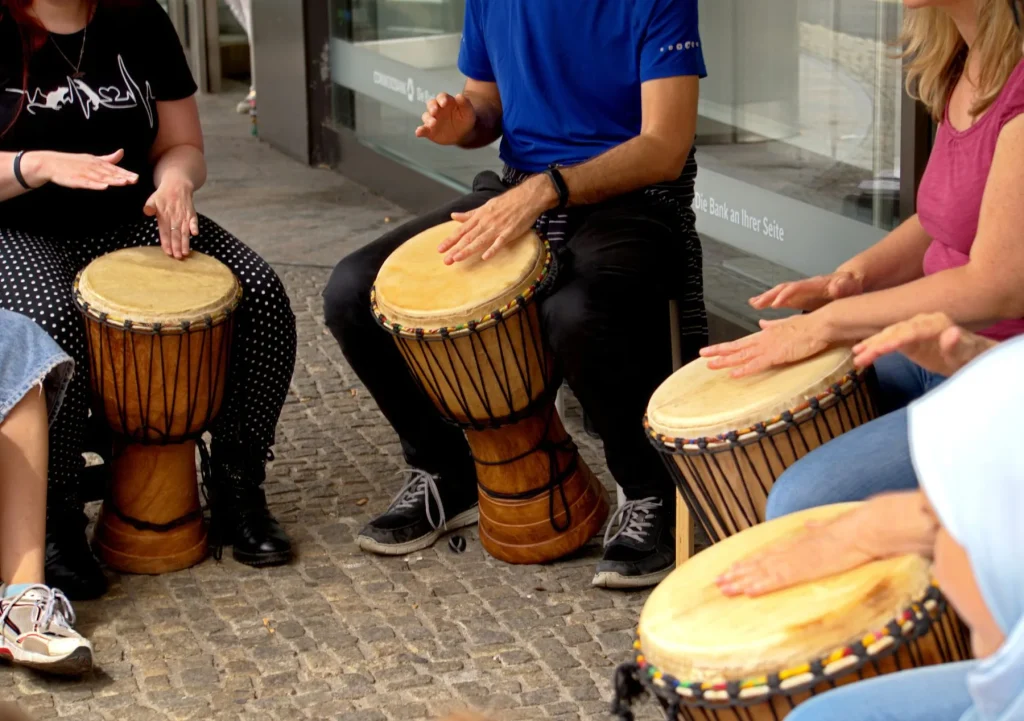
Aim for a model that fits between the knees and lets the hands fall naturally. No raised shoulders, wrists free.
Example of suitable craftsmanship
A common handmade model from Guinea measures 43–47 cm high, with a 22–24 cm head, and weighs around 2.5–4.5 kg. This is often a comfortable size in France.
Small, standard, large
Small = easy to handle, but limited projection. Standard = richer sound, but may be tall. Large = heavy and bulky, often unsuitable.
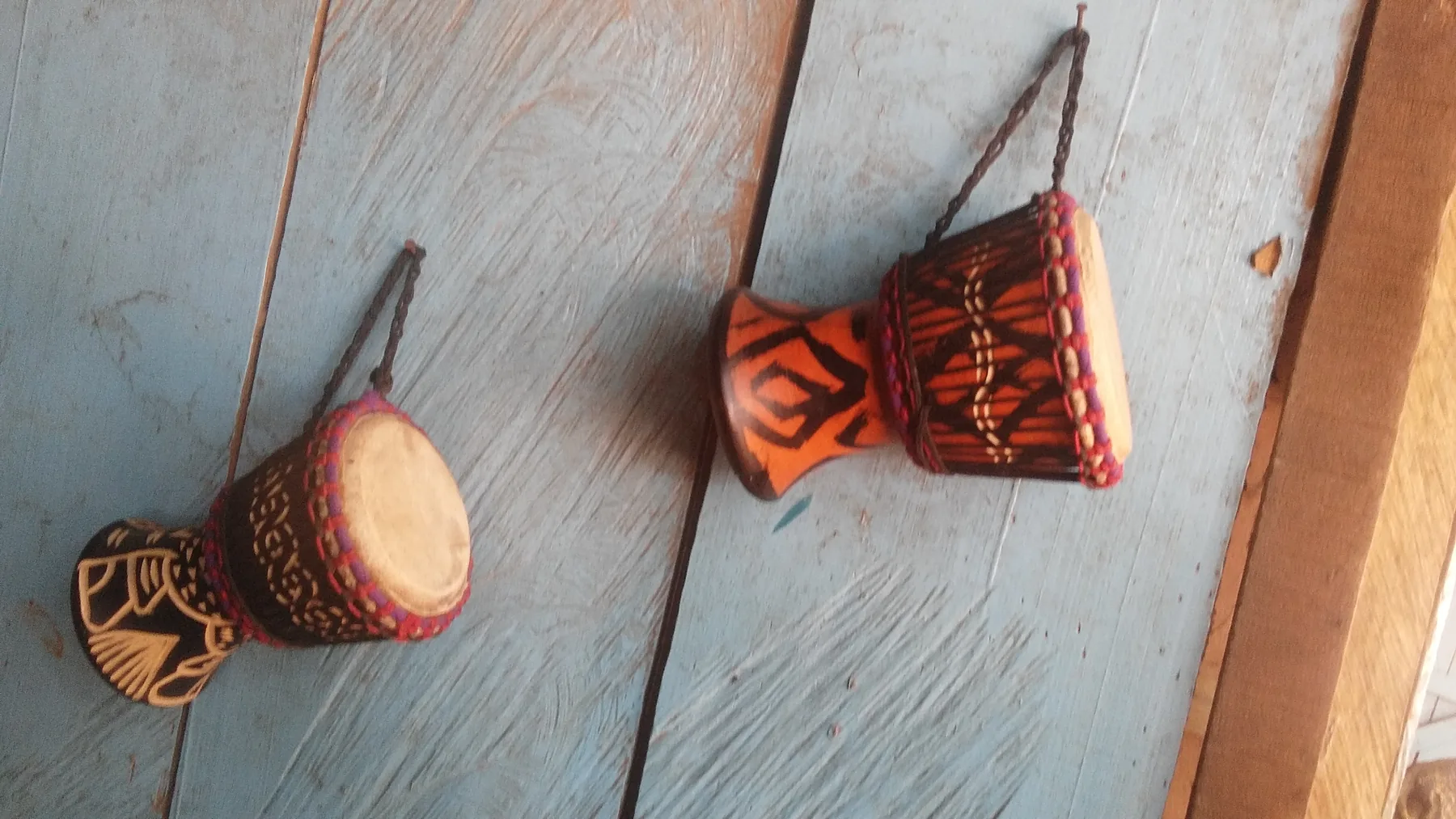
Quick comfort checklist: relaxed shoulders, free wrists, non-aggressive rim, stability without rotation, possibility of playing for 10–15 minutes without discomfort.
Buying tip: if you hesitate between two sizes, favor the one that improves posture and stability rather than the one that makes the most noise. For more information on warranty and use, see this useful page on frequently asked questions.
How djembe size affects tone and projection
The size of the instrument directly determines its range and sonic impact.
Deeper bass on larger shells, brighter highs on smaller ones
Size → range relationship: the larger the shell and head surface, the fuller the bass. Smaller models emphasize attacks and higher tones.
Practical consequence: a large format will produce a rich bass, useful for carrying the rhythm outdoors. A small format favors precision in fast strokes.
Indoor vs outdoor projection: what volume for what use
Outdoors, projection matters: a larger model keeps the rhythm clear against ambient noise.
At home or in a small group, a compact format is often enough. It limits volume and remains more comfortable for those nearby.
Resonance and responsiveness: nuance, fast rhythms and stroke control
A large shell offers longer resonance and a wider palette of nuances. It sometimes requires more strength to control the stroke.
Smaller models respond faster. They help the hand perform short, precise patterns without excessive effort.
“A good size lets you distinguish bass, tone and slap without forcing.”
Choose according to use: solo at home, workshops, lessons or a small ensemble. The balance between volume and comfort guides the choice.
| Format | Dominant sound | Projection | Recommended use |
|---|---|---|---|
| Small | Clear highs and attacks | Low to moderate | Home, fast rhythms, workshops |
| Medium | Balanced (bass/tone/slap) | Moderate | Versatile: lessons, small groups |
| Large | Rich, deep bass | Strong | Outdoors, workshops, large ensembles |
Tone also depends on the head, shell material and tension. For details on suitable models and recommendations in France, see this dedicated page.
Safety and playing comfort for children
Playing comfort rests on three simple points: position, finish and head adjustment. These elements limit irritation, reduce fatigue and encourage the pleasure of playing.
Stability and posture
Place the instrument tilted between the knees so the cavity remains open. If the angle is too upright, the sound becomes choked and the object may slip.
Check the base: pads, rings or a stand stabilize the instrument during long workshops. Good friction on the thighs prevents rotation.
Wood finish and head tension
Rounded edges and smooth varnish prevent splinters and irritation on the forearms. Check the condition of the wood before buying.
Head tension affects the stroke: a loose membrane encourages hitting harder, which causes fatigue. Excessive tension makes the surface hard and uncomfortable.
Physical effort and good practice
Favor short, regular sessions with breaks. This protects the joints and keeps the child interested.
Use relaxed hands and a bouncing stroke rather than brute force. Controlled volume preserves sound quality and arm strength.
- Mini-checklist before buying: no splinters, even tension, solid ropes, shell stability.
- Goal: a safe and comfortable instrument lets the child focus on rhythm rather than discomfort.
For practical answers on warranty or workshop use, see the frequently asked questions.
Materials and quality: wood, head, ropes and durability
The nature of the materials very often determines an instrument’s longevity and sound.
What makes quality: shell material, head quality, evenness of tension and overall finish. These elements influence timbre, weight and tuning stability.
Natural goatskin: lively sound and care
The skin offers a lively grain and rich dynamics. It gives warmer bass and more nuanced slaps.
Important: natural skin reacts to humidity and temperature. Store the instrument in a dry place and avoid sudden changes to preserve its quality.
Synthetic head: stability and resistance
Synthetic membranes stay in tune longer. They suit schools, workshops and outdoor sessions well.
Practical and low-maintenance, this option keeps a consistent sound in every season.
Wood shell (gmelina) vs ABS/plastic
Wood, such as gmelina, brings an organic timbre and a good weight/durability balance. ABS shells are lighter and very resistant.
For group use or frequent transport, plastic models are often recommended.
Rope tension and points to check
Check the lacing: even tension, no wear, clean knots and the possibility of retuning. Regular rope tension ensures reliable tuning stability.
Before buying, look at photos of the rim, lacing details, weight and dimensions on the site. Consider recognized brands (Meinl, Toca, Nino, Afroton, Terre) depending on whether you want synthetic durability or wooden craftsmanship.
Budget and value for money: how much to plan in France
Before buying, define the use: occasional discovery or regular practice. This choice guides the budget and points you toward practical models or more refined pieces.
General price ranges in France: entry level under €120 (compact, synthetic), mid-range €120–300 (better tuning stability, more worked skin), handmade pieces and large shells €300 and above (unique pieces, natural skin).
What you pay for as the budget rises
The higher you go, the more quality you gain: richer skin, tuning stability, safer finishes and durability. Transport and weight also increase: some large models exceed 10 kg.
Examples and factors that vary
Useful entry-level examples: Meinl Junior (~€52), Toca 7″ (~€55), Nino (~€62). These models are durable, easy to carry and well suited to workshops.
| Range | Indicative price | Main advantage | Recommended use |
|---|---|---|---|
| Entry | <€120 | Durability, lightness | Discovery, workshops, outdoors |
| Mid-range | €120–300 | Tuning stability, richer sound | Regular lessons, progress |
| Handmade | >€300 | Unique piece, natural skin | Concerts, long-term use |
- Factors that change the price: size, wood species, natural vs synthetic head, lacing quality, finishes and transport costs.
- Hidden costs: case, natural-skin care, bulk and transport.
“If the child takes regular lessons, investing in a better-quality model optimizes progress and long-term use.”
Simple advice: a well-finished, suitable mid-budget instrument is better than a large, imposing model that is difficult to play. To complete your choice, also see this useful article on equipment and transport.
Learning tips: starting djembe well as a child
The most effective method remains simple: three sounds, a neutral posture and brief repetitions.
The basic sounds to practice
Bass: strike the center for a deep sound. Tone: hand near the rim for a clear sound. Slap: lively attack near the rim with rebound.
Simple rhythms and progression
Start by distinguishing the three sounds before any complex pattern.
Set up short sessions (8–12 minutes), three times a week. Concrete goal: hold a simple pulse for 1 minute.
Managing skin and tension
Natural skin: sensitive to humidity, it can lose tension (duller sound); readjust the ropes or store the instrument in a dry place.
- Hand placement: center = bass, rim = tone/slap; let the head rebound.
- Warm up the wrists, keep volume moderate, pause if pain appears.
- Playing in a group strengthens listening and regularity.
| Approximate age | Session length | Goal |
|---|---|---|
| 3–5 years | 5–10 min | Produce 3 distinct sounds |
| 6–9 years | 10–15 min | Hold a pulse for 1 min, simple patterns |
| 10+ years | 15–25 min | Rhythmic variations, group playing |
“Recording a short sequence each week helps track progress and maintain motivation.”
For beginner and equipment resources, see this useful article: which tongue drum to choose.
Conclusion
In short, these quick reference points simplify the selection of the right instrument.
Remember five clear criteria: a comfortable size, portable weight, safe finish, materials suited to the intended use, and a coherent budget.
Handmade reference point: ~43–47 cm high, 22–24 cm head, 2.5–4.5 kg. This format is often suitable for ages 6–10.
Impact of size on tone: large = bass and projection; small = responsiveness and highs. Choose according to use: home, workshop or outdoors.
Before buying, check stability on the knees, non-aggressive edges, even tension and a clear product sheet on the site.
Select 2–3 models, compare dimensions, weight, materials and price; prioritize comfort and playing pleasure. A child with a suitable instrument progresses better and plays more often.