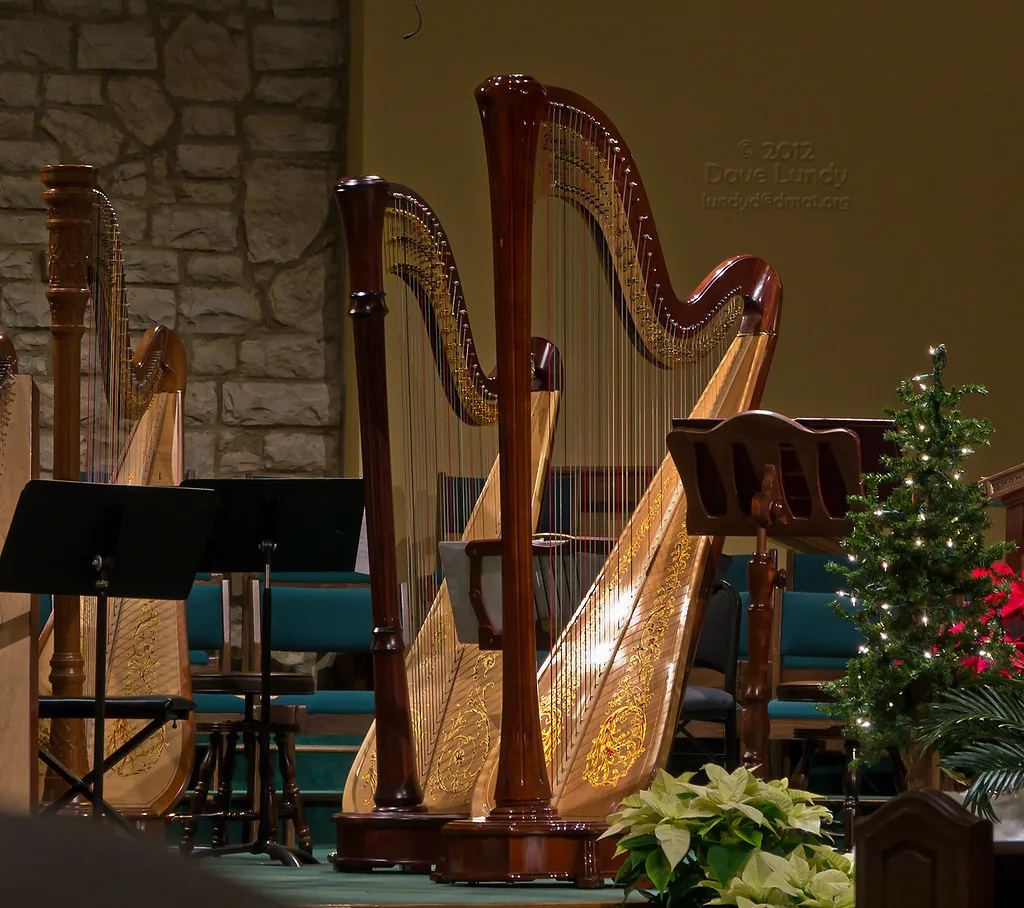
The harp is a fascinating instrument, used for centuries in many cultures. Its elegance and enchanting sound captivate music lovers around the world.
Depending on the model, the number of strings varies considerably. Celtic, pedal, and chromatic versions offer different configurations suited to each musical style.
To make playing easier, some models include colored markers. C notes are often marked in red, while F notes appear in blue. These details make learning more intuitive.
This guide will reveal the technical specifics of this legendary instrument. You will also discover its rich history and its role in modern music.
Introduction to the harp
A symbol of grace and poetry, this triangular instrument has enchanted music lovers for millennia. Its slender outline and crystalline tones make it a jewel of music.
What is a harp?
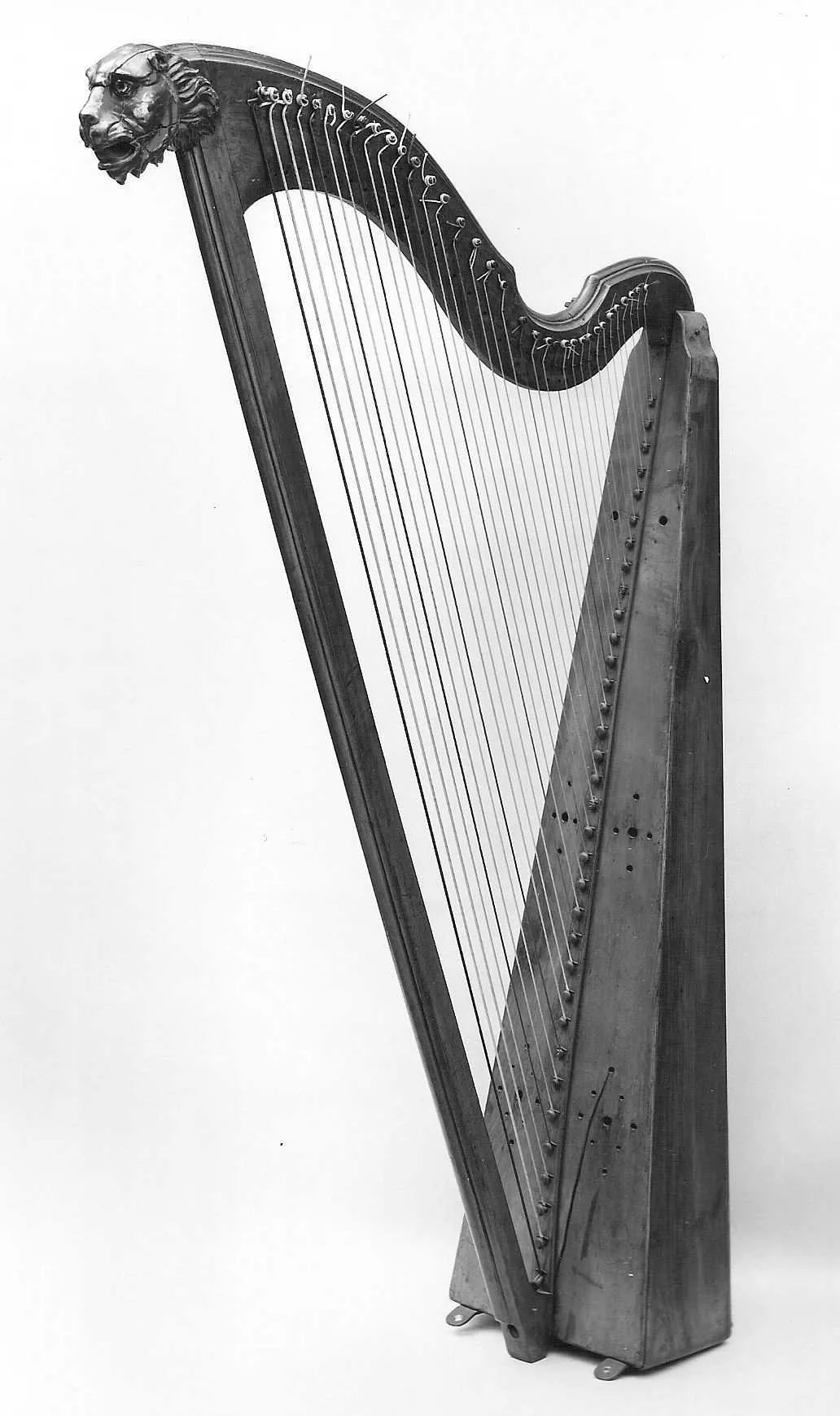
The harp is distinguished by its triangular shape, made up of three key elements:
- The column, which supports the structure
- The soundboard, which amplifies the sound
- The strings stretched between these two parts
First appearing in Mesopotamia around 3500 BCE, it evolved from the primitive musical bow. Unlike the lyre with its parallel uprights, its asymmetrical design allows for better resonance.
“The harp is a perfected musical bow, where each string sings like a celestial voice.”
The importance of strings in the harp
The strings are the vibrating soul of the instrument. Their number and material directly influence:
- The range (span of notes)
- The expressiveness of the playing
- The richness of the tone
Historically made of gut, they now also use nylon or metal. The major innovation was the Erard harp with its pedal system, which revolutionized its technical possibilities.
According to archives, the term “harp” appears 58 times in ancient texts, proof of its cultural importance across the centuries.
How many strings does a harp have?
Their number varies according to the model, influencing the range and the repertoire that can be played. From compact versions to concert models, each design answers specific artistic needs.
Variations by type
The Celtic harp, popular for its portability, generally has 34 strings. The bass uses metal-wound strings for deep resonance, while the treble uses nylon.
By contrast, the pedal harp, the star of orchestras, has 47. Its mechanical system allows instant alterations, expanding its expressive potential.
Concrete examples
- The troubadour harp, ideal for beginners, is limited to 22 nylon strings.
- Marc Brule’s “Phoenix” covers 5 octaves with 36 strings, blending tradition and modernity.
- Paraguayan versions (36 strings) and Andean versions (32 to 38) differ in weight and timbre.
“The Pleyel chromatic harp, with its double rows, was abandoned despite its ingenuity, as it was considered too complex for musicians.”
Tip: colored markers (red C, black F) make it easier to find your way around the model, especially for apprentice harpists.
The different types of harps
Models vary according to period and musical style. Some prioritize portability, while others focus on polyphony. Here are the main categories that have marked the history of this instrument.
The Celtic harp
Prized for its compact format, this version uses a Celtic mechanism with levers for semitones. Its 34 strings combine metal (bass) and nylon (treble), ideal for traditional melodies.
Medieval bards used it with metal strings, which produced a bright timbre. Today, it remains popular in folk music.
The pedal harp
Equipped with 47 strings, it dominates orchestras thanks to its Erard pedals. This system provides three pitches per string, making rapid alterations easier.
The double-action mechanism (invented in 1810) offers more nuance than the single-action system. However, its cost often reserves it for professionals.
| Type | Stringing | Mechanism | Use |
|---|---|---|---|
| Celtic | 34 (metal/nylon) | Levers | Traditional |
| Pedal | 47 (nylon/metal) | 7 pedals | Classical |
| Troubadour | 22 (nylon) | None | Beginners |
The chromatic harp
Uncommon today, it has two crossed planes of strings to cover every note. The rivalry between Pleyel and Erard shaped its development, although it is rare now.
Claude Debussy composed pieces suited to this system, but its complexity limited its adoption.
The troubadour harp
With only 22 nylon strings, it is the perfect choice for getting started. Its clean design and accessible price make it a favorite in music schools.
Electro-acoustic versions, such as those used by Alan Stivell, have helped bring it into modern genres.
“The pedal harp is a technical feat, but the Celtic harp captivates through its authenticity.”
History and evolution of the harp
The history of the harp is intertwined with that of civilizations. This instrument, born more than 5,000 years ago, has adapted to the needs of musicians and the artistic trends of each century.
Ancient origins
First appearing in Mesopotamia, it derives from the musical bow. The earliest versions had fewer than 10 gut strings. The Egyptians refined it by adding decorative columns.
In the Middle Ages, European bards used it to:
- Tell epic tales
- Accompany religious songs
- Animate royal courts
Development in Europe
The 18th century marked a turning point. Marie Antoinette popularized the harp at the court of Versailles, inspiring composers such as Naderman. Its repertoire expanded with dedicated pieces.
In 1804, Le Sueur’s opera Ossian used 12 harps in concert, a record for the time. Parisian luthiers innovated, including Sebastien Erard with his fork mechanism (1810).
Modern innovations
The 20th century saw the birth of the electric harp. Artists such as Casadesus brought it into jazz. Alan Stivell revived the Celtic harp in the 1970s, fusing tradition and modernity.
“The harp is a bridge between ages, able to sing ancient melodies as naturally as contemporary rhythms.”
Construction and mechanisms of the harp
The design of a harp rests on meticulous acoustic engineering. Every element, from the strings to the resonance body, influences its sound and playability.
String materials
Strings vary according to their register:
- Bass: wound metal for powerful vibration
- Middle: natural gut, valued for its warm sound
- Treble: nylon, stable despite temperature changes
Gut offers a velvety timbre, but requires frequent adjustment of the tension. Nylon, less sensitive to humidity, simplifies maintenance.
Role of pedals and levers
Pedal harps use a complex system:
- 7 pedals (one per note) operating forks
- Millimeter-level precision to alter semitones
- Optional 8th pedal adjusting the sound holes
This mechanism allows rapid modulations, essential for the classical repertoire.
Physical structure
The hollow column, often made of maple, amplifies vibrations. The curved body supports pressure equivalent to 500 kg, distributed across the instrument’s 34 kg.
Prices reflect this complexity: from €5,000 for a Celtic harp to €150,000 for a concert harp. A monthly check of the curvature preserves its integrity.
“A well-built harp is a balance between strength and lightness, where every gram counts for resonance.”
The harp in music
For centuries, this instrument has enchanted classical and contemporary melodies. Its role ranges from majestic symphonies to jazz improvisation, proving its adaptability.
Classical repertoire
Romantic composers magnified its capabilities. Berlioz includes 6 harps in his Symphonie fantastique, creating spellbinding effects.
Debussy explores the bisbigliando technique (rapid tremolo) in his pieces. Nearly 80% of concertos were written between 1780 and 1820, the golden age of the instrument.
Use in traditional music
The Celtic repertoire, especially that of O’Carolan (17th century), uses pentatonic notes. Andean versions adopt specific tunings for rituals.
Alan Stivell modernized these traditions with electro-acoustic playing. Bjork, meanwhile, fuses its timbre with electronic beats.
The harp in the orchestra
Essential in symphonic ensembles, it brings unique textures. Nino Rota uses it in the soundtrack of The Godfather for its intimate character.
Alice Coltrane and Deborah Henson-Conant revolutionized its use in jazz, proving its versatility.
| Genre | Artist/Work | Distinctive feature |
|---|---|---|
| Classical | Berlioz – Symphonie fantastique | 6 simultaneous harps |
| Celtic | O’Carolan | Medieval melodies |
| Cinema | Nino Rota – The Godfather | Dramatic atmosphere |
“The harp is the soul of the orchestra: it can whisper like a breeze or thunder like a storm.”
Playing techniques
Mastering this instrument requires a methodical approach. The positions of the hands and precise movements are essential for producing harmonious sounds.
Basic methods
Harpists generally use 4 to 5 fingers per hand. Traditional technique favors the pads of the fingers, while some Celtic styles use the nails to obtain a brighter tone.
Among the fundamental exercises:
- Arpeggios in E-flat major to work on fluidity
- Specific stretches from the Salzedo method
- Glissandos covering up to 2 octaves
Styles and variations
Modern playing incorporates innovations such as:
- MIDI pedals (L&H models)
- The “double left hand” technique for complex passages
- Rapid alternation between semitones
Beware of risky postures: poor positioning can cause tendinitis. Teachers recommend regular breaks during practice.
“The harp demands as much precision as a wind instrument, with the sensitivity of a violin.”
Choosing your harp
Between compact and professional models, today’s range satisfies every profile. Whether you are a beginner or an experienced harpist, several criteria guide your choice.
Criteria for beginners
For a beginner, ease of learning comes first. Teachers often recommend:
- A troubadour harp (22 nylon strings) for its light weight (1.20 m)
- A controlled budget: rental at €200/year with insurance
- Colored markers to identify notes quickly
Avoid decorative harps that cannot be tuned. Always test the resonance in A-flat before buying.
Options for professionals
Experienced harpists prefer high-end instruments. Salvi, Camac, and Lyon & Healy offer:
- 47-string models with pedal mechanisms
- Solid-body electric harps for amplified concerts
- A standard height of 1.80 m for optimal projection
Visit a specialized workshop such as La Richerais in Nantes to try different timbres.
| Model | Size | Average price | Where to try |
|---|---|---|---|
| Troubadour | 1.20 m | €1,500 | Magasin de la Harpe (Paris) |
| Camac Electro | 1.75 m | €12,000 | Approved workshops |
Maintenance and tuning
A well-maintained harp keeps its beautiful sound for decades. Regular maintenance preserves the quality of the materials and the accuracy of the notes.
Practical advice
Here are the essential steps for keeping your instrument in perfect condition:
- Check the surrounding humidity (ideally 40 to 50%)
- Clean the column with beeswax twice a year
- Avoid sudden changes in temperature
- Store it in a ventilated silk cover
Frequency and methods
Tuning requires specific tools: a T-shaped key and an electronic tuner. Professionals recommend:
- 2 weekly sessions for professional models
- 1 monthly tuning for student harps
- Replacing the strings every 18 months
| Element | Frequency | Required tools |
|---|---|---|
| Full tuning | 2 times/week | Tuner, key |
| Cleaning | 1 time/month | Microfiber cloth |
| Replacing a string | In case of damage | Round-nose pliers |
“An out-of-tune harp loses its soul. The musician’s ear must guide every adjustment.”
The harp today
The world of the harp is experiencing an unprecedented revival. This ancestral instrument now appeals to a varied audience, from classical music lovers to enthusiasts of contemporary sounds.
Popularity and current trends
The market shows impressive growth:
- +300% sales for Celtic harps since 2000
- Increased demand for hybrid electric models
- An explosion of tutorials on TikTok (#harpgoals)
Technological innovations are transforming practice:
- MIDI harp with built-in loop effects
- Connected learning apps
- Virtual concerts via streaming
Major figures on today’s scene
Some harpists are redefining the limits of the instrument:
- Xavier de Maistre – Virtuoso of the classical repertoires
- Lavinia Meijer – Pioneer of modern adaptations
- Alan Stivell – Ambassador of the electrified Celtic harp
“The harp is no longer confined to aristocratic salons: it now vibrates in clubs and on digital platforms.”
Dedicated festivals are enjoying growing success:
- Celtic Harp Meetings (Lorient)
- World Harp Congress (Edinburgh)
- Night of the Harp (Geneva)
The world record of 250 harpists playing together (Japan, 2019) illustrates this momentum. Prestigious schools, such as the CNSM in Paris, are training a new generation of virtuosos.
Conclusion
Between tradition and modernity, this instrument continues to captivate. Today’s models offer between 22 and 47 strings, suited to every level and every musical style.
Learning is becoming accessible thanks to monthly rentals. Many beginner harpists report rapid progress with suitable methods.
Whether for classical or contemporary music, the harp offers an infinite field of exploration. Let your passion guide you and explore AFHARP resources to get started.