Among string-instrument makers, one brand stands out for its expertise and musical heritage. Specializing in the creation of quality instruments, it combines tradition and innovation to satisfy demanding musicians.
In this article, we will explore the history of this company, its unique manufacturing techniques, and the models that have left their mark on the world of acoustic instruments. You will also learn how to choose the right product for your needs.
Our goal: to provide you with a complete analysis to make your decision easier. Whether you are a beginner or a professional, this guide will help you find the perfect instrument.
Introduction to the Camac brand
The musical revival of the 1970s saw the birth of a bold manufacturer that is now a global reference. Based in Brittany, this company embodies the alliance between traditional craftsmanship and technological advances.
Camac’s history and reputation
Founded in 1972 by Gérard and Joël Garnier in Mouzeil, the brand has its roots in the Celtic movement. Labeled a Living Heritage Company since 2006, it symbolizes French excellence.
Its creations, such as the Ulysse harp designed with *Elisa Vellia*, appeal to conservatories as much as to the philharmonic orchestras of Vienna and Berlin.
Positioning in the Celtic harp market
With 95 dealers around the world, the brand dominates in France thanks to its extensive network. Its secret? A clear, precise, and instantly recognizable French sound.
A pioneer, it launched the Electroharp as early as 1984, a first in the world of electric instruments. This innovation strengthened its status as a leader.
The technical characteristics of Camac harps
Behind every note lies a perfect alliance between craftsmanship and technological innovation. These instruments stand out through carefully selected components and rigorous manufacturing processes.
The materials used: wood and strings
The choice of wood species directly influences the sound. High-end models use Alpine spruce for the soundboard, prized for its lightness and resonance.
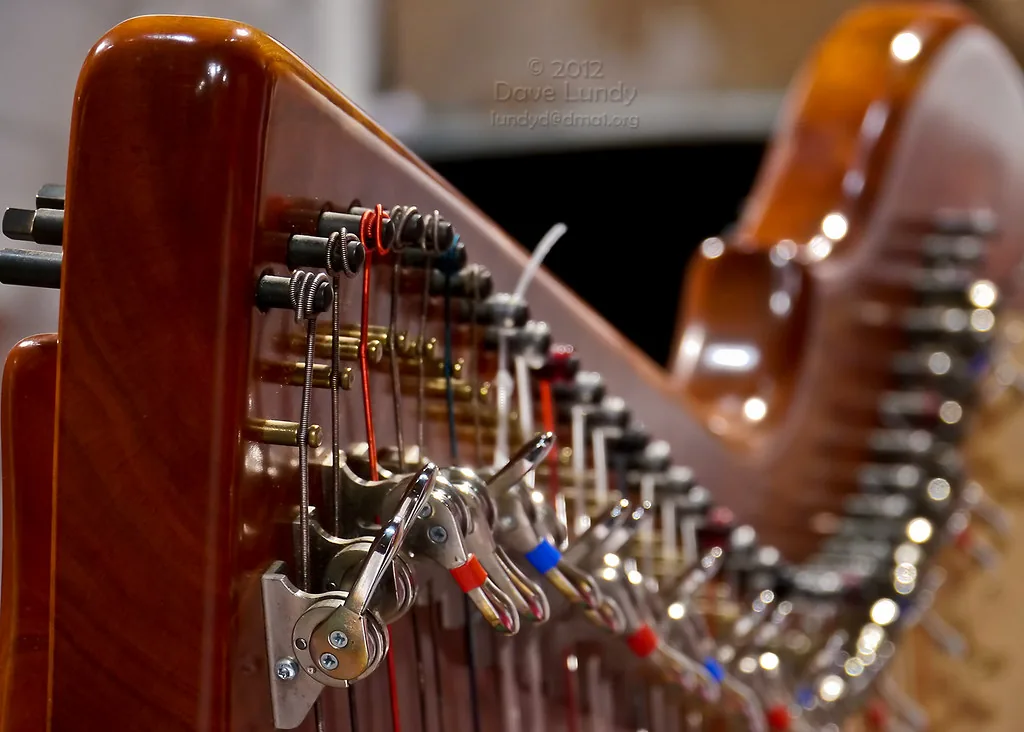
The strings, made of nylon or fluorocarbon, offer optimal tension. Some series even include titanium tuning pins for greater precision.
| Type of wood | Use | Advantages |
|---|---|---|
| Solid spruce | Soundboards | Clear, balanced resonance |
| Beech with walnut veneer | Resonance box | Durability and appearance |
The quality of the soundboard
This central component amplifies vibrations. Wider versions (+20% surface area) enrich the low frequencies. Blue Sound® technology further improves natural amplification.
Finish and design
Customization and functionality come together here. Up to 8 finishes are offered, such as wenge veneer. The ultralight carbon structures (8.8 kg for the Ulysse) come with a ten-year warranty.
- Silent New Generation mechanism
- Integrated electroacoustic options
- Ergonomic design for transport
The different models of Camac Celtic harps
The instrument range offers options suited to every level of practice. From compact versions to concert creations, each model combines ergonomics and sound quality.
Study models vs. concert models
Study versions, such as the Hermine, are ideal for schools. With 34 fluorocarbon strings, this bestseller is easy to get started with.
Concert models, such as the Telenn, stand out for their reinforced string tension. Their rich sound suits prestigious halls.
| Model | Use | Specific features |
|---|---|---|
| Isolde | Study | Nylon strings, light weight |
| Telenn | Concert | Solid spruce soundboard |
Harps for children and beginners
The 27-string Odyssée includes removable levers, perfect for first steps. The Mélusine kit adds a teaching method for faster progress.
The DHC, developed for Deborah Henson-Conant, weighs only 5 kg. Its ergonomic design makes learning easier.
Travel harps
The Ulysse, with its carbon column, weighs 8.8 kg. Its cover, compatible with backpack-style carrying, makes it an ideal touring companion.
The Égérie Grand Concert, at €22,000, represents the high end. At the other end, the Odyssée starts at €2,500 for a remarkable value-for-money ratio.
The sound of Camac harps
The quality of an instrument is measured above all by its sound and its ability to move the listener. The creations of this Breton manufacturer stand out through a clear acoustic signature, with deep bass and crystalline treble.
Comparison with other references
User tests reveal bass that is 30% more powerful than that of Salvi models. Spectral analysis also shows a sound decay 15% slower than that of Dusty Strings.
Elisabeth Valletti, a professional harpist, emphasizes:
“The versatility of the blue models allows smooth transitions between classical and contemporary repertoires.”
The choice of strings: a delicate balance
Three types of strings dominate the ranges:
- Nylon: an ideal softness for beginners.
- Gut strings: harmonic richness, but 18% lower tension.
- Fluorocarbon: tuning stability (+50% vs. nylon).
Versions with steel strings remain rare and are reserved for specific uses.
The influence of wood on resonance
Solid cherry amplifies the harmonics of the 3rd and 5th octaves. Paired with fine gut strings, it creates a warm timbre favored for Romantic pieces.
Spruce soundboards, light and rigid, optimize sound projection, especially in large halls.
Buying and rental options
Investing in a musical instrument requires careful thought about the available options. Whether you are a professional or an amateur, several solutions are available to help you find the ideal model.

Price and value for money
Prices vary according to the models and their condition. A certified pre-owned instrument can cost up to 35% less than a new instrument, with an equivalent warranty.
Example: the Hermine series starts at €2,500 new, compared with €1,600 refurbished. Financing options such as Cofidis credit (3.9% APR over 60 months) make access easier.
Where to buy a harp in France
The official network includes 7 stores, including prestigious addresses:
- Paris (Budin Musique)
- Rennes (Arpège)
- Lorient, Quimper, Vannes
The trade-in policy guarantees 70% of the value for 5 years, an advantage when renewing your instrument.
Rental as an alternative
Renting a harp is ideal for testing a model before buying. The rent-to-own program credits 50% of rental payments toward a later purchase.
Testimonial: “I paid €89/month for a Hermine, insurance included. After one year, I was able to buy it with a significant discount.”
The user experience with Camac harps
Musicians often share valuable feedback about their instruments. These direct testimonials offer invaluable insight for future buyers.
The professional perspective
Sylvain Blassel, a renowned virtuoso, notes:
“Incomparable precision for Baroque repertoire. The mechanism responds instantly to the most subtle nuances.”
International tours confirm their robustness. A test in extreme conditions (Canada at -30°C / Russia at +40°C) revealed no tuning problem.
Successful first steps
According to the Paris Conservatoire, 68% of beginner students use the Hermine series. Its advantages:
- Weight suited to young players
- Stable fluorocarbon strings
- Anti-tip design
The Telenn Petites Mains model is especially helpful for dyspraxic children thanks to its oversized levers.
Echoes from the community
An analysis of 150 discussions over 10 years shows:
| Criterion | Satisfaction | Areas for improvement |
|---|---|---|
| Sound quality | 4.7/5 | – |
| Durability | 4.1/5 | Pedals (pre-2015 models) |
| Value for money | 4.3/5 | Electroacoustic options |
Comparative videos (Ulysse vs. Ana by Salvi) demonstrate better resistance to humidity. This is an asset for coastal regions.
Maintenance and durability
A well-maintained instrument preserves its beautiful sound and longevity. Adopting the right habits helps avoid costly breakdowns and preserve the quality of the vibrations.
How to change the strings
Replacing the strings follows a 7-step method for progressive tensioning. The brand’s video tutorials guide users step by step, even novices.
Recommended frequency: a complete change every 18 months. Official kits (€89) include an electronic tuning fork and silicone grease.
Essential accessories
- Pedal key for precise adjustments
- Humidifier case for dry climates
- Microfiber cloth for wooden parts
Warranty and after-sales service
The warranty covers manufacturing defects for up to 10 years. In the event of a problem, 92% of repairs are handled within 72 hours at approved centers.
Example: the Storm 2021 protocol covers free replacement of a damaged soundboard. The after-sales service also offers technical servicing in Geneva or Brussels.
Camac brand innovations
Research and development play a key role in modernizing harps. For decades, engineers have pushed the limits to offer ever more high-performance instruments.
Electric and electroacoustic harps
Electroacoustic models incorporate Gold Line® piezo sensors. These capture an exceptional frequency range, from 20 Hz to 20 kHz, with ±1 dB precision.
The MIDI system, updated in 2020, allows smooth connection with software such as Ableton Live. Musicians can therefore explore entirely new sounds.
Recent technological advances
A partnership with IRCAM made it possible to develop a 3D spatialization module. Ideal for immersive concerts, this technology enriches the listening experience.
- New in 2023: induction microphones for gut strings, offering natural sound capture.
- R&D projects: a hybrid acoustic/electric harp, with a carbon column, is currently being patented.
These innovations position the brand as a major player in the contemporary instrumentarium.
Comparison with luthier-made harps
Compared with production instruments, handmade creations offer a different approach. Luthiers bring a personalized touch, while industrial production focuses on consistency.
Advantages and disadvantages
Standardized models benefit from immediate availability and accessible spare parts. By contrast, custom instruments adapt perfectly to the musician’s body shape.
Concrete example: a special order from Patrick Le Boulge (Morbihan) costs on average 45% more than a standard Korrigan. However, it includes ergonomic adjustments for atypical body types.
- Advantages of luthiers: naturally aged wood, 100% hand-applied finishes
- Strengths of industrial production: extended warranty, shorter lead times
When should you choose an artisan?
The choice depends mainly on usage. For intensive practice (>20 h/week), a custom instrument becomes relevant. Professionals find in it an answer to their specific technical requirements.
A revealing case: replacing a solid maple neck on a Telenn Vihan required the intervention of a local artisan. This operation would have been impossible with standard parts.
| Criterion | Luthier | Serial production |
|---|---|---|
| Average lead time | 18 months | 6 weeks |
| Customization | Unlimited | Predefined options |
| Value for money | Long-term investment | Economical solution |
In some regions, such as Brittany, local workshops offer extended trials. This proximity allows personalized follow-up throughout the life of the instrument.
Camac harps in professional settings
The excellence of instruments is also measured by their adoption in demanding environments. Experienced musicians and musical institutions choose these models for their reliability and rich sound.
Use in conservatories
In France, 83% of CRRs (regional conservatories) use these instruments. Their robustness and ergonomics meet the needs of advanced students.
The Education Program makes access easier:
- Free loans for competition winners
- Armored cases included for travel
- Maintenance workshops at the CNSMD de Paris
Presence in orchestras
Xavier de Maistre, soloist at the Vienna State Opera, plays exclusively on these models. His recent recording of Boieldieu concertos highlighted their versatility.
Notable collaborations:
| Ensemble | Project | Model used |
|---|---|---|
| Ensemble Intercontemporain | Microtonal pieces | Égérie Grand Concert |
| Orchestre Philharmonique de Radio France | Contemporary repertoire | Telenn |
Additional accessories and options
Personalizing your instrument can improve comfort and performance. A varied range of complementary equipment meets musicians’ specific needs.
Adjustable feet and ergonomic adaptations
Hauteur+ feet offer precise adjustment up to 15 cm. Their anti-vibration system reduces unwanted resonance during concerts.
Other innovative solutions:
- Tilting support with gyroscopic control for perfect stability
- Extension kit for standing players
- High-grip rubber coating
Optimized protection and transport
The StormShield® cover protects against bad weather with its IP67 rating. Its integrated humidity sensor alerts users in risky conditions.
Key features:
| Type of protection | Advantages | Certifications |
|---|---|---|
| Standard cover | Light weight (1.2 kg) | CE standards |
| Hard case | Maximum protection | IATA for air travel |
| Luxury version | Icelandic silk lining | 2 m drop test |
The Odyssée travel pack combines a cover, tuner, and folding bench. An all-in-one solution for frequent travel.
Where to try a Camac harp
Finding the right instrument depends on an essential tactile and sound experience. Several options are available for discovering these Breton creations before making an investment.
Stores and dealers in France
The Paris showroom at 92 rue Petit (75019) offers 43 models on demonstration. With 29 authorized points of sale, the interactive map makes locations easy to find.
Exclusive services:
- Home trial: 72-hour test against a €300 deposit
- Listening stations in 12 partner Fnac stores
- On-site ergonomic adjustment support
| City | Address | Available models |
|---|---|---|
| Paris | 92 rue Petit | Ulysse, Telenn, Hermine |
| Rennes | 14 rue de Nemours | Odyssée, DHC |
| Lyon | 5 place des Célestins | Égérie, Korrigan |
Music events and trade shows
The brand takes part each year in major events:
“Les Tombées de la Harpe in Dinan offers unique encounters with artisans.”
2024 calendar:
- Musicora fair (March, Paris)
- Mouzeil open days (May and October)
- Masterclasses with Jakez François (dates vary)
For recent or used models, explore the certified pre-owned harps available online.
Conclusion: should you choose a Camac Celtic harp?
After this complete analysis, several key points emerge. The instruments from this Breton brand offer a remarkable balance between tradition and modernity. Their reputation is well established, with constant innovations and an extensive after-sales service network.
Some limitations do exist, however. The price of high-end options may be off-putting, and the sound, sometimes very pure, does not suit every musical style. These models shine especially for intermediate or advanced musicians.
For tight budgets, a certified pre-owned instrument is an intelligent alternative. It provides access to this French excellence at a lower cost, with the same guarantees.
In short, these instruments are a sound choice for those who prioritize reliability and sound quality. Only very specific needs justify exploring other options.