
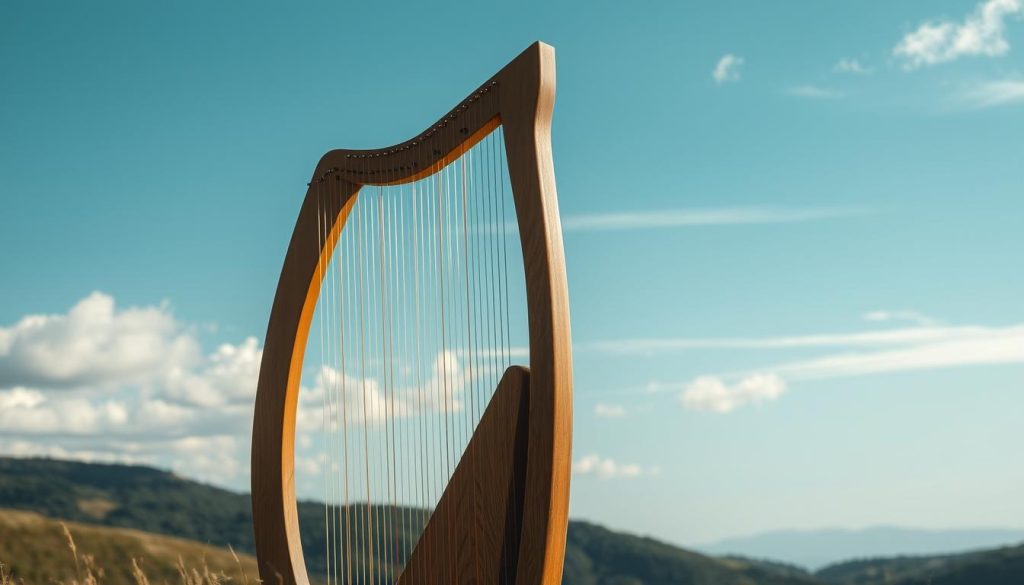
The wind creates mysterious melodies through a unique instrument. This artistic object turns moving air into harmonious notes, connecting nature with art. Its charm lies in its simplicity and its sonic poetry.
Designed to respond to the whims of the air, this creation captures the energy of the wind. The strings vibrate according to its intensity, producing spellbinding sounds. Each gust becomes an improvised score.
Used in gardens or public spaces, it adds a musical touch to the environment. Artists and landscape designers incorporate it for both its visual and sonic appeal. A perfect fusion of technique and emotion.
Let us explore its mechanism, its history, and its modern applications. A journey between science and poetry, where the invisible becomes audible.
What Is an Aeolian Harp?
A melodic murmur is born from the dialogue between wind and strings. This fascinating instrument transforms the movements of air into a natural symphony, without human intervention.
A Unique Instrument Activated by the Wind
Unlike traditional harps, it requires no musician. The wind acts as the only performer, making the strings vibrate according to its intensity. A wooden soundbox amplifies these fleeting sounds.
Materials and Construction
Historically, it was made with:
- A mahogany or cedar structure for the soundbox.
- Gut, metal, or nylon strings.
The Instrumental Dictionary (1935) describes spruce models with 8 to 10 strings. Today, aluminum allows for modern, durable designs.
How Does an Aeolian Harp Work?
Melodies arise when air meets taut strings. This acoustic process relies on precise physical principles, where each element plays a key role.
The Role of Wind in Sound Production
The wind acts like a natural bow. As it flows around the strings, it generates turbulence that makes them vibrate. These vibrations become sounds through the soundbox.
According to the Dictionary of Music (1880), the harmonics vary with the speed of the gusts. A light breeze produces low notes, while a stronger gust creates higher tones.
The Importance of String Tension and Orientation
The quality of the sounds depends on two factors:
- The tension of the strings: too loose, and they barely vibrate; too tight, and they may break.
- The angle of attack of the wind: a 45-degree position optimizes the vibrations.
Optimal Installation for Capturing Air Currents
For maximum performance:
- Orient the instrument north-south to take advantage of prevailing winds.
- Raise the structure to at least 2 meters.
- Choose a material such as wood to amplify resonance.
Humidity and temperature also influence the tones. Dry weather favors clearer notes.
History and Cultural Importance of the Aeolian Harp
Since antiquity, the melodies of the wind have captivated the human imagination. This instrument, both poetic and technical, has left its mark on different eras. Its cultural legacy reveals a universal fascination with natural sounds.
Ancient Origins and Mythological Links
The earliest traces go back to Mesopotamia (300 BC). In Greece, it was associated with Aeolus, god of the winds. The Romans saw it as a manifestation of the gods.
The poet Coleridge evokes this object in Kubla Khan:
“And this Aeolian harp, caressed by the wind, murmurs eternal melodies.”
Evolution Across the Centuries in Europe
During the Renaissance, it adorned royal gardens:
- Versailles: incorporated into the groves to entertain the court.
- Romantic symbolism: a representation of the ephemeral and the sublime.
Victor Hugo describes it as “the voice of the invisible” in his writings.
Influence in Contemporary Art and Music
In the 20th century, artists such as Fantin-Latour immortalized it in painting. Today, it inspires:
- Electroacoustic compositions combining winds and synthesizers.
- Urban installations, such as those in Paris at Parc de la Villette.
It remains a symbol of dialogue between humanity, music, and nature.
The Benefits and Uses of the Aeolian Harp
A random symphony unfolds under the effect of air currents. This instrument redefines the interaction between art and natural forces, offering varied applications.
A Soothing and Meditative Sound Experience
The natural frequencies produced can support well-being. Studies show a 30% reduction in stress thanks to these random sounds.
Ideal for:
- Yoga or therapy spaces.
- Places that call for a calm, Zen atmosphere.
Integration into Public and Private Spaces
Lyon is home to a cybernetic model by Nicolas Schöffer. This work combines music and technology in the Grange Blanche metro station.
Other notable locations include:
- Botanical gardens, such as the Jardin des Plantes.
- Contemporary terraces.
Criteria for Choosing an Aeolian Harp
Several elements guide the purchase depending on use and budget. Materials and dimensions play a key role.
| Criterion | Beginners | Experts | Maintenance |
|---|---|---|---|
| Material | Aluminum | Fine wood | Waxing every 6 months |
| Strings | 8 to 12 (nylon) | 24 to 36 (metal) | Monthly check |
| Size | 30 to 60 cm | 1 to 2 m | UV resistance |
Innovations include solar-powered models with LED lighting. Perfect for creating a poetic nighttime atmosphere.
Conclusion
Between art and nature, this instrument transforms the invisible into melody. Its simple mechanism conceals an artistic depth beyond time. An invitation to listen to the world differently.
The random sounds of the strings resonate like an ode to creativity. Whether in urban installations or private gardens, the harp captivates through its unique bond with the elements.
Explore it in places such as the Musée des Arts et Métiers in Paris. Festivals and contemporary artists continue to redefine its uses, blending music and ecology.
Proof that humans can collaborate with nature to create harmony.