
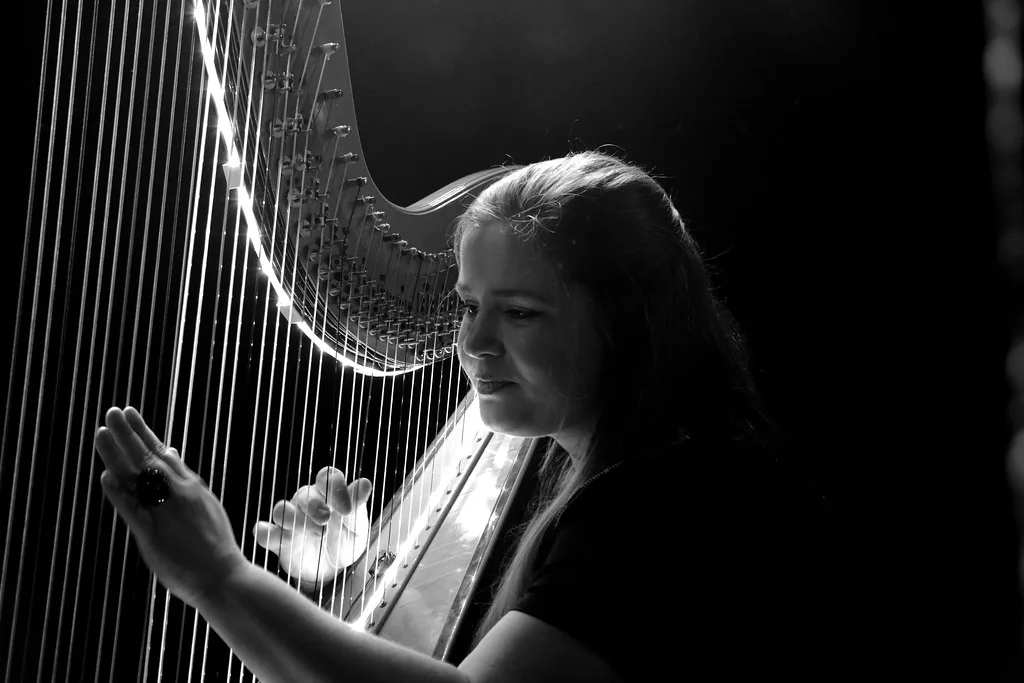
Since antiquity, this instrument with plucked strings has captivated listeners with its spellbinding tone. First appearing in Mesopotamia more than 5,000 years ago, the harp has evolved and been refined across the centuries.
Its complex mechanism allows for great expressiveness. Modern models offer a wide range of notes, ideal for introducing children from age 7 to music.
Nylon or gut strings produce crystal-clear sounds. Some models have 47 strings, covering up to six octaves according to historical sources.
We will examine the exact scope of its melodic and technical possibilities in detail in the following paragraphs.
Introduction to the harp and its range
Discovered in the royal tombs of Ur, the harp has fascinated people for millennia. This 5,000-year-old instrument was already a treasure in Mesopotamia. Its gut strings vibrated during sacred rituals.
In ancient Egypt, it symbolized connection with the gods. The Greeks associated it with Apollo, god of the arts. Its design evolved toward a triangular shape, better suited to art music.
The modern harp, with its 47 strings, incorporates ingenious pedals. These mechanisms allow notes to be modulated, giving it a range of six and a half octaves. Materials vary (nylon, metal) to create unique sounds.
Adopted by symphony orchestras, it shines through its polyphony. Its sparkling strings and complex pedals make it a majestic instrument, capable of exceptional nuance.
What is the range of the harp?
Composers value the harp for its remarkable compass. This instrument covers low and high notes with rare fluidity.
Definition of range
Range refers to the span of notes an instrument can play. For the harp, it extends from C1 to G#7, or 6.5 octaves.
Gut or nylon strings enhance this resonance, making it ideal for arpeggios.
The classical pedal harp
With 47 strings, the classical pedal harp allows alterations through an ingenious system. Created by Sébastien Érard in 1811, it adjusts semitones (flat, natural, sharp).
This versatility gives it a central role in orchestras.
Comparison with other instruments
Unlike the guitar (4 octaves), the harp rivals the piano through its harmonic richness. Here is a comparative analysis:
| Instrument | Range | Number of notes |
|---|---|---|
| Classical harp | 6.5 octaves | 47 strings |
| Piano | 7.25 octaves | 88 keys |
| Guitar | 4 octaves | 6 strings |
Despite having fewer notes than the piano, the harp excels through its natural resonance. Its open strings create sustained harmonies, a unique advantage.
The harp’s technical characteristics
Beneath its elegant appearance, the harp conceals sophisticated mechanics. Every detail, from the strings to the pedals, influences its tone and range.
The strings: materials and layout
The low strings (35) use wound metal for powerful resonance. The middle and high registers favor gut or nylon, offering crystal-clear notes.
Tension ranges from 700 to 1,500 newtons. This range ensures stability and expressiveness, especially in complex arpeggios.
The role of pedals in note modulation
The 7 pedals operate 1,400 mechanical parts. Inspired by Sébastien Érard, this system adjusts semitones via rotating discs.
This innovation preserves the integrity of the strings while expanding melodic possibilities.
The different types of harps and their ranges
The Pleyel chromatic harp (78 strings) exceeds standard models. At the opposite end, the Burmese harp (13 strings) embodies traditional restraint.
Electroacoustic models, such as the Camac, integrate MIDI sensors for modern sounds.
| Type of harp | Range | Specific features |
|---|---|---|
| Celtic harp | 4 octaves | Light, portable |
| Paraguayan harp | 3.5 octaves | Distinctive curve |
| Electroacoustic harp | 6 octaves | MIDI output |
These variations show how resonance and technique adapt to cultures and musical needs.
History and evolution of the harp
Across the ages, the harp has undergone spectacular transformations. Its rich and complex history reflects the technical and cultural advances of the civilizations that adopted it.

Ancient origins: from Mesopotamia to Egypt
The earliest traces go back to Mesopotamia, 5,000 years ago. These arched harps, 2 meters high, had fewer than 10 strings.
In Egypt, they adorned royal tombs. Their design evolved toward more compact models, symbolizing divine connection.
The evolution toward the modern harp
In the Middle Ages, the Gothic harp emerged with 28 strings. The Renaissance introduced the arpa doppia, capable of playing complex chords.
Marie Antoinette popularized the pedal harp in 1770. This model, tuned in B-flat, charmed European courts.
Major innovations: hooks, pedals and mechanisms
In 1811, Sébastien Érard revolutionized the instrument with the double-action harp. Its 47 strings and 7 pedals offered an extended range.
The 20th century saw the birth of the electroacoustic harp, such as the Camac model, which fuses tradition and technology.
- 1660: first Tyrolean hook harp.
- 1894: Pleyel chromatic harp (78 strings), abandoned in 1933.
- 1990: electric Celtic harp without a soundbox.
Conclusion: the importance of range in music
The harp stands out for its exceptional sonic span. This instrument offers a unique expressive palette, ideal for symphonic concerts. Its spellbinding glissandos enrich the classical and contemporary repertoire.
Electroacoustic models expand its possibilities. They fuse tradition and innovation, as this technical study shows. The wide range makes learning easier, while still demanding deep artistic mastery.
Rooted in Celtic and South American cultures, the harp remains a pillar of world music. Its melodic potential continues to inspire composers and performers.