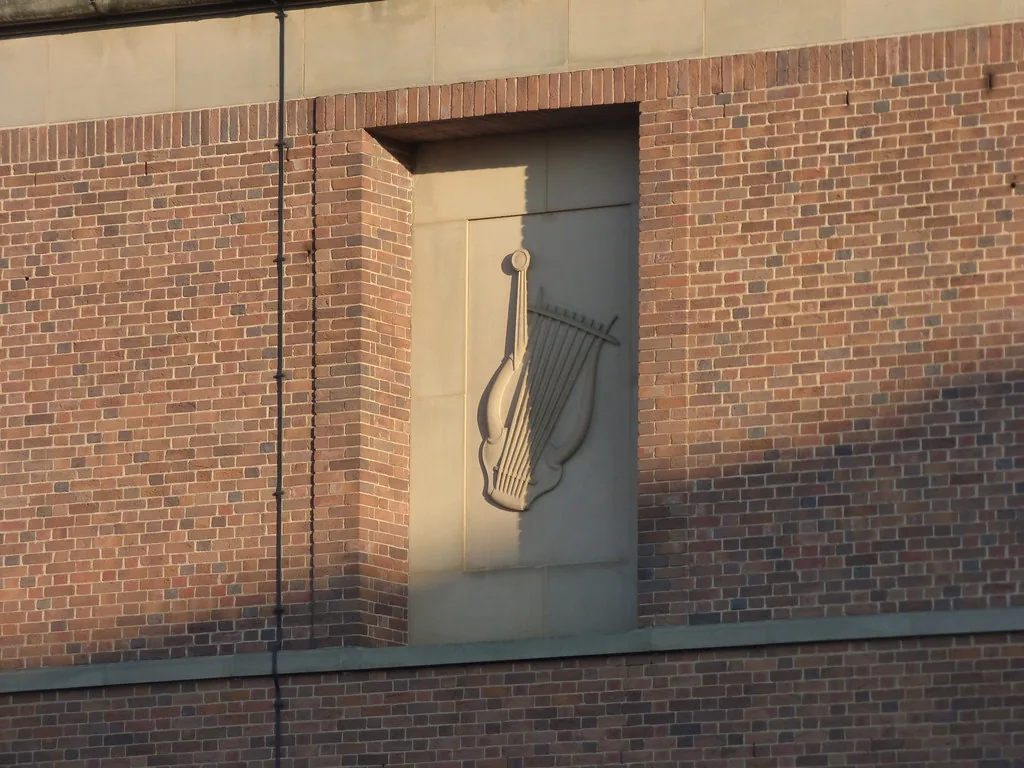
Since antiquity, two instruments with strings have captivated music lovers: the lyre and the harp. Their elegant silhouettes and enchanting sound have endured across the centuries.
Yet their visual resemblance often leads to confusion. These emblematic objects of ancient music share common traits, but conceal very distinct technical and historical features.
Used in Greek myths or Egyptian ceremonies, these vibrant strings carry rich symbolism. Their cultural role and unique construction deserve clarification.
This article explores their origins, playing techniques, and repertoires. Let us discover how to distinguish these jewels of musical heritage.
Introduction: two legendary string instruments
These mythical instruments have crossed eras with grace and mystery. Their unique construction and cultural role make them timeless symbols of music.
Definitions and historical contexts
The Greek lyre, used as early as the 5th century BC, is distinguished by its strings running parallel to the soundboard. It accompanied poets and banquets, embodying the art of its era.
The harp, by contrast, has radial strings. Its ancestor, the Babylonian harp-lyre, shows how these models evolved separately.
| Feature | Lyre | Harp |
|---|---|---|
| String alignment | Parallel | Radial |
| Size | Portable | Larger |
| Historical use | Recitations | Ceremonies |
Why are these instruments so often confused?
Their triangular frame and plucked strings create a visual resemblance. Mistakes found in medieval paintings have also fueled the confusion.
The musician’s hand uses similar techniques, reinforcing the ambiguity. Yet their mechanism and repertoire differ profoundly.
Origins and evolution of the lyre and the harp
The history of these instruments reveals fascinating paths. Each followed a unique course, shaped by technical innovations and distinct cultural uses.
The lyre in ancient Greece
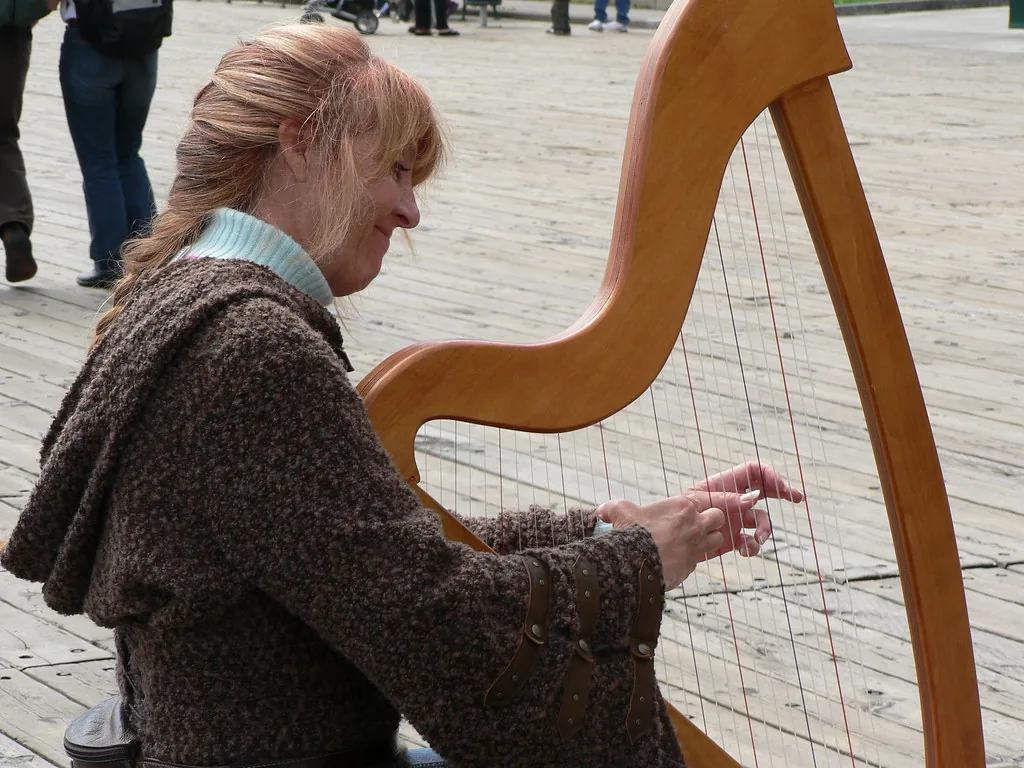
According to mythology, Hermes made the first lyre from a tortoise shell. This natural material, combined with gut strings, gave rise to a refined musical art.
Archaeologists have found traces of this instrument at the Delphi Museum. The cradle kithara, dating from 450 BC, shows the evolution of its form.
"The lyre becomes Apollo’s attribute, a symbol of poetry and divine music."
Over time, the number of strings increased from 5 to 8. This development made it possible to broaden its musical repertoire.
The harp, from ancient civilizations to the modern orchestra
Unlike the lyre, the harp uses a more complex structure. The Babylonians were already carving this instrument from solid wood.
| Aspect | Ancient lyre | Ancient harp |
|---|---|---|
| Main material | Shell | Wood |
| Number of strings | 5-8 | 10-15 |
| Use | Poetry | Ceremonies |
The 19th century marked a turning point with the invention of pedals. This metal system allowed the modern harp to enter symphony orchestras.
Find more information about the detailed history of the lyre and its variations through the ages.
The lyre and the harp: structural and functional differences
A technical analysis reveals fundamental differences in their construction. Their body and mechanisms meet distinct acoustic needs.
Size and shape: a clear visual distinction
The body of the modern harp reaches 1.80 m, compared with no more than 50 cm for ancient lyres. This difference affects their portability and sound power.
The harp’s triangular shape contrasts with the rounded curves of Greek lyres. These models directly influence the projection of the notes.
Resonating bodies and string systems
The harp’s soundbox uses solid wood with a rear sound hole. The lyre uses either a grooved plate or a side box to amplify vibrations.
"The parallel-string system of lyres limits their range, unlike radial harps."
| Element | Lyre | Harp |
|---|---|---|
| Resonating body | Plate/box | Triangular |
| Number of strings | 5-8 | 47 |
| Sound transmission | Parallel | Perpendicular |
The role of pedals and tuning pegs
The double-action pedals of harps allow complex modulations. Lyres use manual tuning pegs for simpler tuning.
This mechanical system explains why the harp dominates symphony orchestras. The lyre, for its part, retains a more intimate approach.
Playing techniques compared
The way they are played reveals striking contrasts between these two instruments. Each requires a unique approach, influenced by its shape and cultural heritage.
Hand position and posture
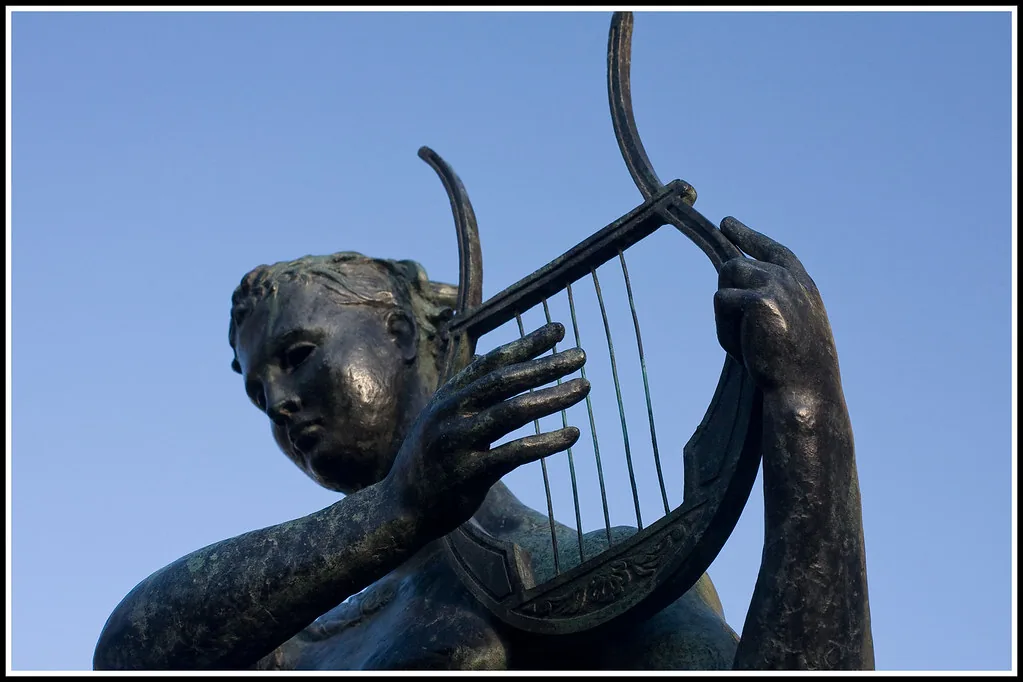
On a harp, the left hand works the bass notes while the right hand plays the treble. This fixed distribution allows orchestral precision.
The lyre offers more freedom. Both hands can alternate or synchronize, as on a guitar. This flexibility encourages improvisation.
A portable instrument
Held standing or sitting, the lyre is often played with an ivory plectrum. Its light weight allows broad movements, ideal for nomadic performances.
Unlike the harp, it does not allow notes to be changed during performance. This technical limitation influences its repertoire.
Between floor and orchestra
The harpist sits with the instrument leaning against the shoulder. This ergonomic position makes it possible to reach every string without fatigue.
Only small orchestral harps are sometimes carried in the arms. Their reduced size nevertheless preserves the distribution between left hand and right hand.
The lyre: a mythological and musical symbol
At the heart of Greek legends, one instrument embodies the fusion of art and divinity. Its name still resonates today as a cultural emblem.
The myth of Hermes and Apollo
According to tradition, Hermes fashioned the first lyre from a tortoise shell and cow gut. This myth tells how Apollo, charmed by its melody, exchanged it for a herd.
The tortoise symbolizes wisdom, while the strings represent creativity. This story illustrates the importance of this object in Orphic rites.
Traditional making and materials
Craftspeople used tanned hides for the resonating body. These natural materials guaranteed a warm, deep sonority.
In the last century, the Kerylos Museum reproduced Hellenistic models. Their modest length, no more than 50 cm, recalls their nomadic use.
The harp: from simplicity to mechanical complexity
The evolution of harps shows a remarkable technical journey. This instrument underwent radical transformations, moving from primitive models to sophisticated mechanisms.
The different types through history
The earliest Egyptian angular harps date from 3000 BC. Their basic triangular form contrasted with the curves of Gothic models from the Middle Ages.
Chromatic harps appeared in the 15th century. Their system of crossed strings made it possible to play every note without manual alterations.
| Type | Period | Feature |
|---|---|---|
| Angular harp | Antiquity | 15 strings max. |
| Gothic harp | Middle Ages | Slender curves |
| Chromatic harp | Renaissance | 34 crossed strings |
The addition of pedals, a revolution
In 1810, Sébastien Érard invented the double-action system. Its 7 pedals allow instant modulations, a true technical revolution.
"The fork mechanism makes it possible to raise each note by a semitone or a whole tone."
This innovation changed everything. Harpists could now play in every key without retuning. The weight, however, rose from 12 kg for Celtic harps to 40 kg for concert models.
Maintenance requires special expertise. A pedal harp has nearly 1,400 mechanical parts, which require precise adjustments.
Distinct uses and repertoires
Their musical uses reveal contrasting artistic worlds. Although they share common origins, these instruments developed unique social and cultural functions.
Companion of poets and banquets
In ancient Greece, this instrument accompanied Homeric hymns. Its range, limited to 1.5 octaves, was perfectly suited to poetic recitations.
Aristocratic symposia used it for drinking songs. Its educational role was central in paideia, the system that trained young Greeks in art and philosophy.
In classical and folk music
The harp conquered concert halls in the 19th century. Composers such as Debussy wrote pieces that showcased its extended range.
The Celtic repertoire, especially the works of O’Carolan, shows its popular roots. Today, electric versions are even incorporated into jazz.
| Aspect | Ancient lyre | Modern harp |
|---|---|---|
| Typical repertoire | Delphic paeans | Classical preludes |
| Context of use | Private banquets | Public concerts |
| Academic presence | 2% of conservatories | 90% of conservatories |
"The harp offers an unrivaled sound palette, while the lyre captivates through its acoustic intimacy."
These differences explain their current place in the world of music. One embodies tradition, while the other constantly explores new horizons.
Common confusions and clarifications
Certain misunderstandings persist between these ancestral instruments, despite their clearly defined characteristics. Visual similarities and sometimes interchangeable terms feed these mix-ups.
Lyre or zither: cousins that are often confused
The zither, with its 6 parallel strings made of metal, is clearly distinct from the lyre with gut strings. The word "kithara" in ancient Greek in fact designates a full-fledged musical instrument.
Unlike the plucked lyre, the zither is played by striking the strings. The Treasury of the Athenians at Delphi shows a true lyre, identifiable by its tuning pegs.
Orchestral harp and harp-lyre: close in appearance, but distinct
The term "harp-lyre" is confusing. In reality, it refers to small portable harps, with no connection to ancient lyres.
The major difference lies in their mechanics: modern harps use pedals, while lyres remain manual. A detail that changes everything in the relationship between strings and harmonies.
"The zither produces a characteristic metallic sound, absent from traditional lyres."
| Element | Lyre | Zither |
|---|---|---|
| Type of strings | Gut | Metal |
| Playing technique | Plucked | Struck |
| Etymological origin | Latin "lira" | Greek "kithara" |
Cultural influence and modern legacy
Timeless symbols, they continue to inspire artists and craftspeople today. Their name evokes both history and contemporary creation.
The lyre as an artistic emblem
In France, it has embodied poetry since the goguettes of the 19th century. Les Enfants de la Lyre made it an academic symbol.
Its heraldic use appears in coats of arms, emphasizing its educational role. Alongside the Irish Celtic harp, it represents a learned tradition.
The harp, between tradition and innovation
Modern MIDI harps now stand alongside classical models. Their electronic part allows unprecedented experimentation.
Today’s market reflects this duality: €5,000 for a concert harp, versus €800 for a handcrafted lyre. Musicians’ two hands explore these possibilities.
"The electric harp fuses heritage and technology, creating a new musical language."
| Aspect | Lyre | Harp |
|---|---|---|
| National symbolism | France (poetry) | Ireland (Celtic) |
| Recent innovations | Carbon fiber | MIDI/pedals |
| Average price | €800 | €5,000 |
Conclusion: two instruments, two worlds
These string instruments, although similar in appearance, belong to distinct musical worlds. Their history, construction, and use reflect unique artistic traditions.
To explore these differences further, visit places such as the Cité de la Musique. Workshops let visitors experience each musical art for themselves.
Over time, they have shaped the evolution of Western music. Using their exact names preserves their cultural identity.
Whether you are a music lover or simply curious, these jewels of heritage are worth discovering. Their technical and symbolic richness continues to inspire.