Medieval music is a fascinating field that takes us back to the origins and evolution of European music. When we talk about this historical period, it can be difficult to determine precisely when medieval music began. However, by studying the available sources and the main characteristics of the era, we can better understand the roots and development of these captivating sounds.
The Beginnings of Medieval Music
There is no exact date for the beginning of medieval music, because it was influenced by various earlier traditions and cultures. However, this period is generally considered to begin around the 9th century, when sacred and secular music developed in Western and Central Europe. It also corresponds to the emergence of musical notation and to the growing role of the Church in daily life.
The Influence of Ancient Music
The roots of medieval music go back to the influences of Antiquity, especially Greek and Roman music. The musical theories and modes of that era had a major impact on the later development of European music, particularly in Christian liturgy. The earliest Gregorian chants, dating from the 9th century, are closely linked to these ancient traditions.
Sacred Music and Christian Liturgy
One defining aspect of medieval music is its connection with religion. Sacred music, of which Gregorian chant is an emblematic example, was an integral part of the religious life of Christian communities. Compositions were intended to accompany liturgical ceremonies and to support the faithful in their spiritual practice.
Gregorian Chant
Gregorian chant is one of the earliest forms of medieval music to be documented in writing, thanks to the emergence of musical notation. It is a monodic style of singing, meaning that it consists of a single melodic line without instrumental accompaniment. Gregorian chant spread rapidly and became highly popular in Western Europe, particularly thanks to the support of Charlemagne and his successors.
Sacred Polyphony
From the 11th century onward, medieval music evolved toward more elaborate forms with the appearance of the first polyphonies. These compositions bring together several melodic lines layered over one another to create a harmonious effect. Sacred polyphonies, such as organum, helped enrich Christian liturgy and offered composers of the time new artistic possibilities.
Secular Music and the Troubadours
Alongside sacred music, medieval music was also marked by a rich repertoire of secular music. Songs of love, war, and everyday life lay at the heart of this tradition, carried especially by troubadours and trouvères. They were poet-musicians who traveled through courts and towns to present their works.
The Troubadour Repertoire
Troubadours developed a lyrical and expressive style that left its mark on the history of European music. Their compositions addressed varied themes, such as courtly love, chivalry, and social satire. Famous troubadours include William IX, Duke of Aquitaine, as well as Bernart de Ventadorn and Beatritz de Dia.
The Influence of Other Cultures
Medieval secular music was also influenced by cultural exchanges with other regions of the world. For example, Eastern and Arab music had a notable impact on the evolution of instruments and composition techniques in Western Europe. Likewise, folk songs and country dances bear witness to the richness and diversity of local musical traditions.
The Instruments of Medieval Music
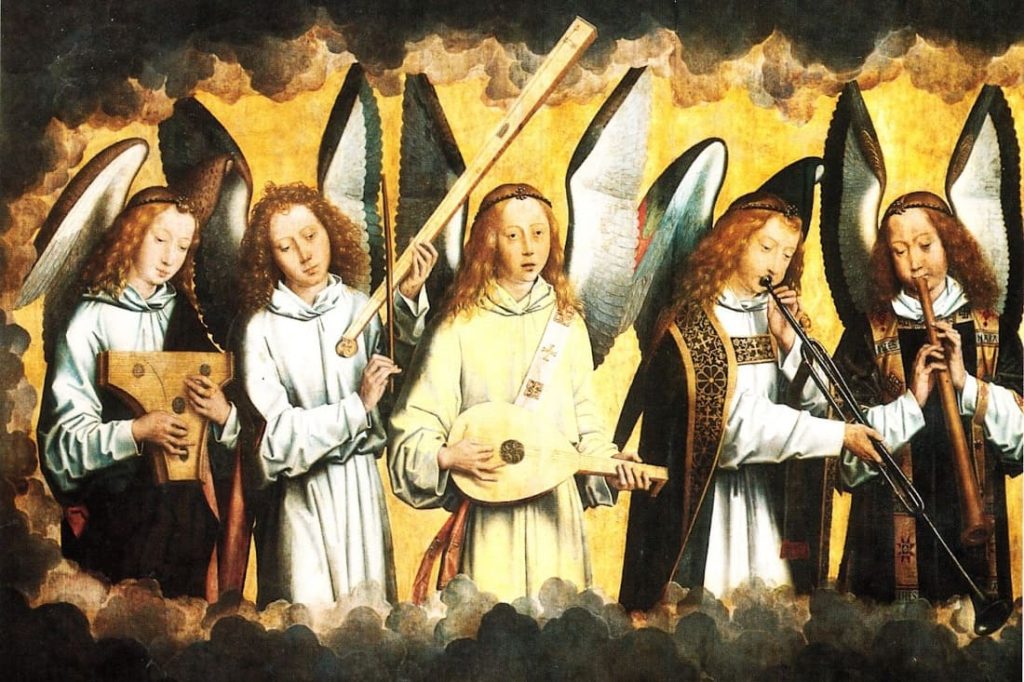
The medieval period was characterized by a wide variety of instruments that accompanied songs and instrumental compositions. Among the most common instruments were:
- The vielle: a bowed string instrument, an ancestor of the violin
- The lute: a plucked string instrument, similar to the modern guitar
- The recorder: a wooden wind instrument, used especially in chamber music ensembles
- The bagpipe: a wind instrument with a double reed, very popular in medieval folk music
- Percussion: tambourines, cymbals, bells, and other rhythmic objects used to accompany melodies and dances
Medieval music therefore offers a rich and diverse panorama of European musical traditions. From its beginnings, influenced by Antiquity, to its height with sacred and secular polyphony, it helps us better understand the evolution of music over the centuries.
Expand your knowledge of medieval music by discovering the complete repertoires of this style in our other article.