In this article, we will explore the fascinating world of medieval music, focusing on its origins, the major figures who contributed to its development, and the influences that shaped this unique musical period.
The Rise of Liturgical Chant
In the early Middle Ages, music was used mainly in a religious context. The most widespread genre was liturgical chant, which consisted of monophonic melodies accompanied by sacred or secular words. Among the most famous liturgical chants is Gregorian chant, which takes its name from Pope Gregory I (540-604).
Gregory I and Gregorian Chant
Although Gregory I is often credited with inventing Gregorian chant, it is unlikely that he composed these musical pieces himself. In reality, Gregorian chant is a body of melodies inherited from Jewish tradition and early Christian music, gathered and codified under the authority of Gregory I. However, there is no doubt that this pope played a major role in spreading and promoting this musical style, especially through his work to unify and standardize the Church’s liturgical practices.
The Development of Musical Notation
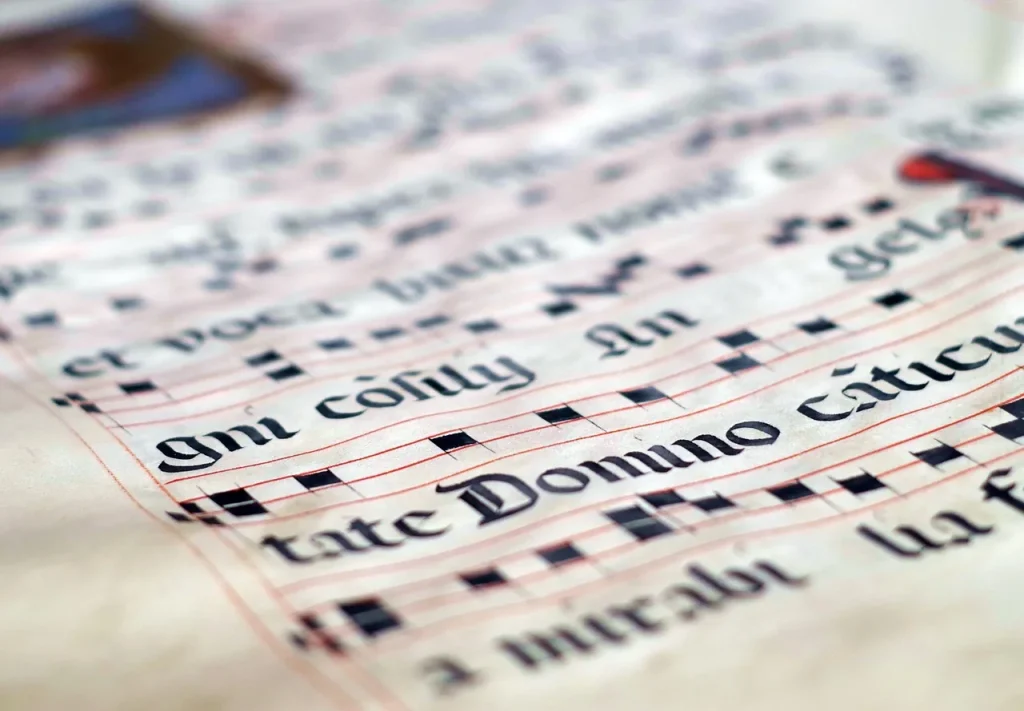
For much of the Middle Ages, music was transmitted mainly by oral tradition. However, from the ninth century onward, the first forms of written musical notation began to appear. The neumes, ancestors of modern notes, were used to represent pitch and duration in liturgical chants. The use of neumes greatly eased the circulation of musical works and made it possible to preserve them through the centuries.
The Innovations of Ademar de Chabannes and Guido d’Arezzo
Two medieval figures played a key role in the evolution of musical notation: Ademar de Chabannes (989-1034) and Guido d’Arezzo (991-1050). Ademar was the first to use neumes with lines, allowing melodies to be read with greater precision. Guido d’Arezzo, meanwhile, is regarded as the inventor of the modern staff, as well as the solmization system, the ancestor of solfege.
The Emergence of Polyphony
During the eleventh century, medieval music underwent a major revolution: the introduction of polyphony. Unlike monody, in which a single melody is sung or played, polyphony involves the layering of several distinct voices or melodic lines. This innovation greatly enriched musical language and opened the way to new forms of artistic expression.
The Notre-Dame and Saint-Martial Schools
Polyphony developed mainly in monasteries and cathedrals, where monks and canons were both performers and composers of these works in several parts. Two schools stand out for their influence and innovations: the Notre-Dame school (in Paris) and the Saint-Martial school (in Limoges). The masters of these schools, such as Leonin, Perotin, and Adam of Saint-Victor, revolutionized medieval music by developing techniques for combining and organizing different voices.
- The Notre-Dame school (1160-1250) is especially known for its “organa,” polyphonic pieces based on a pre-existing Gregorian chant. Leonin and Perotin, the two leading representatives of this school, developed methods for synchronizing rhythms and harmonizing melodies, thereby creating a coherent and complex structure.
- The Saint-Martial school (1100-1200), for its part, specialized in creating sequences, poetic and musical compositions that combine verses and refrains. Adam of Saint-Victor is one of the most emblematic figures of this school, having composed many sequences that celebrate the Christian faith and the beauty of divine creation.
Troubadours and Trouveres: The Flowering of Secular Music
Alongside sacred music, the Middle Ages also saw the development of a secular musical art, carried mainly by the troubadours (in southern France) and the trouveres (in the north). These itinerant poets and musicians often came from the nobility and sang of courtly love, feats of war, and the joys and sorrows of everyday life. The works of the troubadours and trouveres tell us about the musical tastes and social concerns of the period, while also showing a real concern for beauty and a high level of artistic ambition.
William IX of Aquitaine and Richard the Lionheart
Among the most famous troubadours and trouveres are William IX of Aquitaine (1071-1127), regarded as the first great troubadour, and Richard the Lionheart (1157-1199), king of England and a talented composer. Their songs were accompanied by instruments such as the lute, vielle, or flute, and reflected a constant search for refinement and emotion.
In Summary
From Gregory I to Richard the Lionheart, through Guido d’Arezzo and Leonin, the history of medieval music is marked by exceptional figures who knew how to innovate and push back the artistic limits of their time. Their contributions, whether in liturgical chants or secular songs, shaped a unique and priceless musical heritage.
Want to return to the roots of medieval music? Discover when this style was invented to learn more about the Middle Ages.