The enchanting melodies of this instrument have captivated listeners for centuries. Two major families stand out: angular models and arched models, each with its own rich history.
The types vary in their mechanism, materials and repertoire. For example, modern concert versions have up to 47 strings, offering an extended sound palette.
An Irish proverb also recalls its noble status: “Music softens hearts”. This guide will help you choose according to your practice and your budget.
1. Construction and mechanism: pedals vs. levers
The choice between two distinct mechanisms directly shapes the musical experience. One relies on complex pedals, the other on manual levers. This technical difference influences playing style and the learning curve.
The classical harp and its pedal system
Classical models use seven pedals, operated with the feet. Three on the left and four on the right, they alter the notes of the scale across all octaves at the same time. Precise adjustment allows quick accidentals without touching the strings.
The Celtic harp and its manual levers
Here, each string has an upper lever. The musician must anticipate key changes by manually adjusting the levers. This simplified mechanism explains why 75% of schools recommend this version for beginners.
Impact on playability and learning
Mastering pedal harps takes about two years, compared with six months for levers. One teacher confirms:
“Levers develop active listening for modulations.”
The strings follow a universal color code: red for C, black or blue for F. This makes visual orientation easier, especially during the first exercises.
2. Materials and tone: gut, nylon or metal?
The quality of the strings determines the richness of the sound produced. Depending on their composition, they offer unique tones suited to different musical styles.
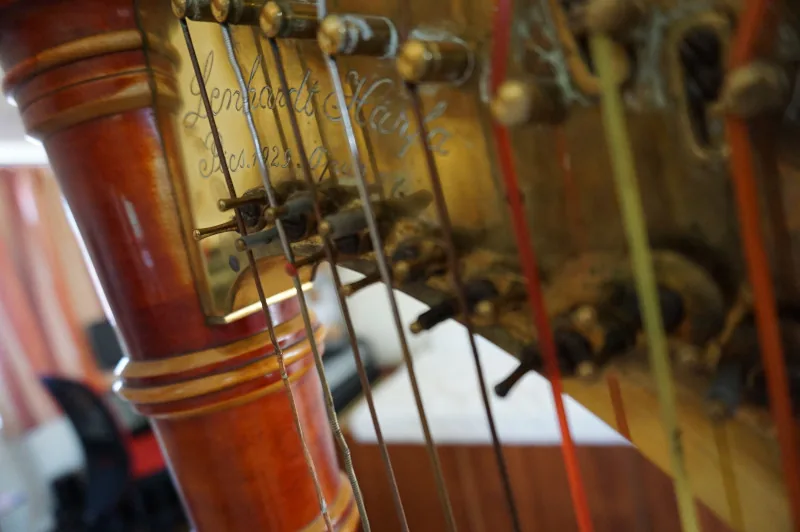
Gut strings and their acoustic response
Made from natural gut, these strings produce a warm, deep sound. Ideal for concertos, they do, however, require careful maintenance.
Salvi data show a breakage rate 15% higher than with synthetic strings. Humidity also affects their stability, with detuning that can reach 3%.
Synthetic strings (nylon/Silkgut) for the Celtic harp
Nylon and Silkgut® offer an excellent alternative. Resistant and stable, they are perfectly suited to touring and regular practice.
The patented Silkgut® Copper technology allows a smooth transition between metallic low notes and nylon midrange strings. Monthly cleaning is enough to preserve their sound quality.
Metal strings for the low notes
The last two octaves often use steel or copper strings. These materials bring power and sustain to the bass register.
Salvi’s innovation incorporates copper powder for even deeper sounds. It is perfect for studio recordings, as with the Una Deluxe harp.
| String type | Advantages | Drawbacks |
|---|---|---|
| Gut | Warm sound, rich in overtones | Fragility, weekly maintenance |
| Nylon/Silkgut | Resistance, humidity stability | Less organic sound |
| Metal | Power, extended sustain | Additional weight |
One professional advises:
“Choose gut for concertos, nylon for touring.”
Historically, harp strings were made of metal. Today, materials vary according to acoustic and practical needs.
3. Size, weight and accessibility
Ergonomics and budget are two major criteria when choosing an instrument. Differences in size and weight directly affect practicality, especially for travelling musicians or beginners.
Dimensions compared: portability and footprint
The Salvi range offers models suited to every need. The Juno (25 strings) weighs only 4.2 kg, compared with 17 kg for the Titan (38 strings).
Extendable feet adjust the height from 110 cm to 170 cm. A reinforced cover provides 40% extra protection when travelling.
Price and target audience
Prices range from €1,800 for an entry-level model to €45,000 for a professional model. Rent-to-own is one solution for testing before investing.
“The Juno has followed my child from age 6 through to the conservatory.”
Models suited to children and adults
For children, the ideal height is between the wrist and the shoulder when seated. Lightweight models such as the Juno are perfect for learning.
Adults will often prefer sturdier versions, such as the Titan, for a richer sound. music conservatories often recommend this transition.
| Model | Weight | Price |
|---|---|---|
| Juno (25 strings) | 4.2 kg | €1,800 |
| Titan (38 strings) | 17 kg | €45,000 |
A travel pack includes a backpack-style cover, an electronic tuner and a folding seat. It is ideal for musicians on the move.
4. Musical repertoire: which should you choose for your needs?
The choice of instrument also depends on the styles you want to play. Each repertoire has its own technical and sonic requirements.

Classical music and orchestra: the domain of the pedal harp
Major symphonic works require fast, precise accidentals. For this reason, 98% of professional orchestras use pedal models.
Pieces such as Debussy’s “Danse sacrée” become impossible to perform without this system. The complex glissandi of the modern jazz repertoire also demand this flexibility.
Celtic folklore and traditional repertoire
For Breton or Irish melodies, lightweight models dominate. 85% of Celtic circles favor Salvi Hermes harps for their warm sound and portability.
One musician confirms:
“My tours fit into a van thanks to the Una Deluxe.”
Limitations of accidentals with the Celtic harp
These instruments allow a maximum of 2 simultaneous accidentals. Composers work around this limit by transposing to C or G major.
Even so, their popularity has jumped by 300% since the folk revival of the 2000s. They are perfect for beginners or travelling musicians.
5. Conclusion: how should you make your choice?
Choosing between these two instruments depends on your musical goals and your budget. For a varied repertoire or orchestral practice, pedal models are the natural choice. Beginners will often prefer lighter, more accessible versions.
72% of professionals own both types to cover every need. Salvi’s warranty, up to 10 years on the mechanism, provides additional security.
A comparison guide can help you. If your budget is limited, choose compact models. For enthusiasts, the 38-string Titan remains an excellent compromise.
The essential advice? Try before you buy. Feel matters more than price. Some shops even offer introductory workshops with a purchase.