For centuries, the harp has fascinated people with its evocative power. Far more than a simple instrument, it embodies a bridge between the earthly and the celestial. Its rich symbolism crosses cultures, from Celtic traditions to biblical stories.
Associated with water and nature, it evokes enchanting landscapes. The vibrations of its strings inspire peace and harmony. Today, it even finds a place in modern therapeutic approaches.
Discover how this mythical object has shaped history. Explore its origins, its many facets, and its present-day legacy. To go further, consult this forum dedicated to harp symbolism.
Introduction to the Harp as a Sacred Instrument
The earliest traces of the harp date back more than 5,000 years, revealing its role far beyond music. This mythical object served as a bridge between human beings and the divine, carrying legends and power.
The Ancient Origins of the Harp
Discovered in Mesopotamia around 3000 BCE, the Sumerian harp is the known ancestor. In Egypt, it accompanied funerary rites as a symbol of spiritual elevation.
The medieval Celtic harp, with its 32 to 38 strings, was carved from alder. Its proportions followed Pythagorean rules, linking harmony and the cosmos.
Its Role in Early Civilizations
Among the Celts, it was the instrument of the bards, guardians of oral history. Kings used it to assert their authority, as shown by the harp of Guilhem VIII (1192).
| Civilization | Type of harp | Main use |
|---|---|---|
| Sumerian | Angular | Religious ceremonies |
| Egyptian | Arched | Funerary rites |
| Celtic | Monoxylous | Oral transmission |
In Ethiopia, the beganna, an angular harp, was used in liturgies. Every culture left its mark on it, but all celebrated its bond with the sacred.
The Harp in Celtic Tradition: A Bridge Between Worlds
In Ireland, the Irish harp transcends its musical role. It embodies the soul of a nation, weaving links between the visible and the invisible. Its vibrations have resonated for centuries, carrying messages of culture and resistance.
A National Emblem Rich in History
The Irish harp has appeared on coins since 1536. A symbol of identity, it was used during the 1798 rebellion to transmit secret codes. Edward Bunting preserved 300 traditional melodies in 1792, safeguarding this unique heritage.
The famous Brian Boru harp, dating from the 14th century, is kept at Trinity College Dublin. Its elegant design and metal strings produce a crystalline sound, characteristic of the traditional playing technique.
Druids and Bards, Guardians of Tradition
Druids used this instrument during lunar festivals. They believed in its power to communicate with the Otherworld. Bards, for their part, played it to tell stories and honor kings.
- Unique technique: fingernails against metal strings
- Rituals linked to the cycles of the moon
- Oral transmission of legends and genealogies
The Legend of Dagda and His Magic Harp
One mythical tale tells how Dagda’s harp miraculously returned during the battle of Mag Tuired. Its melodies could lull warriors to sleep or galvanize them, revealing its transcendent power.
| Element | Symbolic role | Cultural impact |
|---|---|---|
| Metal strings | Link between earth and sky | Recognizable distinctive sound |
| Curved shape | Representation of the rainbow | Artistic inspiration |
| Ritual use | Spiritual communication | Preservation of traditions |
Even today, the harp remains a powerful symbol. It unites past and present while continuing to inspire through its spellbinding vibrations. Its legacy endures, bearing witness to a time when music and spirituality were one.
The Biblical Harp: Instrument of Angels and King David
The Bible gives the harp a sacred role far beyond simple melody. Mentioned 150 times under the names nevel and kinnor, it embodies the connection between the human and the divine.
David the Harpist Before Saul
King David soothed Saul’s torments with his melodies. Psalm 33 evokes a 10-string harp, a number symbolizing the Commandments. Carolingian psalters from the 9th century illustrate this scene with a refined artistic form.
The Harp as a Symbol of Divine Praise
In Benedictine monasteries, harps accompanied processions. Each note was considered a prayer. Guilhem VIII of Montpellier drew inspiration from David for his seal, marking his spiritual authority.
- The 10 strings: a link with Mosaic law.
- Liturgical use: harmony between earth and sky.
- Influence on medieval art.
Medieval Representations of the Celestial Harp
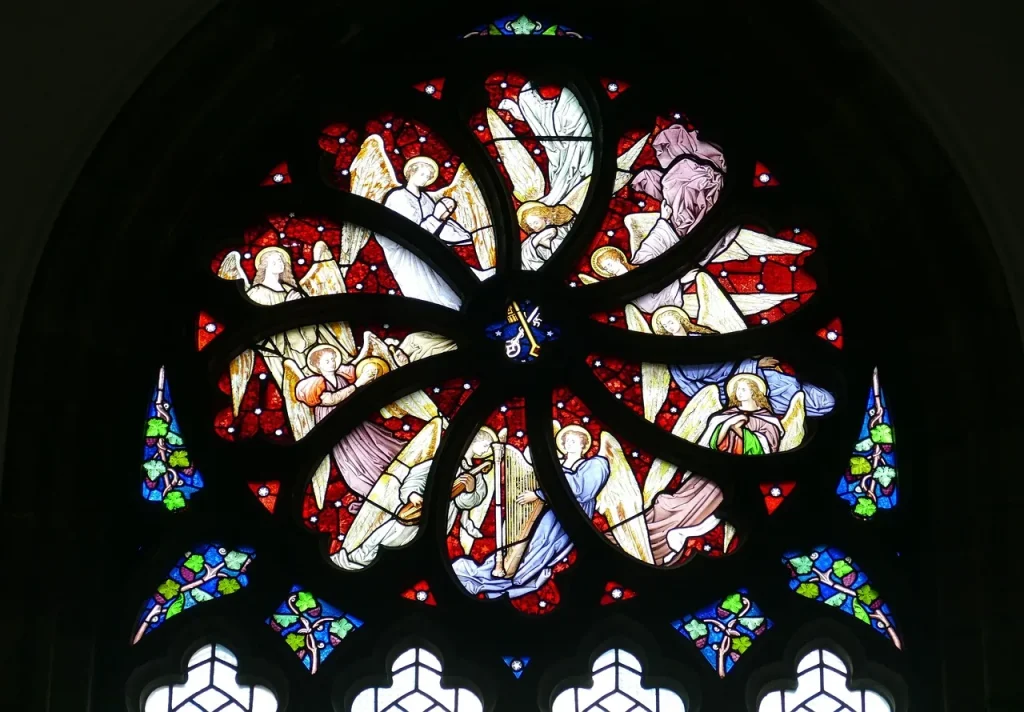
The fresco at Saint-Savin-sur-Gartempe (12th century) shows harp-playing angels surrounding Christ. These works reinforce the symbolism of music as the language of the heavens.
“The harp is the voice of angels, carrying prayers toward the stars.”
This sacred legacy endures, blending history, faith, and art in a universal hymn.
Universal Symbolism of the Harp
Across the ages, the harp has shaped the collective imagination through its profound symbolism. Its strings and structure evoke concepts far beyond music, touching on cosmic balance and the expression of the soul.
Spiritual Ascent Through Vertical Strings
The vertical strings represent the connection between earth and sky. In many traditions, their number corresponds to the chakras or the planets. For example, 7 strings symbolize the 7 celestial bodies visible to the naked eye.
Cosmic Harmony and Pythagorean Proportions
The harp of Guilhem VIII was built according to a 2:3 ratio, the perfect fifth. These Pythagorean proportions reflect universal order. Kepler drew inspiration from them for his theory of the harmony of the spheres, linking music with the movement of the planets.
The Vibration of the Strings as the Sound of the Soul
Each vibration of the strings creates a unique resonance. Pythagoras discovered musical intervals by observing hammers in a forge. Today, harp modes (Dorian, Phrygian) are used to induce meditative states.
- Sympathetic resonance: described by Al-Farabi as a dialogue between strings.
- String tension: a metaphor for energetic balance.
- Musical modes: each scale influences the state of consciousness differently.
These principles show how the harp transcends its role as an instrument to become a language of the soul and the cosmos.
The Harp in Therapy and Meditation
Today, the harp has found a new calling in the therapeutic field. Its soothing sounds and particular vibrations make it a valuable tool for physical and mental well-being.
The Vibrational Effects on Consciousness
The HeartMath Institute has shown that the harp’s low frequencies can induce heart coherence. These vibrations act directly on the nervous system, encouraging an expanded state of consciousness.
Joachim Delahaut developed the technique of “floating harmonics.” This approach uses natural resonances to balance the body’s subtle energies.
Use in Energy Care
At St. Luke’s Hospital in the United States, a specific protocol helps manage post-operative pain. Sound therapies reduce painkiller use by up to 40%.
The HarpeHope® program shows promising results in pediatric oncology. As reported in this study, children exposed to the harp fall back asleep more quickly.
Guided Meditations With the Sound of the Harp
Tuning to 432 Hz creates a particular synergy with Tibetan bowls. Together, they produce sounds that make it easier to enter deep meditation.
At the Fez Festival of Sacred Music, workshops explore this age-old practice. Participants report transformative experiences.
“The harp does not heal only the body; it harmonizes the soul with the rhythms of the universe.”
| Approach | Application | Benefits |
|---|---|---|
| Floating harmonics | Energetic rebalancing | Stress reduction |
| Hospital protocol | Pain management | Reduced medication use |
| Sound meditation | Personal development | Mental clarity |
These innovative methods show how the harp continues to evolve. From sacred instrument, it becomes a bridge toward modern healing.
The Harp in Art and Spiritual Iconography
Medieval art often represented the harp as a sacred symbol. This instrument appears in varied works, from royal seals to religious frescoes. Its iconography reveals a deep spiritual dimension.
Medieval Representations Such as That of Guilhem VIII
The seal of Guilhem VIII, analyzed by the CNRS, shows a 24-string harp. Carved from alder wood, its resonating box follows sacred proportions. This detail confirms its political and spiritual role.
Medieval monoxylous harps were carved directly from trunks. Compared with maple, alder offered better resonance. This carving technique testifies to exceptional craftsmanship.
The Harp in Christian Sacred Art
In Romanesque churches, 23% of ecclesiastical coats of arms include a harp. The fresco in the Palatine Chapel (1132) shows an angelic concert. The instruments have a delta shape, a symbol of the Trinity.
The Rabula Manuscript (586) reveals Byzantine influence. The harp-psaltery accompanies the psalms there. Its vertical strings evoke ascent toward the divine.
Symbolism of Harp-Playing Angels
Before the 15th century, 87% of angels were represented with a harp. These figures adorn stained-glass windows and illuminations. Their instrument symbolizes celestial music.
“Harp-playing angels sing the harmony of the spheres, where every note is a prayer.”
The restoration of Marie Antoinette’s harp revealed lapis-blue pigments. This color, associated with the sky, strengthens the link between the instrument and the sacred.
| Work | Period | Symbolic detail |
|---|---|---|
| Seal of Guilhem VIII | 12th century | 24 strings for the 24 elders of the Apocalypse |
| Palatine fresco | 1132 | Trinitarian delta shape |
| Rabula Manuscript | 586 | 10-string psaltery (Commandments) |
These artistic representations show how the harp has crossed the centuries. From royal instrument, it becomes a messenger of the divine in medieval art.
Conclusion: The Harp, Eternal Symbol of Spiritual Harmony
From ancient history to modern practices, the harp retains its unique power. It connects eras and cultures through its universal symbolism. Its role evolves, but its essence remains.
Artists and scientists are rediscovering its potential today. Contemporary installations explore its vibrations. Neuroscience research confirms its benefits for the brain.
This instrument transcends borders. The “Harp of Nations” project bears witness to this, uniting traditions through music. Each string seems to carry a message of unity.
The spiritual harmony it embodies remains timeless. To feel it, listen to its melodies or try playing it. Its silent language speaks directly to the soul.